MOTS-c and getting older: what the age-related work actually found
MOTS-c levels fall with age, and in old mice restoring them improved physical capacity. The aging angle is the most human-relevant part of the MOTS-c story, and also the part most often oversold.
28 September 2026 · 2 min read
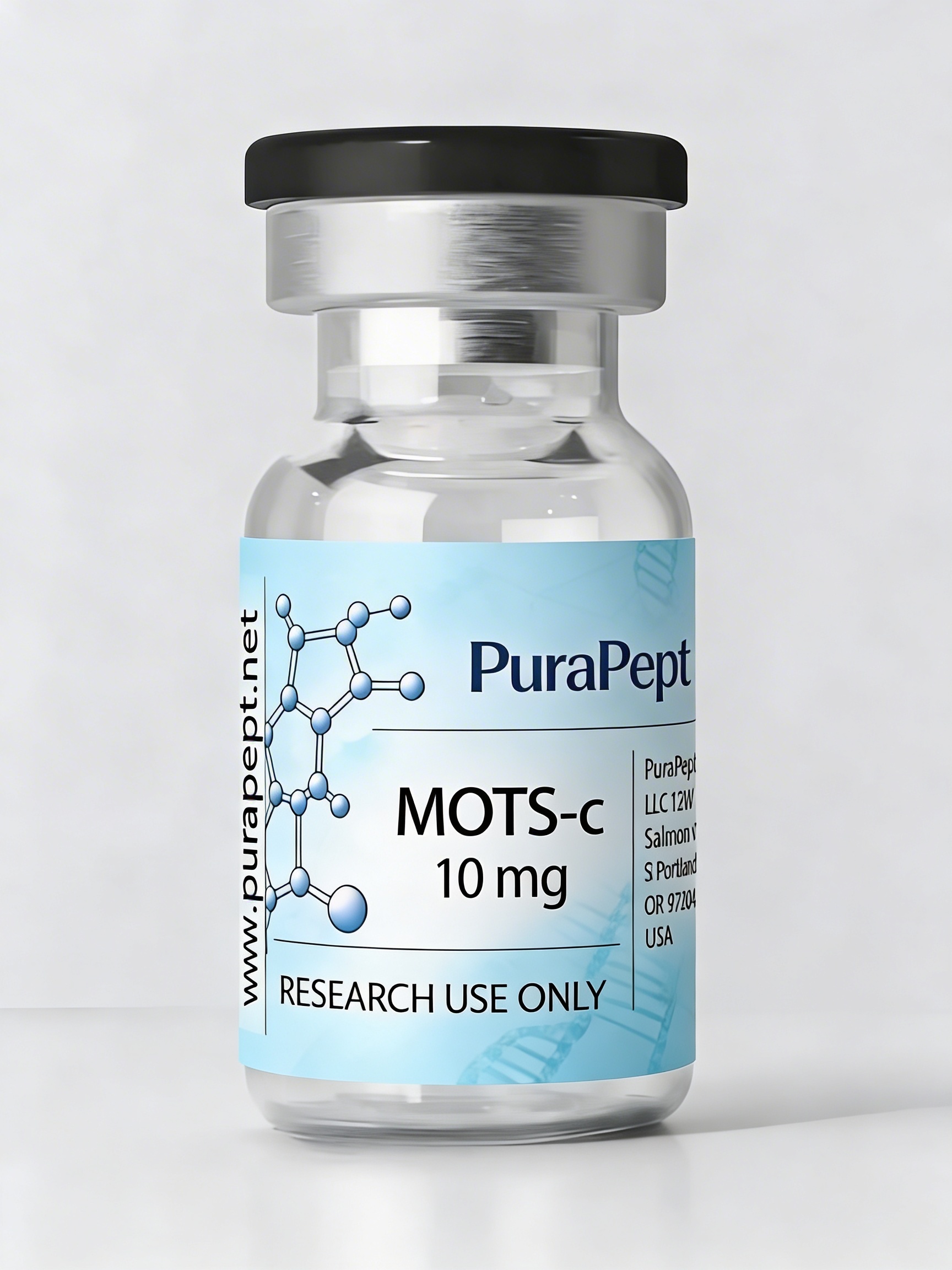 MOT-c 10 mg
There is a standard arc to aging biology: something declines with age, restoring it in an old animal helps, headlines follow, and the human evidence quietly stays at zero. MOTS-c is currently midway through that arc, and it deserves a careful read precisely because the animal work is better than average.
The starting point: a peptide from inside the mitochondria
MOTS-c is 16 amino acids long and encoded in mitochondrial DNA, inside the 12S rRNA gene. Lee’s 2015 Cell Metabolism paper showed it signals through AMPK, the cell’s energy sensor, and reported that treated mice resisted both age-related and diet-induced insulin resistance plus diet-induced obesity. That paper founded the field. Everything since is commentary on it.
The aging paper
Reynolds and colleagues, in Nature Communications in 2021, tied three observations together. First, circulating MOTS-c declines with age, in rodents and in people. Second, it rises with exercise, which earned it the “exercise-induced” label. Third, giving it to aged mice improved measures of physical capacity and muscle homeostasis. Old animals moved better and held muscle better than untreated old animals.
That third finding is the one that travels. It should travel with its companions: the subjects were mice, the aging was murine aging, and “improved physical capacity” in a mouse is a long corridor away from grip strength or walking speed in a person.
Why this angle is worth separating from the metabolic one
Most MOTS-c coverage treats it as a metabolic compound with an aging footnote. Flip that and the picture sharpens. The metabolic results answer a mechanism question: does this peptide engage energy homeostasis. The aging results answer a relevance question: does the thing it engages matter when the organism is old. Declining endogenous levels plus functional improvement on restoration is the classic signature of something worth investigating, not the signature of something proven.
Human data so far are measurements, not interventions: MOTS-c levels across ages and metabolic states, plus genetic association work on mitochondrial variants. Nobody has run a randomised trial of administered MOTS-c in people. No human effect size exists. No human safety profile exists.
What the data do not show
A way to slow aging, an exercise replacement, or a basis for personal experimentation. The honest inventory is short: a real mitochondrial peptide, a solid mechanism, mouse physiology that responds, and human data limited to observation. Anyone quoting the mouse capacity numbers as though they describe people is skipping the only step that counts.
For researchers, the usual preparation note: MOTS-c here is a single-compound vial. Blends containing it cannot attribute an effect to it. If the question is what MOTS-c does, the preparation under test should contain MOTS-c and nothing else.
Research use only. This page describes published animal and observational literature. It is not medical advice, not longevity advice, and not a suggestion for human use. Nothing we supply is for human or veterinary use.
References.
- Lee C, et al. The mitochondrial-derived peptide MOTS-c promotes metabolic homeostasis and reduces obesity and insulin resistance. Cell Metab 2015. PubMed record (PMID 25738459).
- Reynolds JC, et al. MOTS-c is an exercise-induced mitochondrial-encoded regulator of age-dependent physical decline and muscle homeostasis. Nat Commun 2021. PubMed record (PMID 33473109).