Tesamorelin: the one GHRH analog with phase 3 data, in one population
Two phase 3 trials, 806 patients, one consistent finding: daily tesamorelin trimmed visceral fat in HIV patients on antiretroviral therapy while leaving subcutaneous fat alone. The indication never widened beyond that population, and the fat came back when the drug stopped.
29 September 2026 · 2 min read
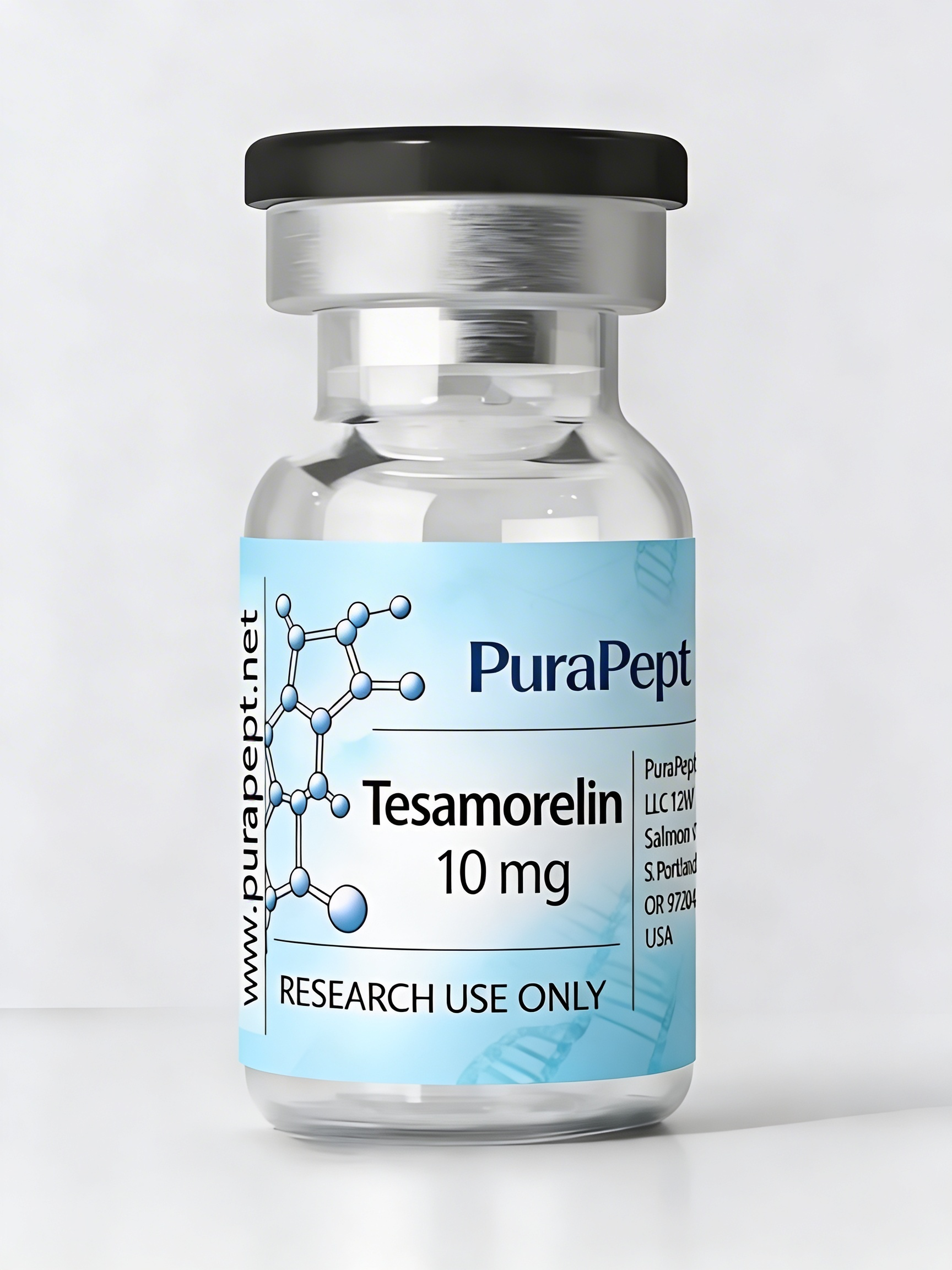 Tesamorelin 10 mg
Most peptides in this catalogue have no human efficacy data at all. Tesamorelin is the exception that clarifies the rule: it has two phase 3 trials behind it, a marketing approval in front of it, and an indication that never escaped the exact population studied. Tesamorelin 10 mg is that compound, and the papers deserve a straight reading.
The problem it was built for
Antiretroviral therapy keeps HIV patients alive and redistributes their fat. Visceral adipose tissue accumulates while limbs stay lean, which reads on a scan as a deep-belly burden with metabolic company. Tesamorelin is a GHRH(1-44) analog, the full-length signalling sequence. In the trials, patients received a daily 2 mg subcutaneous injection. The hypothesis was selectivity: grow the GH pulse enough to mobilise visceral stores without touching the subcutaneous layer patients could not afford to lose.
The single trial first
Falutz ran 404 patients, randomised two-to-one against placebo for six months, then re-randomised the drug arm to continue or switch to placebo for another six. Visceral fat fell 10.9 percent, about 21 square centimetres, against 0.6 percent on placebo. Trunk fat, waist circumference and the waist-to-hip ratio all moved the right way while limb and abdominal subcutaneous fat did not change. IGF-I rose, glucose measures did not, and patients reported less distress about their belly appearance. The extension delivered the detail that matters most: twelve-month continuers held roughly an 18 percent reduction, and patients switched to placebo lost the gains fast.
The pooled confirmation
The second paper combined two such trials, 806 patients in total, 543 on drug and 263 on placebo, and the picture held. Visceral fat down 24 square centimetres against a 2-centimetre rise on placebo, a treatment effect of minus 15.4 percent. Triglycerides fell with an effect near 12 percent, the cholesterol ratio improved, body-image scores moved again, and glucose stayed unmoved at 26 and 52 weeks. The drug was, in the authors’ words, generally well tolerated.
That is a genuine phase 3 record: randomised, blinded, CT-measured, replicated across two studies.
Why the indication stayed put
The compound reached the US market in 2010 as Egrifta, approved for HIV-associated lipodystrophy. Same population as the trials. Nobody extended it to general weight management, because the trials never studied general weight management. A drug that trims visceral fat in antiretroviral-treated patients, preserves their subcutaneous fat, and reverses on discontinuation is a precise instrument, not a broad one. Papers that cite these numbers for any other purpose are borrowing authority the data never granted.
What the data do not show
A weight-loss drug, a longevity intervention, or a result that transfers to people without HIV on antiretroviral therapy. The honest inventory fits in one line: daily GHRH-analog treatment, selective visceral reduction near 15 to 18 percent, maintained only while treatment continues, glucose-neutral inside these trials. The rest is other research that has not been run.
Research use only. This page summarises published randomised trials for research reference. It is not medical advice and not a suggestion for human use. Nothing we supply is for human or veterinary use.
References.
- Falutz J, et al. Effects of tesamorelin, a growth hormone-releasing factor, in HIV-infected patients with abdominal fat accumulation: a randomized placebo-controlled trial with a safety extension. J Acquir Immune Defic Syndr 2010. PubMed record (PMID 20101189).
- Falutz J, et al. Effects of tesamorelin (TH9507), a growth hormone-releasing factor analog, in HIV-infected patients with excess abdominal fat: a pooled analysis of two multicenter, double-blind placebo-controlled phase 3 trials with safety extension data. J Clin Endocrinol Metab 2010. PubMed record (PMID 20554713).
- DailyMed: Egrifta (tesamorelin) current US labelling (approval record for HIV-associated lipodystrophy)