ACE-031: what the human myostatin trial measured
The class has one human myostatin-inhibition trial in Duchenne muscular dystrophy. It was stopped after the second dose regimen because of epistaxis and telangiectasias, and every efficacy result in it was a non-significant trend.
11 October 2026 · 4 min read
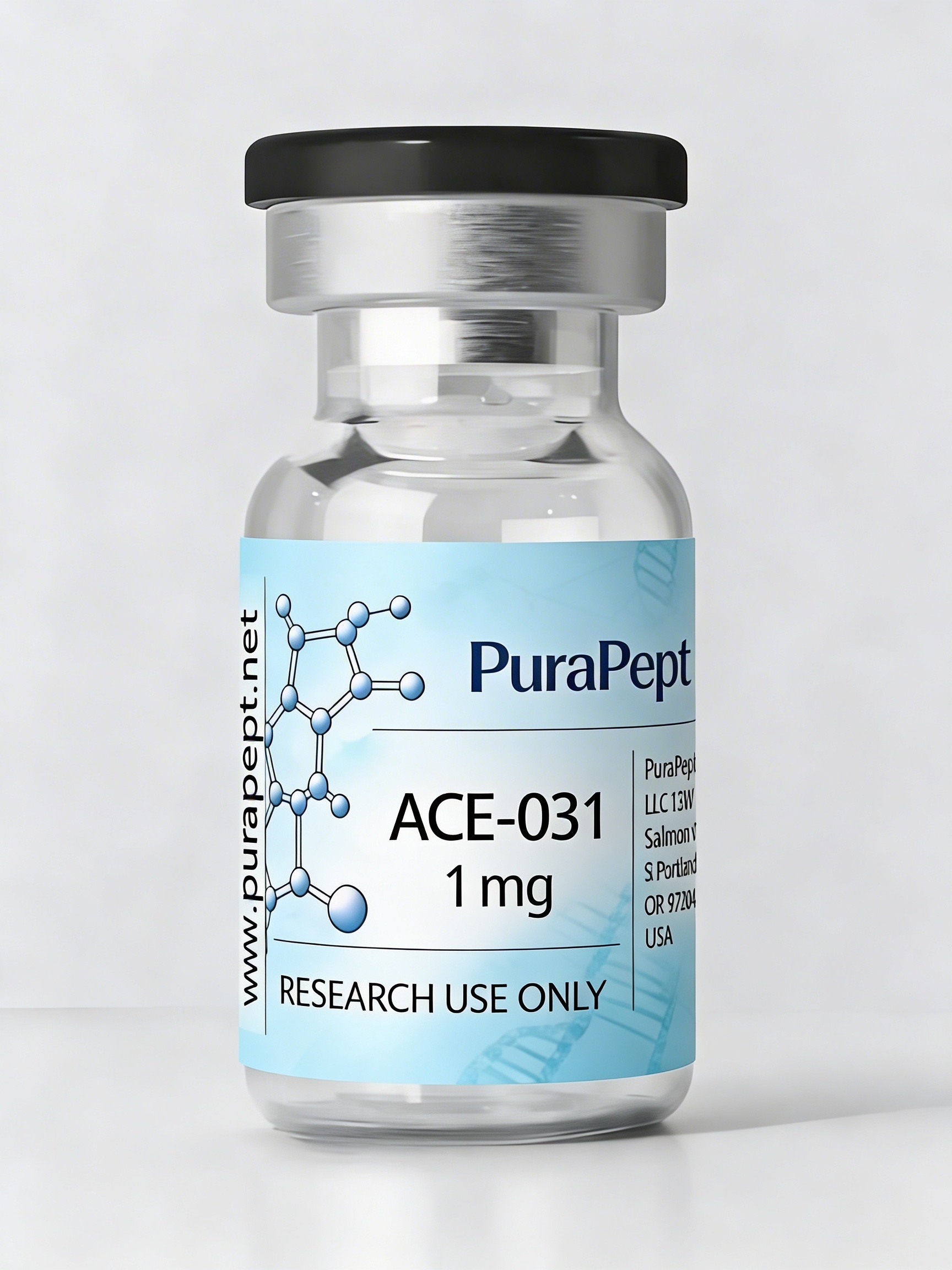 ACE-031 1 mg
Myostatin is a brake. It is an endogenous negative regulator of muscle growth, and the idea that has run a long way through this field is that you can release the brake. The biology is not in doubt. What is in doubt, after thirty years, is what releasing it does to a person — and the one human trial of the class that reported its own results reported them as trends and stopped early for a reason that had nothing to do with muscle.
The one human trial
The paper is from 2017, in Muscle Nerve, and it is the centre of this page. ACE-031 was given subcutaneously every two to four weeks to ambulatory boys with Duchenne muscular dystrophy, in a randomised, double-blind, placebo-controlled, ascending-dose design. The primary objective was safety. The secondary objectives were pharmacokinetics and pharmacodynamics.
The safety result is the one that ended it. There were no serious or severe adverse events, but the study was stopped after the second dosing regimen because of epistaxis and telangiectasias — nosebleeds and dilated surface vessels — which the authors treated as a potential safety signal rather than a nuisance. Their conclusion is careful and worth quoting in spirit: non-muscle-related adverse events contributed to the decision to discontinue the study.
Every efficacy number in the trial is a trend. The 6-minute walk test held its distance on ACE-031 where it declined on placebo. Lean body mass and bone mineral density trended up, fat mass trended down. None of it reached statistical significance. That is the entire clinical efficacy dataset for the compound: a stopped trial, a small number of children, and directions rather than results.
What the mechanism actually predicts
The rationale for the class was never weak. Myostatin signals through activin type II receptors, and those receptors sit on a node that several ligands use, which is why blocking them does more than block myostatin.
The clearest demonstration is a 2014 paper in Molecular and Cellular Biology on a human anti-ActRII antibody, bimagrumab. It raises muscle mass in mice dramatically — the authors describe the effect as going beyond what a myostatin inhibitor alone achieved — and it protects muscle from glucocorticoid-induced atrophy, including the loss of tetanic force. The knock-on detail is that the pathway is not only a brake on size. It is also connected to bone, and that is where the mouse data stops being simple.
A 2013 paper in Experimental Gerontology tested a myostatin propeptide-Fc in 24-month-old mice, weekly, for a season. Muscle responded: tibialis anterior mass up 7%, muscle fibre diameter up 16% in the extensor digitorum longus and 6% in the soleus. Bone did not: femoral bone volume, ultimate force, stiffness and toughness were all statistically indistinguishable from vehicle, and there was no measurable change in bone formation or resorption. Pharmacological inhibition in an aged animal, the authors conclude, hits skeletal muscle harder than it hits bone — which is not the same as the developmental picture from knock-out mice.
The human observation that keeps the hypothesis alive is a person, not a trial. A 2005 review in Current Opinion in Rheumatology notes that loss of myostatin results in muscle hypertrophy in a human subject. One case, and it is the right case, because a genetic absence of the brake is not the same intervention as a drug that blocks the receptor for a season.
What the data do not show
They do not show that ACE-031 builds muscle in a person, because the only human trial stopped and reported trends, not results. They do not show a functional benefit: the 6-minute walk test moved in the right direction and did not reach significance. They do not show bone benefit in anyone, and the aged-mouse data argue against assuming it. They do not show a safe exposure schedule for a myostatin-inhibitor class in healthy muscle, because the only schedule ever tested in humans was abandoned over a bleeding and vascular signal in the first two dose regimens.
They do not show that the material sold as a research compound is the clinical agent. The trial describes a fusion protein of activin receptor type IIB with an IgG1 Fc fragment, administered subcutaneously every two to four weeks. A vial of lyophilised material is not that product, and a page that blurred the two would be doing the thing this whole research desk exists not to do.
They also do not show the brake is unbrakeable. The mechanism is real, the mouse data are strong and specific, and a class that fails once for one reason in one population is not a class that has been refuted. What exists today is a mechanism, a stopped trial, and an honest gap between them.
Where this sits on the shelf
The compound as supplied by the manufacturer: ACE-031.
What we supply
The ACE-031 preparation above, as supplied by the manufacturer, tracked, from inside the EU.
Research use only. This page summarises published studies for research reference. It is not medical advice, not a protocol, and not a suggestion for human use. Nothing we supply is for human or veterinary use.
References.
- Campbell C, McMillan HJ, Mah JK, et al. Myostatin inhibitor ACE-031 treatment of ambulatory boys with Duchenne muscular dystrophy: results of a randomized, placebo-controlled clinical trial. Muscle Nerve 2017;55(4):458-464.
- Wagner KR. Muscle regeneration through myostatin inhibition. Curr Opin Rheumatol 2005;17(6):720-724.
- Lach-Trifilieff E, Minetti GC, Sheppard K, et al. An antibody blocking activin type II receptors induces strong skeletal muscle hypertrophy and protects from atrophy. Mol Cell Biol 2014;34(4):606-618.
- Arounleut P, Bialek P, Liang LF, et al. A myostatin inhibitor (propeptide-Fc) increases muscle mass and muscle fiber size in aged mice but does not increase bone density or bone strength. Exp Gerontol 2013;48(9):898-904.