Oral NAD+ itself: what the blood-level studies actually measured
The only randomised trial of an oral NAD+ product ran five days in 50 analysed adults and raised whole-blood intracellular NAD by 53% while plasma NAD did not move at all. That compartment split is the honest headline — and every clinical benefit in the field belongs to the precursors, not to the molecule.
2 November 2026 · 4 min read
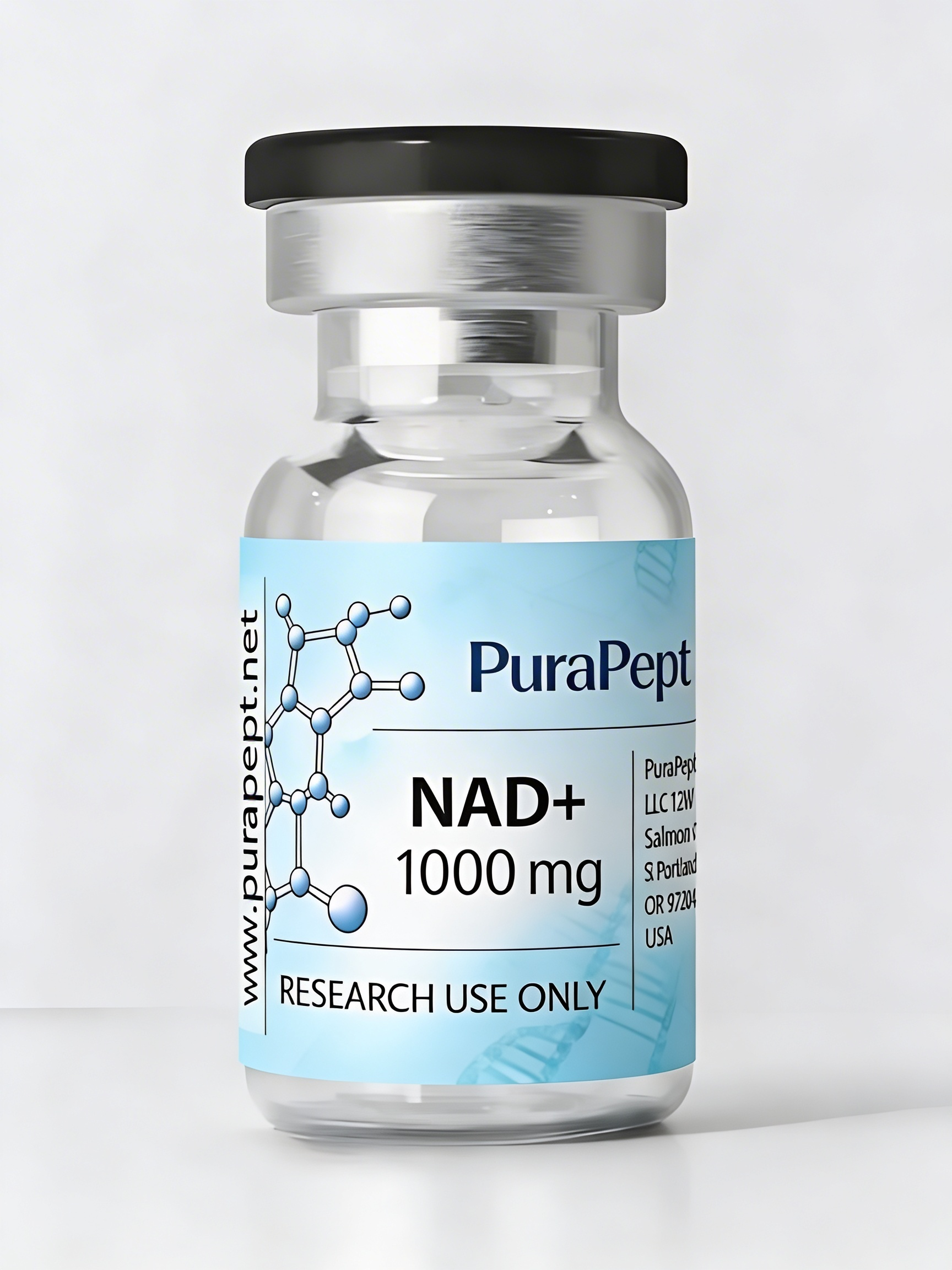 NAD+ (Buffered) 1000 mg
Nicotinamide adenine dinucleotide is one of the most widely talked-about molecules in aging research, and for most of that conversation the compound on the shelf is not NAD+ itself — it is a precursor that the body converts into it. The preparation on this page is different: NAD+ (Buffered), 1000 mg, the cofactor rather than its building block. That single distinction decides which studies can honestly be used to talk about this product, and it is worth stating at the top: the randomised human evidence for oral NAD+ itself is one trial, and it lasted five days.
The one randomised trial of an oral NAD+ product
The RENEWAL-NAD+ study, published in Geroscience in 2026, is a double-blind, randomised, placebo-controlled phase 0/1b trial in healthy adults aged 45 to 75. Sixty people were randomised, with n = 50 in the primary analysis, and they took oral NAD+ — in a physicochemically modified formulation, LathMized NAD+, which alters the supramolecular organisation and solution behaviour of the molecule while preserving its native structure — for 5 days.
Its primary endpoints were two different compartments: intracellular NAD measured in whole blood, and circulating NAD measured in separated plasma.
The result is precise and unusual:
- Intracellular whole-blood NAD rose 53 % versus placebo at day 6 (p = 5.48e-14, Hedges’ g = 3.66).
- Plasma NAD did not change (p = 0.60).
- Plasma catabolites rose substantially: 1-methyl-nicotinamide p = 5.39e-13, N1-methyl-2-pyridone-5-carboxamide p = 2.95e-16.
The authors call this compartment-selective augmentation, and they are right to. NAD+ is a large coenzyme that does not freely cross membranes, which is exactly why oral absorption is debated at all: the trial did not show NAD+ arriving in the bloodstream, it showed NAD+ inside blood cells and its metabolites appearing in plasma.
The rest of the report is where a responsible reader should slow down. Symptom incidence was comparable between groups (p = 0.68). Only one mild adverse event occurred in the NAD+ arm — nausea, grade 1. And the paper states plainly that no secondary clinical, vital-sign, wellbeing or wearable-derived endpoint survived multiplicity correction. Exploratory multi-omic analyses are ongoing. The trial was retrospectively registered. Several of the authors hold equity in the company that owns the formulation.
Five days, one pharmacodynamic signal, no clinical outcome. That is a genuinely interesting result and it is not a health claim.
What the precursor literature does and does not transfer
Everything else people cite about NAD+ comes from nicotinamide riboside, nicotinamide mononucleotide or nicotinamide itself. Those studies are strong and real, and they are about different compounds.
The 2022 trial by Okabe and colleagues randomised 30 healthy subjects to 250 mg/day NMN or placebo for 12 weeks. Whole-blood NAD+ rose significantly; nicotinic acid mononucleotide rose significantly while NMN itself did not; no abnormalities appeared in physiological or laboratory tests. The 2023 multicentre trial by Yi and colleagues randomised 80 middle-aged adults to placebo, 300, 600 or 900 mg NMN daily for 60 days: blood NAD concentrations rose in every treated group at day 30 and day 60 (all p ≤ 0.001), with the highest values in the 600 mg and 900 mg arms, and no safety issues were found.
The Parkinson phase I trial — NADPARK, thirty newly diagnosed treatment-naive patients, 1000 mg nicotinamide riboside or placebo for 30 days — went further than any of them, measuring brain. Brain NAD rose significantly but variably by 31-phosphorus magnetic resonance spectroscopy, CSF metabolites moved with it, and only the patients whose brain NAD rose showed altered cerebral metabolism on FDG-PET. The authors conclude that the findings nominate NR as a potential neuroprotective therapy “warranting further investigation in larger trials”.
Read that last clause as the state of the field rather than as hedging. The 2023 Endocrine Reviews critical appraisal says it more directly: early human studies show NAD+ levels can be raised safely in blood and some tissues by oral precursors, and “clinical pharmacology, metabolism, and therapeutic mechanisms of NAD+ precursors remain incompletely understood”. The 2025 Nature Aging review of NAD+ clinical trials ends with the same request — further large-scale studies to determine optimal dose, administration routes and frequency, long-term safety, and interindividual variability.
The animal literature is the strongest part of the whole story and the least transferable: the 2016 Cell Metabolism paper gave mice NMN for twelve months and reported suppressed age-associated weight gain, enhanced energy metabolism, improved insulin sensitivity and plasma lipids, and better eye function. Mice are not people, and the human trials above were designed precisely because that gap needed closing.
What the data do not show
- No oral NAD+ product has a clinical-outcome trial. The 53 % intracellular rise is a blood-level change over five days in 50 analysed adults. It is not a longevity result, a metabolic result or a health result.
- No oral NAD+ trial has shown an effect on plasma NAD at all. If a marketing page claims NAD+ “reaches your bloodstream”, the trial cited above measured the opposite: p = 0.60.
- The precursor results do not transfer. A blood NAD rise from NMN or NR is evidence about those compounds. It is not evidence about what a 1000 mg NAD+ product does.
- The mouse data is not a human claim. Twelve months of NMN in mice is a mouse study.
- Nothing here is a dose recommendation or a health claim. The gram and milligram figures are the regimens those studies ran. Everything supplied here is a research material, and no statement on this page is advice for any person.
For the mitochondrial side of the same field, the clinical file in SS-31 and the aging endpoints are set out on our page on SS-31 and the mitochondrial disease trials.
References.
- Kornilov SA, Hastings WJ, McGrath LF, et al. Oral LNAD+ rapidly elevates whole blood intracellular NAD and metabolic flux without elevating plasma NAD: evidence from a randomized controlled trial. Geroscience 2026 (PMID 42530810).
- Zhang J, Wang HL, Lautrup S, et al. Emerging strategies, applications and challenges of targeting NAD(+) in the clinic. Nat Aging 2025;5(9):1704-1731 (PMID 40926126).
- Bhasin S, Seals D, Migaud M, Musi N, Baur JA. Nicotinamide adenine dinucleotide in aging biology: potential applications and many unknowns. Endocr Rev 2023;44(6):1047-1073 (PMID 37364580).
- Okabe K, Yaku K, Uchida Y, et al. Oral administration of nicotinamide mononucleotide is safe and efficiently increases blood nicotinamide adenine dinucleotide levels in healthy subjects. Front Nutr 2022;9:868640 (PMID 35479740).
- Yi L, Maier AB, Tao R, et al. The efficacy and safety of β-nicotinamide mononucleotide (NMN) supplementation in healthy middle-aged adults: a randomized, multicenter, double-blind, placebo-controlled, dose-dependent clinical trial. Geroscience 2023;45(1):29-43 (PMID 36482258).
- Brakedal B, Dölle C, Riemer F, et al. The NADPARK study: a randomized phase I trial of nicotinamide riboside supplementation in Parkinson's disease. Cell Metab 2022;34(3):396-407.e6 (PMID 35235774).
- Mills KF, Yoshida S, Stein LR, et al. Long-term administration of nicotinamide mononucleotide mitigates age-associated physiological decline in mice. Cell Metab 2016;24(6):795-806 (PMID 28068222).