AICAR and the exercise claim: what humans measured
AICAR is an AMPK activator. The exercise-mimetic framing comes from a cell-culture and rodent literature. The human record is small: one ten-man intravenous infusion study in type 2 diabetes that reported no increase in muscle AMPK phosphorylation, and a 223-patient urine study that found no difference in endogenous AICAR between controls and diabetes. This page reports both.
25 October 2026 · 4 min read
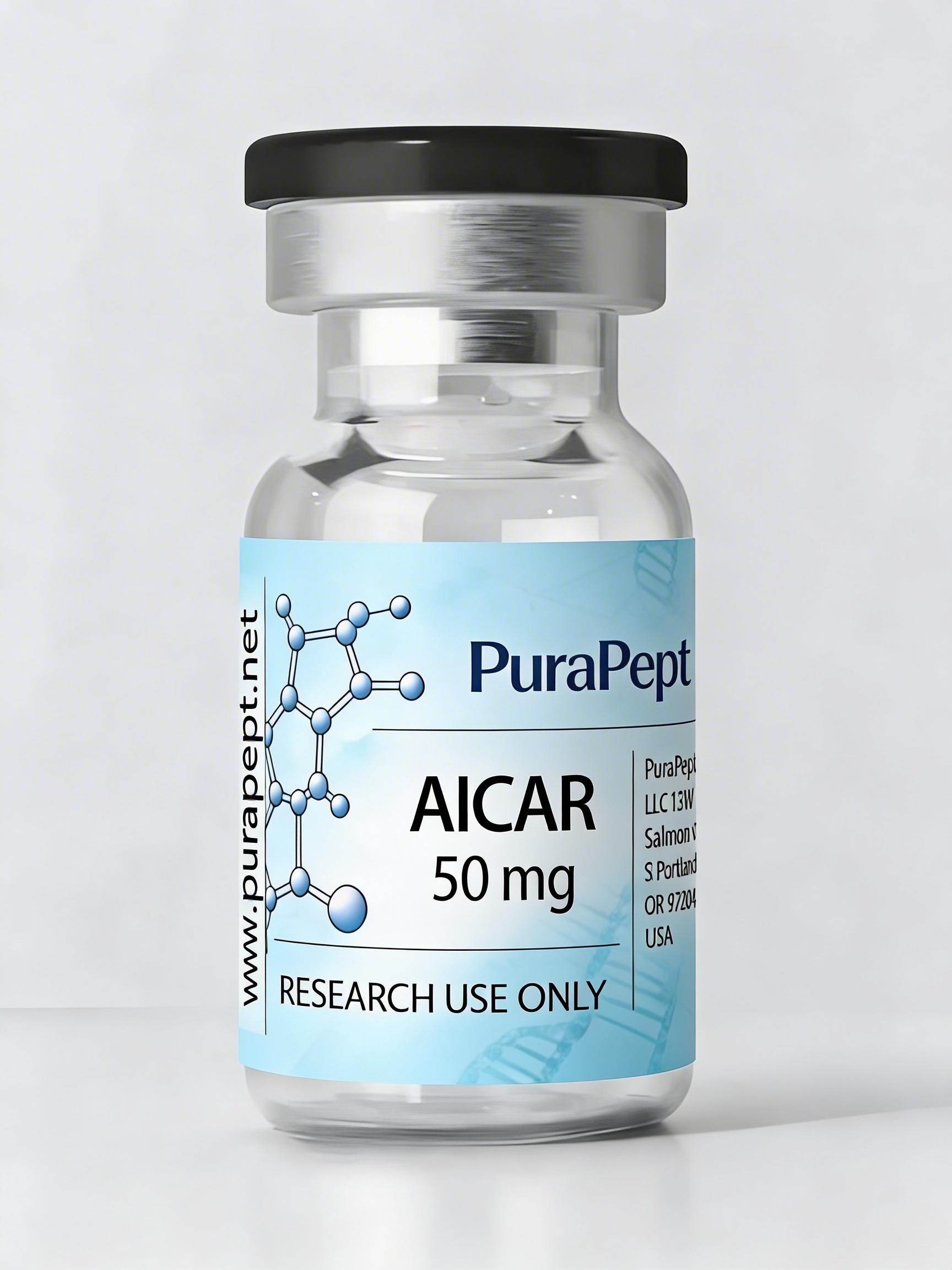 AICAR 50 mg
AICAR — 5-aminoimidazole-4-carboxamide riboside — is an endogenous activator of AMP-activated protein kinase, the enzyme that is switched on in situations where cellular energy status changes, such as muscle contraction and hypoxia. The case for it as an “exercise mimetic” is built on that mechanism, and on the fact that the same review records metformin as another compound that can pharmacologically activate AMPK.
What the human studies on this page actually measured is narrower than the framing.
The only human infusion study, in ten men with type 2 diabetes
The 2008 Diabetologia paper used stable isotope methodology with blood and muscle biopsy sampling to assess glucose and fatty acid kinetics in ten male type 2 diabetic patients, age 64 ± 2 years, BMI 28 ± 1 kg/m², during continuous intravenous infusion of AICAR at 0.75 mg kg⁻¹ min⁻¹ or sodium chloride 0.9%.
Plasma glucose rate of appearance fell following AICAR administration, while the rate of disappearance was similar in the AICAR and control test. Blood glucose disposal, expressed as the rate of disappearance as a percentage of appearance, was increased (p < 0.001), and a greater decline in plasma glucose concentration was observed (p < 0.001). Plasma NEFA rate of appearance and rate of disappearance were both significantly reduced, with a significant decline in plasma NEFA concentration.
The sentence that limits the whole paper is in the results: “Although AMPK phosphorylation in skeletal muscle was not increased.” What did increase was acetyl-CoA carboxylase phosphorylation (p < 0.001).
So the drug was infused intravenously for a short window in ten men with type 2 diabetes, it lowered glucose, and the muscle biopsy did not show the target being phosphorylated. That is a real result. It is not a performance result, not a lean-mass result, and not a study in healthy people.
The 223-patient urine study, a null result
The 2018 Acta Diabetologica paper set out with a mechanism: loss and reduction of AMPK signalling plays an important role in the development of insulin resistance in type 2 diabetes, and that loss could be due to a loss of AICAR. The question was whether urinary AICAR differs in diabetes and whether it associates with late complications.
Urine AICAR was measured by liquid chromatography tandem mass spectrometry in 223 patients: 5 healthy controls, 63 with pre-diabetes, 29 with newly diagnosed type 2 diabetes and 126 with long-standing type 2 diabetes.
Mean urine AICAR across all 223 was 694.7 ± 641.1 ng/ml. There was no significant difference between control and diabetes patients, 592.3 ± 345.1 against 697.1 ± 646.5 ng/ml. No association was found with any biochemical or clinical parameter measured, with two exceptions: age, R = -0.34, p < 0.01, and estimated glomerular filtration rate, R = 0.19, p = 0.039. Linear regression confirmed these.
The authors’ conclusion is that clinical diabetes is not associated with a change in endogenous AICAR levels, and that loss of AICAR may therefore not be the mechanism by which AMPK signalling is reduced in diabetes. The proposed mechanism this study was built to test did not survive it.
Where AMPK sits in fat metabolism — the human biopsy study
The 2004 FASEB Journal paper is the closest thing on this page to a human exercise study, and it did not administer AICAR. Eight male subjects completed 60 minutes of cycle exercise at 70% of VO2 peak on two occasions, once with normal and once with low pre-exercise muscle glycogen, the low-glycogen condition being known to enhance exercise-induced AMPK activity. Muscle samples were taken before and immediately after exercise.
Pre-exercise glycogen averaged 375 ± 35 and 163 ± 27 mmol × kg⁻¹ dry matter for the normal and low conditions. AMPK α2 did not differ between trials at rest and increased 3.7-fold (P<0.05) by exercise in the low-glycogen condition only. Hormone-sensitive lipase activity increased in the normal condition, from 1.67 ± 0.13 to 2.60 ± 0.26 mmol × min⁻¹ × kg⁻¹ dry matter, and that increase was attenuated by AMPK α2 activation in the low-glycogen condition despite higher plasma epinephrine.
AICAR appears in this paper only at the end, in L6 myotubes in culture, where epinephrine-induced increases in hormone-sensitive lipase activity were totally attenuated by AICAR administration.
The human part measured exercise, glycogen and AMPK. The AICAR part was a cell line. Those are not the same claim, and this page does not merge them.
What the data do not show
They do not show an exercise-performance or endurance effect in people. The only human AICAR administration study on this page is an intravenous infusion in ten men with type 2 diabetes measuring glucose and fatty acid kinetics.
They do not show muscle AMPK activation from administered AICAR. The infusion study reports that skeletal muscle AMPK phosphorylation was not increased.
They do not show an endogenous AICAR deficiency in diabetes. The 223-patient study found no difference between controls and patients, and the authors state the mechanism it was testing does not hold.
They do not show fat loss, lean mass or strength in any human readout.
Where this sits on the shelf
The compound as supplied by the manufacturer: AICAR
What we supply
The AICAR preparation above, as supplied by the manufacturer, tracked, from inside the EU.
Research use only. This page summarises published studies for research reference. It is not medical advice, not a protocol, and not a suggestion for human use. Nothing we supply is for human or veterinary use.
References.
- Boon H, Bosselaar M, Praet SF, et al. Intravenous AICAR administration reduces hepatic glucose output and inhibits whole body lipolysis in type 2 diabetic patients. Diabetologia 2008;51(10):1893-900.
- Mendler M, Kopf S, Groener JB, et al. Urine levels of 5-aminoimidazole-4-carboxamide riboside (AICAR) in patients with type 2 diabetes. Acta Diabetol 2018;55(6):585-592.
- Watt MJ, Steinberg GR, Chan S, Garnham A, Kemp BE, Febbraio MA. Beta-adrenergic stimulation of skeletal muscle HSL can be overridden by AMPK signaling. FASEB J 2004;18(12):1445-6.
- Musi N, Goodyear LJ. AMP-activated protein kinase and muscle glucose uptake. Acta Physiol Scand 2003;178(4):337-45.