AOD-9604 and fat loss: what has actually been measured
The compound was patented as a fat-loss candidate on the strength of mouse data, reached phase IIa, and no human trial has ever printed a fat number. The whole measured record is rodents, plus one anti-doping assay paper.
9 October 2026 · 5 min read
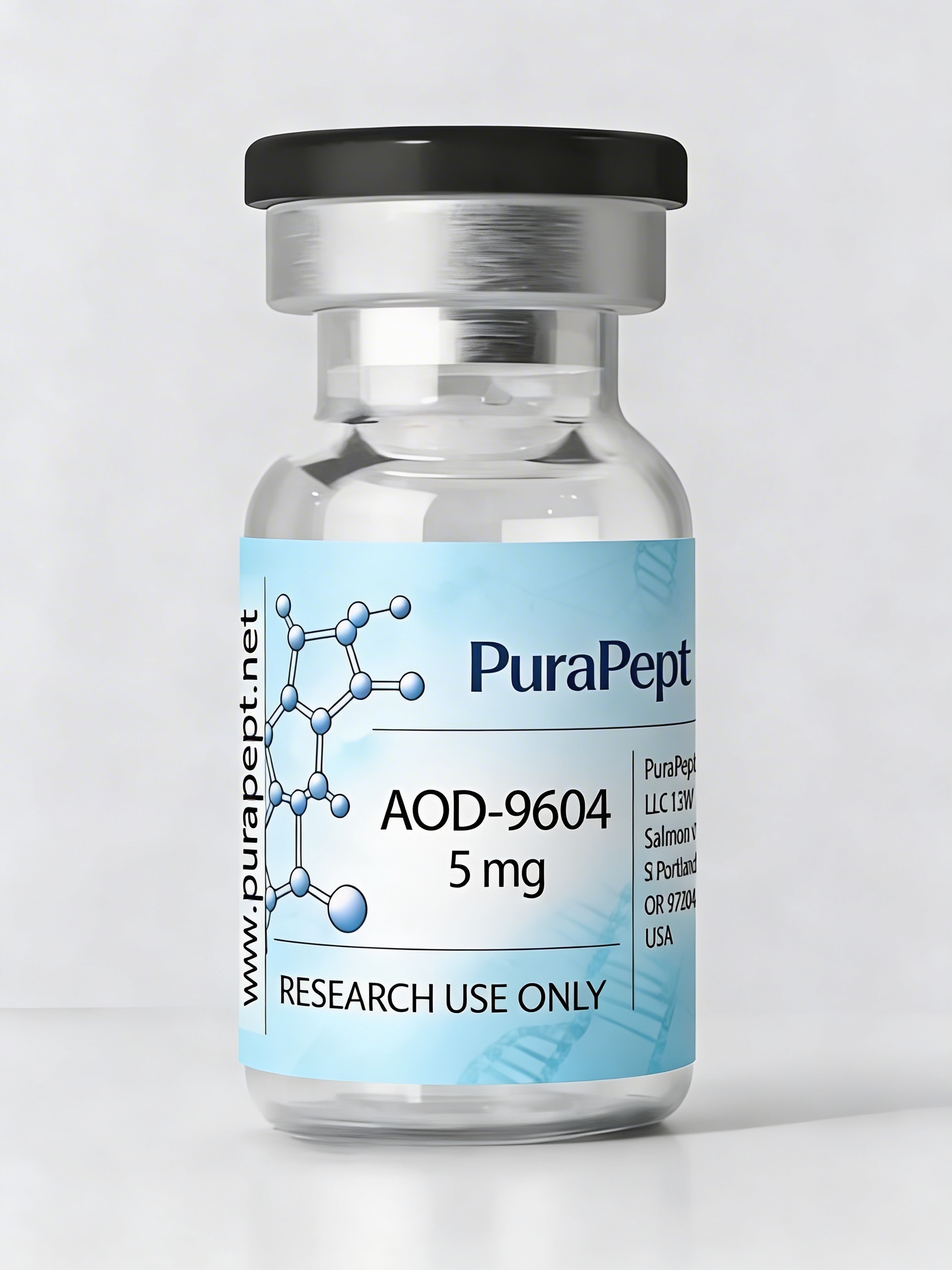 AOD-9604 5 mg
The claim attached to AOD-9604 is old, loud and completely unsupported by anything measured in a person: that this fragment of growth hormone burns fat. The compound is a synthetic analogue of the lipolytic domain of human GH. It was developed on the back of rodent work, it reached clinical trials, and the clinical literature never printed a fat number. That is the whole story, and it is worth reading carefully, because the gap between the two halves of it is where the product marketing lives.
What the animal work actually measured
The foundational paper is from Melbourne, 2000, and it is the strongest evidence the compound has. An oral dose of 500 micrograms per kilogram for nineteen days cut the body-weight gain of the animals by more than half: 15.8 plus or minus 0.6 grams against 35.6 plus or minus 0.8 grams in controls. Adipose tissue lipolytic activity went up. And chronic treatment did not damage insulin sensitivity, measured by euglycemic clamp, which was the safety argument the authors made at the end of the abstract.
Read the abstract for what it does not say. It names the species, and the species is obese Zucker rats, a rodent model of genetic obesity rather than a diet-induced one. What it does not print is the number of animals, whether the groups were randomised, and any fat-mass measurement: the figure is a reduction in weight gain over nineteen days, not a body composition result in an obese animal, and certainly not in an adult human.
A 2001 paper in Endocrinology took the mechanism apart. Fourteen days of chronic intraperitoneal AOD9604 in obese mice reduced body weight and body fat and raised the RNA for the beta(3)-adrenergic receptor, the main lipolytic receptor on fat cells, back to the level seen in lean mice. The knock-out arm is the good part: in beta(3)-AR knock-out mice the weight and lipolysis change did not happen at all. An acute dose still raised energy expenditure and fat oxidation in those same knock-out mice, which is how the authors argue that the effect is not mediated directly through the receptor even though the compound raises its expression.
That is a coherent mechanism in mice, tested with a knock-out, published in a good journal. It is also, entirely, a mouse result. The whole pharmacological case for the compound rests on it.
The clinical half that never printed a number
The development story is traceable in the review literature, and it is thin in a specific way. A 2004 review in Current Opinion in Investigational Drugs has one sentence on it: by February 2002, phase IIa trials were underway. A 2006 review of obesity drugs in clinical development lists AOD9604 among the compounds “in clinical trials” and points at what it might add, namely that it improves adipose tissue function.
Neither review prints a result, and neither cites a trial that does. That is the finding. Trials were started; a fat-loss result in people was never published in a form a reader can check. A 2026 review of therapeutic peptides in orthopaedics, which names AOD-9604 among the growth hormone secretagogues, puts the same absence in one clause: although the preclinical studies are promising, there is a current lack of clinical trials.
If you are keeping a score of what is known about AOD-9604 and what is claimed about it, this is the whole ledger. The claim is a fat number. The measurement is a mouse.
The one human-adjacent measurement, and what it is not
There is a 2013 paper in Drug Testing and Analysis whose title is the reason this compound keeps coming up in conversations about sport: AOD-9604 does not influence the WADA hGH isoform immunoassay. PubMed carries no abstract for that record, so its title is all that can be quoted here and no result from inside the paper is claimed.
Understand what that sentence is worth. It is a property of an immunoassay, not a property of the compound’s effect. An assay can fail to react with a molecule that does nothing at all, and a molecule that does nothing at all can still fail to react. The paper is good work and its finding is narrow: this particular test does not see this particular compound. It says nothing about fat, and it is not evidence that anything works.
Where the enthusiasm comes from
The most recent review of the whole grey-market peptide field, in Sports Medicine in 2026, is unusually blunt about the mechanism behind this class of claims. Its authors note that rigorous human safety data for unapproved peptides are scarce and that there is potential for serious harm, and then they make the point that matters most for a page like this one: they discuss the placebo effect as a mediator of peptide efficacy, and the way social media amplifies it.
That is a testable observation about the market rather than about the molecule. A compound with a compelling mechanism story, a memorable name and no human outcome data is exactly the object that expectation attaches to. The honest description of AOD-9604 is that it is a fragment of growth hormone with a clean mouse dataset and an empty human one.
What the data do not show
They do not show fat loss in a person, because no trial that measures body composition in humans has been published for this compound. They do not show a weight effect, an appetite effect or an energy-expenditure effect in adults, for the same reason. They do not show a safe dose, because the safety work was done by euglycemic clamp in the animal model the 2000 paper used, and because the 2026 review states outright that rigorous human safety data are scarce. They do not show durability, because there is no human time course. And they do not show a mechanism operating in human adipose tissue, which is the specific step the mouse beta(3)-AR work would have to be extended by.
They also do not show that the compound is inactive. That is the other half of the honest position, and the one this page will not take shortcuts on. Absence of human data is not evidence of absence of effect. It is an absence of data, and it is the reason a compound like this belongs on a research shelf and behind a research framing rather than in a protocol.
Where this sits on the shelf
The compound as supplied by the manufacturer: AOD-9604.
What we supply
The AOD-9604 preparation above, as supplied by the manufacturer, tracked, from inside the EU.
Research use only. This page summarises published studies for research reference. It is not medical advice, not a protocol, and not a suggestion for human use. Nothing we supply is for human or veterinary use.
References.
- Ng FM, Sun J, Sharma L, Libinaka R, Jiang WJ, Gianello R. Metabolic studies of a synthetic lipolytic domain (AOD9604) of human growth hormone. Horm Res 2000;53(6):274-278.
- Heffernan M, Summers RJ, Thorburn A, Ogru E, Gianello R, Jiang WJ, Ng FM. The effects of human GH and its lipolytic fragment (AOD9604) on lipid metabolism following chronic treatment in obese mice and beta(3)-AR knock-out mice. Endocrinology 2001;142(12):5182-5189.
- Wilding JPH. AOD-9604. Curr Opin Investig Drugs 2004;5(4):436-440.
- Jensen MD. Potential role of new therapies in modifying cardiovascular risk in overweight patients with metabolic risk factors. Obes (Silver Spring) 2006;14 Suppl 3:143S-149S.
- Orlovius AK, Thomas A, Schänzer W, Thevis M. AOD-9604 does not influence the WADA hGH isoform immunoassay. Drug Test Anal 2013;5(11-12):850-852.
- Rahman OF, Lee SJ, Seeds WA. Therapeutic Peptides in Orthopaedics: Applications, Challenges, and Future Directions. J Am Acad Orthop Surg Glob Res Rev 2026;10(1):e25.00236.
- Mendias CL, Awan TM. Safety and Efficacy of Approved and Unapproved Peptide Therapies for Musculoskeletal Injuries and Athletic Performance. Sports Med 2026;56(8):1921-1935.