Cagrilintide on its own: what the monotherapy trials found
As a single agent, cagrilintide's randomised record is one dose-finding trial in 706 adults without diabetes and one 30-person arm in a type 2 diabetes study. Weight loss ran 6.0% to 10.8% across 0.3-4.5 mg weekly against 3.0% on placebo, and every phase 3 readout on this molecule is the combination with semaglutide, not the single agent. This page reports the monotherapy numbers and says which results belong to the pair.
22 October 2026 · 6 min read
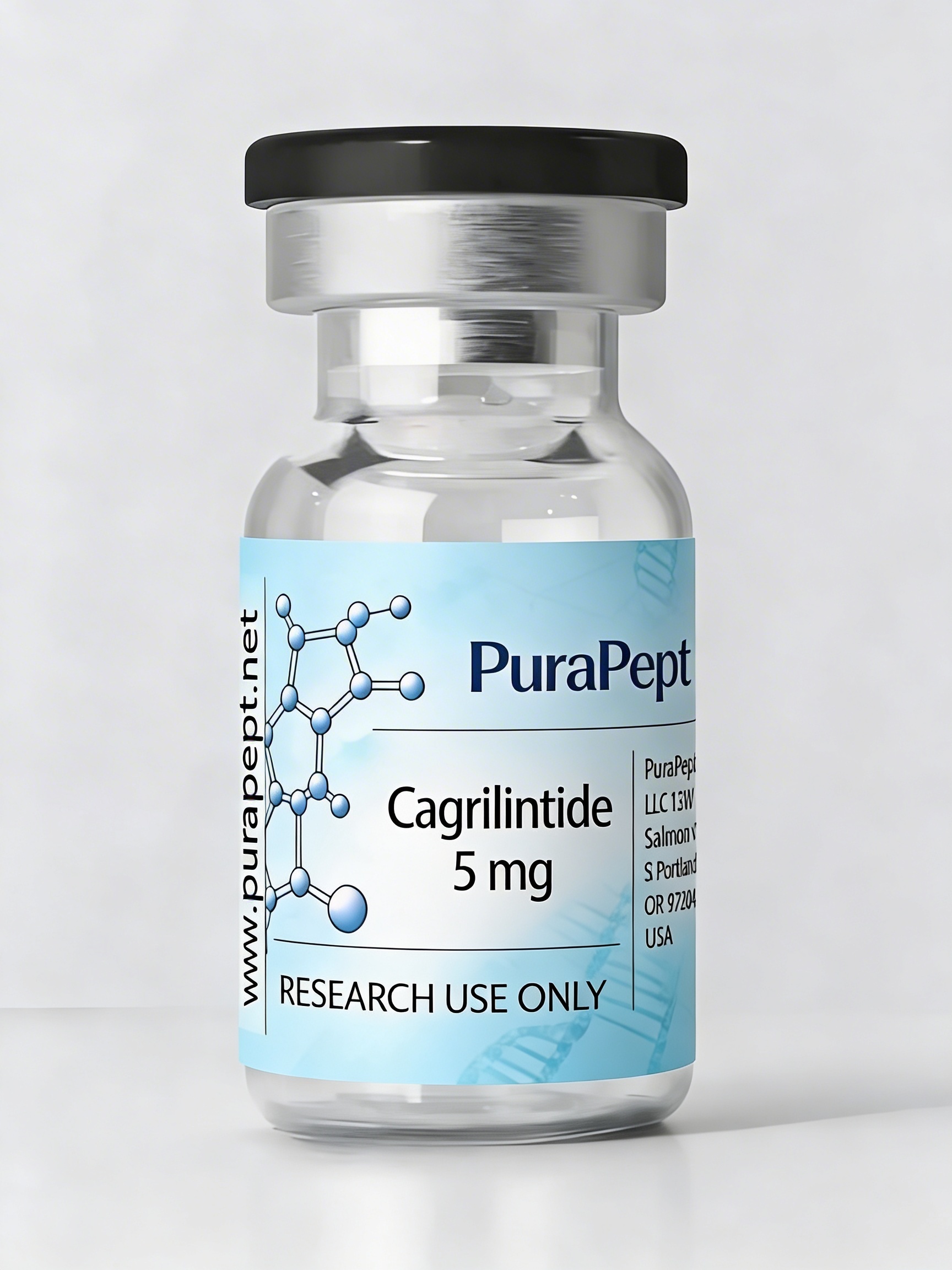 Cagrilintide 5 mg
Cagrilintide is a long-acting amylin analogue. Almost everything written about it is written about it together with semaglutide. This page is about the single agent, because that is what is on this site.
The one trial that randomised cagrilintide alone in people without diabetes
The 2021 Lancet paper is the anchor. It was a multicentre, randomised, double-blind, placebo-controlled and active-controlled, dose-finding phase 2 trial at 57 sites — hospitals, specialist clinics and primary care centres — in ten countries: Canada, Denmark, Finland, Ireland, Japan, Poland, Serbia, South Africa, the UK and the USA. Eligible participants were adults aged at least 18 without diabetes, with a body-mass index of at least 30 kg/m² or at least 27 kg/m² with hypertension or dyslipidaemia.
Between 1 March and 19 August 2019, 706 participants were randomised: 100-102 per cagrilintide dose group across 0·3, 0·6, 1·2, 2·4 and 4·5 mg once weekly, 99 to once-daily liraglutide 3·0 mg, and 101 to volume-matched placebo. The treatment period ran 26 weeks including up to 6 weeks of dose escalation, followed by a 6-week period without treatment. Participants and investigators were masked to active versus pooled placebo but not to the different active treatments, and the primary endpoint was percentage change in bodyweight from baseline to week 26.
The results, by the trial product estimand, which assumes full adherence:
Mean percentage weight reductions from baseline were greater with all doses of cagrilintide, 0·3-4·5 mg giving 6·0%-10·8% (6·4-11·5 kg), versus 3·0% (3·3 kg) on placebo, with estimated treatment differences ranging from 3·0% to 7·8% and p<0·001. Against the active comparator, weight reduction with cagrilintide 4·5 mg was greater than with liraglutide 3·0 mg: 10·8% (11·5 kg) versus 9·0% (9·6 kg), an estimated treatment difference of 1·8%, p=0·03. The treatment policy estimand, which does not assume adherence, gave similar reductions.
The tolerability numbers belong in the same breath. Permanent treatment discontinuation occurred in 73 participants (10%), similarly across groups and mostly due to adverse events (30 participants, 4%); 29 participants (4%) withdrew from the trial overall. More participants receiving cagrilintide 0·3-4·5 mg had gastrointestinal adverse events than placebo, 41%-63% versus 32%, primarily nausea, 20%-47% versus 18%.
The one trial with a monotherapy arm in type 2 diabetes
A 2023 Lancet phase 2 trial randomised 92 participants 1:1:1 to once-weekly CagriSema, once-weekly semaglutide, or once-weekly cagrilintide, all escalated to 2·4 mg, across 17 sites in the USA. Participants had type 2 diabetes and a BMI of 27 kg/m² or higher and were on metformin with or without an SGLT2 inhibitor. Randomisation was 2 August to 18 October 2021 and treatment ran 32 weeks. Sixty-four per cent were male and the mean age was 58 years (SD 9).
Read the three columns as monotherapy versus pair:
Glycated haemoglobin from baseline to week 32 was -2·2 percentage points (SE 0·15) for CagriSema, -1·8 (0·16) for semaglutide and -0·9 (0·15) for cagrilintide alone. The difference favoured CagriSema over cagrilintide by -1·3 percentage points (95% CI -1·7 to -0·8; p<0·0001), but not over semaglutide, at -0·4 (-0·8 to 0·0; p=0·075).
Bodyweight from baseline to week 32 was -15·6% (SE 1·26) with CagriSema, -5·1% (1·26) with semaglutide and -8·1% (1·23) with cagrilintide alone; the difference was greater for CagriSema than for either comparator. Fasting plasma glucose moved -3·3, -2·5 and -1·7 mmol/L respectively. Time in range, defined as 3·9-10·0 mmol/L, was 45·9%, 32·6% and 56·9% at baseline and 88·9%, 76·2% and 71·0% at week 32 for the three groups.
That middle column is the interesting anomaly: at week 32, cagrilintide alone had the highest time in range of the three groups and the smallest HbA1c change. The authors’ conclusion is that CagriSema improved glycaemic control including CGM parameters, that its HbA1c change was greater than cagrilintide but not than semaglutide, and that it produced significantly greater weight loss than either. Adverse events were reported by 68%, 71% and 80% of the three groups respectively; mild or moderate gastrointestinal events were most common; no level 2 or 3 hypoglycaemia and no fatal adverse events were reported.
Thirty people in the monotherapy arm is the entire type 2 diabetes record for this molecule as a single agent.
Why the molecule looks the way it does
A 2021 paper in the Journal of Medicinal Chemistry reports the development work. Amylin has a high propensity toward forming amyloid fibrils, which makes it a challenging drug design effort. The amylin analogue pramlintide is commercially available for diabetes as an adjunct to insulin therapy but requires three daily injections because of its short half-life. The authors report the development of the stable, lipidated long-acting amylin analogue cagrilintide, and the structure-activity efforts that led to its selection for clinical development with obesity as an indication.
A 2024 review in Cardiology in Review sets out the mechanism. Amylin is released with insulin from beta cells in the pancreas and induces its satiating effect via both the homeostatic and the hedonic regions of the brain; semaglutide reduces appetite via GLP-1 receptors in the hypothalamus, increases insulin production and reduces glucagon secretion, and delays gastric emptying. The authors describe these as separate but related mechanisms with an apparently additive effect on appetite reduction, and note that cagrilintide alone as well as in combination with semaglutide has shown weight loss in clinical trials.
The 2025 mechanistic paper tested the receptor dependency in mice. Male wild-type and RAMP1/3 knockout littermates were fed a high-fat diet for 23 weeks before a 3-week treatment period with vehicle, 150 nmol/kg salmon calcitonin or 3 nmol/kg cagrilintide subcutaneously once daily. Body weight loss was seen in wild-type cagrilintide-treated mice at -3·4 ± 0·51 g (P < 0·005; n = 8 per group), whereas salmon calcitonin increased weight by 0·60 ± 0·38 g (P < 0·01). Food intake fell in wild-type animals on day 1 from a vehicle 2·7 ± 0·2 g to 1·2 ± 0·1 g with cagrilintide (P < 0·0001). The authors conclude that cagrilintide’s effect on bodyweight depends on the AMY1R and AMY3R receptors.
The results that are not about cagrilintide alone
Three records on this page report the combination, and it is worth being explicit about which is which.
The 2025 New England Journal of Medicine paper is REDEFINE 2: 1206 adults with overweight or obesity and type 2 diabetes in 12 countries, randomised 3:1 to once-weekly cagrilintide- semaglutide at 2.4 mg each or placebo, with lifestyle intervention, for 68 weeks. Mean change in body weight was -13.7% in the combination group and -3.4% in the placebo group, an estimated difference of -10·4 percentage points (95% CI -11·2 to -9·5; P<0·001). Seventy- three point five per cent of the combination group reached an HbA1c of 6·5% or less, against 15·9% on placebo. Gastrointestinal adverse events were reported by 72·5% and 34·4% respectively.
The 2025 pipeline review states that cagrilintide with semaglutide is in phase III development, and the 2024 BMJ network meta-analysis of 76 trials and 39,246 participants puts CagriSema at the top for weight loss among the agents compared, mean difference -14.03 kg (95% confidence interval -17.05 to -11.00), ahead of tirzepatide at -8.47 kg (-9.68 to -7.26).
None of those three numbers is a cagrilintide-alone number, and they should not be read as one.
What the data do not show
They do not show a phase 3 result for the single agent. Every phase 3 readout in this record is the combination with semaglutide.
They do not show a trial in people with diabetes larger than 30 participants on cagrilintide alone. The type 2 diabetes monotherapy arm is one cell of a 92-person, three-arm study.
They do not show anything beyond 26 weeks of treatment as a single agent in people without diabetes, or beyond 32 weeks in the diabetes arm. Maintenance and withdrawal were not studied as monotherapy in anything cited here.
They do not show a tolerability advantage. Gastrointestinal adverse events ran 41%-63% on cagrilintide against 32% on placebo, with nausea at 20%-47% against 18%, and permanent discontinuation affected 10% of participants.
One catalogue note, stated as a limit rather than as guidance: the doses randomised in the phase 2 trial ran from 0·3 mg to 4·5 mg once weekly, and the preparation on this site is a 5 mg vial, above the highest dose in that trial. There is no randomised monotherapy data beyond 4·5 mg to read.
Where this sits on the shelf
The compound as supplied by the manufacturer: Cagrilintide 5 mg
What we supply
The cagrilintide preparation above, as supplied by the manufacturer, tracked, from inside the EU.
Research use only. This page summarises published studies for research reference. It is not medical advice, not a protocol, and not a suggestion for human use. Nothing we supply is for human or veterinary use.
References.
- Lau DCW, Erichsen L, Francisco AM, et al. Once-weekly cagrilintide for weight management in people with overweight and obesity: a multicentre, randomised, double-blind, placebo-controlled and active-controlled, dose-finding phase 2 trial. Lancet 2021;398(10317):2160-2172.
- Frias JP, Deenadayalan S, Erichsen L, et al. Efficacy and safety of co-administered once-weekly cagrilintide 2.4 mg with once-weekly semaglutide 2.4 mg in type 2 diabetes: a multicentre, randomised, double-blind, active-controlled, phase 2 trial. Lancet 2023;402(10403):720-730.
- Kruse T, Hansen JL, Dahl K, et al. Development of Cagrilintide, a Long-Acting Amylin Analogue. J Med Chem 2021;64(15):11183-11194.
- D'Ascanio AM, Mullally JA, Frishman WH. Cagrilintide: A Long-Acting Amylin Analog for the Treatment of Obesity. Cardiol Rev 2024;32(1):83-90.
- Carvas AO, Leuthardt A, Kulka P, et al. Cagrilintide lowers bodyweight through brain amylin receptors 1 and 3. EBioMedicine 2025;118:105836.
- Davies MJ, Bajaj HS, Broholm C, et al. Cagrilintide-Semaglutide in Adults with Overweight or Obesity and Type 2 Diabetes. N Engl J Med 2025;393(7):648-659.
- Madsbad S, Holst JJ. The promise of glucagon-like peptide 1 receptor agonists (GLP-1RA) for the treatment of obesity: a look at phase 2 and 3 pipelines. Expert Opin Investig Drugs 2025;34(3):197-215.
- Yao H, Zhang A, Li D, et al. Comparative effectiveness of GLP-1 receptor agonists on glycaemic control, body weight, and lipid profile for type 2 diabetes: systematic review and network meta-analysis. BMJ 2024;384:e076410.