Cagrilintide with semaglutide: what the phase 3 trials measured
Two 68-week trials in 4,623 people: 20.4% mean weight change without diabetes, 13.7% with. Both used 2.4 mg of each, weekly.
7 October 2026 · 5 min read
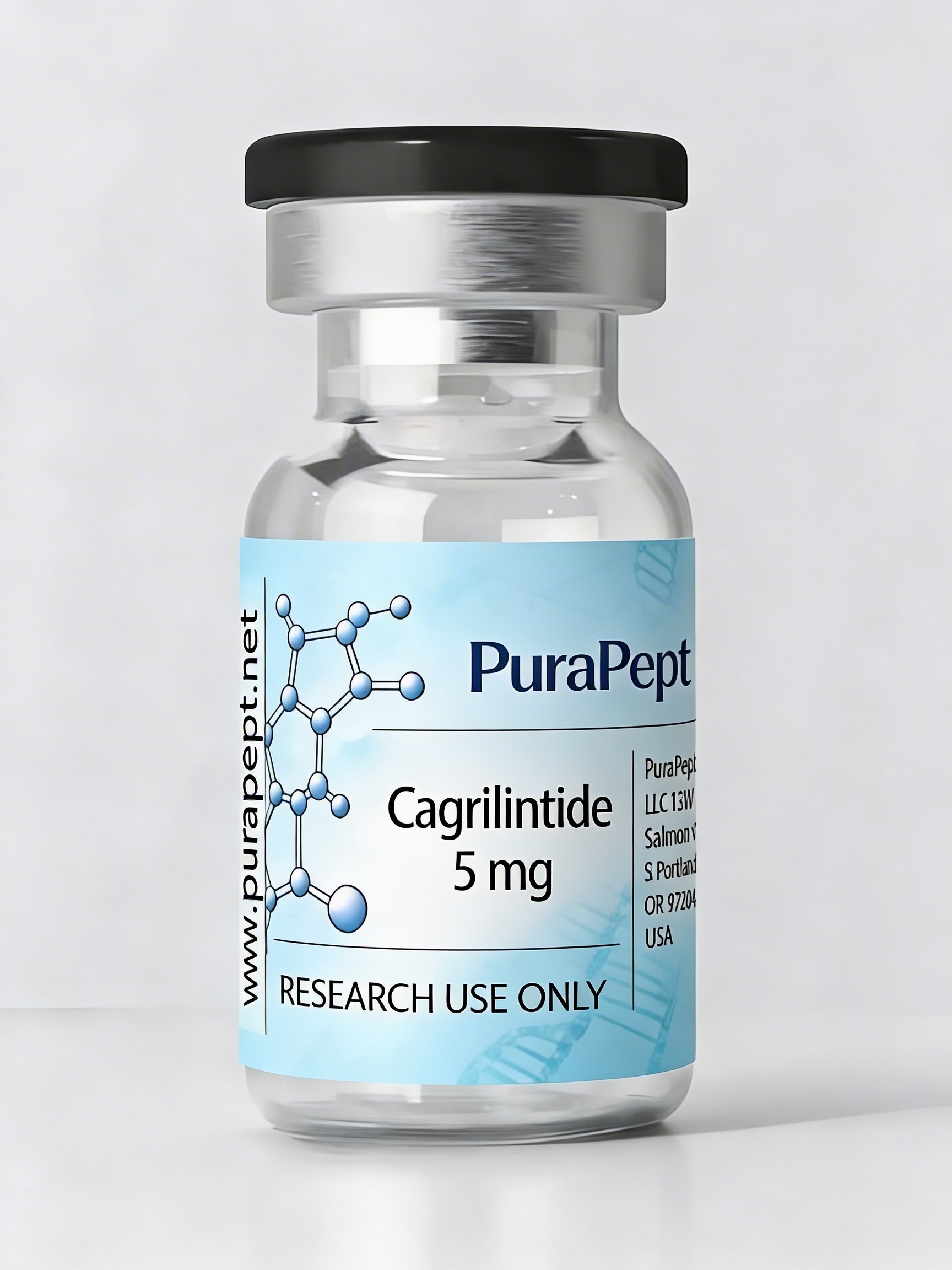 Cagrilintide 5 mg
Cagrilintide is an amylin analogue. Semaglutide is a GLP-1 receptor agonist. They work on different parts of the appetite system, which is the whole reason the combination exists, and in 2025 that reasoning produced two phase 3 trials with hard weight endpoints in 4,623 people. This page is about what those two trials measured, and about three things they did not.
The trial without diabetes
REDEFINE 1 enrolled 3,417 adults without diabetes, with a body mass index of 30 or higher, or 27 or higher with at least one related complication. Randomisation was 21:3:3:7 to the combination of 2.4 mg semaglutide with 2.4 mg cagrilintide, to semaglutide alone, to cagrilintide alone, or to placebo, plus lifestyle intervention for every group, for 68 weeks.
At week 68 the estimated mean percent change in body weight was -20.4% on the combination against -3.0% on placebo, an estimated difference of -17.3 percentage points with a 95% confidence interval of -18.1 to -16.6 and P<0.001. Participants on the combination were more likely than those on placebo to reach every threshold the trial tested, at 5%, 20%, 25% and 30% weight reduction, all P<0.001.
Gastrointestinal adverse events affected 79.6% of the combination group and 39.9% of the placebo group. The authors describe them as mainly transient and mild-to-moderate. That sentence is doing real work and it is worth reading twice: roughly four in five people on the combination had a gastrointestinal event, against two in five on placebo.
The estimand matters too. Effects were estimated with the treatment-policy estimand, which is the intention-to-treat principle, so the -20.4% includes people who stopped treatment. A per-protocol figure would be higher, and this paper does not print one.
The trial with diabetes
REDEFINE 2 kept the 68-week schedule and ran in 12 countries with 1,206 adults who had type 2 diabetes, a body mass index of 27 or higher and glycated haemoglobin between 7% and 10%, allocated 3:1 to the combination or placebo.
Mean weight change was -13.7% on the combination against -3.4% on placebo, a difference of -10.4 percentage points (95% CI -11.2 to -9.5), P<0.001. The number that is specific to this population is the glycaemic one: 73.5% of the combination group reached a glycated haemoglobin of 6.5% or less, against 15.9% on placebo. Gastrointestinal adverse events again dominated, at 72.5% against 34.4%.
Two figures, same mechanism, two populations, and the gap between -20.4% and -13.7% is roughly the price of putting the same trial into people who already have diabetes.
What came before phase 3
The phase 2 work is worth keeping because it shows where the combination stopped being additive.
In 92 people with type 2 diabetes over 32 weeks, glycated haemoglobin fell 2.2 percentage points on the combination, 1.8 on semaglutide and 0.9 on cagrilintide. The difference against cagrilintide was -1.3 points (95% CI -1.7 to -0.8), p<0.0001. The difference against semaglutide was -0.4 points (-0.8 to 0.0), p=0.075. That is not a separation, and the trial says so. On body weight the combination was clearly ahead: -15.6% against -5.1% for semaglutide and -8.1% for cagrilintide. Time in range, 3.9 to 10.0 mmol/L, reached 88.9% on the combination at week 32 against 76.2% on semaglutide and 71.7% on cagrilintide.
Cagrilintide on its own came from a 57-site trial in 10 countries. Across amounts from 0.3 to 4.5 mg, weight reduction ran 6.0% to 10.8% (6.4 to 11.5 kg) against 3.0% (3.3 kg) on placebo under the trial-product estimand, an estimated treatment difference of 3.0% to 7.8%, p<0.001. At the top amount, 4.5 mg, cagrilintide gave 10.8% against 9.0% for daily liraglutide 3.0 mg, a difference of 1.8%, p=0.03. Gastrointestinal adverse events ran 41% to 63% against 32% on placebo, with nausea at 20% to 47% against 18%.
The earliest study, the phase 1b that established the pharmacokinetics, is the one that explains the once-weekly schedule. Cagrilintide had a half-life of 159 to 195 hours and a median time to maximum concentration of 24 to 72 hours, against 145 to 165 hours and 12 to 24 hours for semaglutide. Exposure was proportional to cagrilintide amount and did not change semaglutide exposure or elimination. Of 566 adverse events in 92 exposed participants, 207 (37%) were gastrointestinal.
Where the meta-analysis agrees, and where it does not
A 2024 systematic review and meta-analysis screened 678 articles and pooled 3 randomized trials with 430 individuals. Against semaglutide 2.4 mg alone, CagriSema produced a greater percentage weight reduction, a mean difference of -9.07% (95% CI -11.91 to -6.23), P<0.00001, and a greater absolute reduction of -9.11 kg (-12.84 to -5.39). Against semaglutide or liraglutide, cagrilintide alone was not distinguishable, a mean difference of -1.83% (-4.08 to -0.42), p=0.11.
Two things in that paper matter more than its headline. The heterogeneity is extreme: 96% and 98% in the two pooled comparisons, meaning the trials it pooled are not measuring the same thing. And it was written from 3 trials, 430 people, which is not the same evidence base as 4,623 people at week 68. Read it as a bridge between the phase 2 programme and the phase 3 results, not as an independent confirmation of them.
What the data do not show
They do not show a body-composition breakdown. Neither phase 3 trial reports fat-free mass, and a percentage weight change cannot be split into fat and lean without an endpoint neither paper prints. They do not show muscle retained rather than lost, which is the question most readers arrive with. They do not show a cardiovascular outcome, because both trials measured weight and glycaemia and nothing else. They do not show durability past 68 weeks, or what happens after treatment stops. They do not show cagrilintide working independently of semaglutide at phase 3 scale in a way the estimands can be compared, because the monotherapy arms were 302 people each against 705 for placebo, an allocation built for a coprimary contrast rather than for monotherapy inference.
And they do not separate the 2.4 mg of each from any other combination of the two molecules. Every phase 3 result above is 2.4 mg plus 2.4 mg, once a week, as two separate products.
Where this sits on the shelf
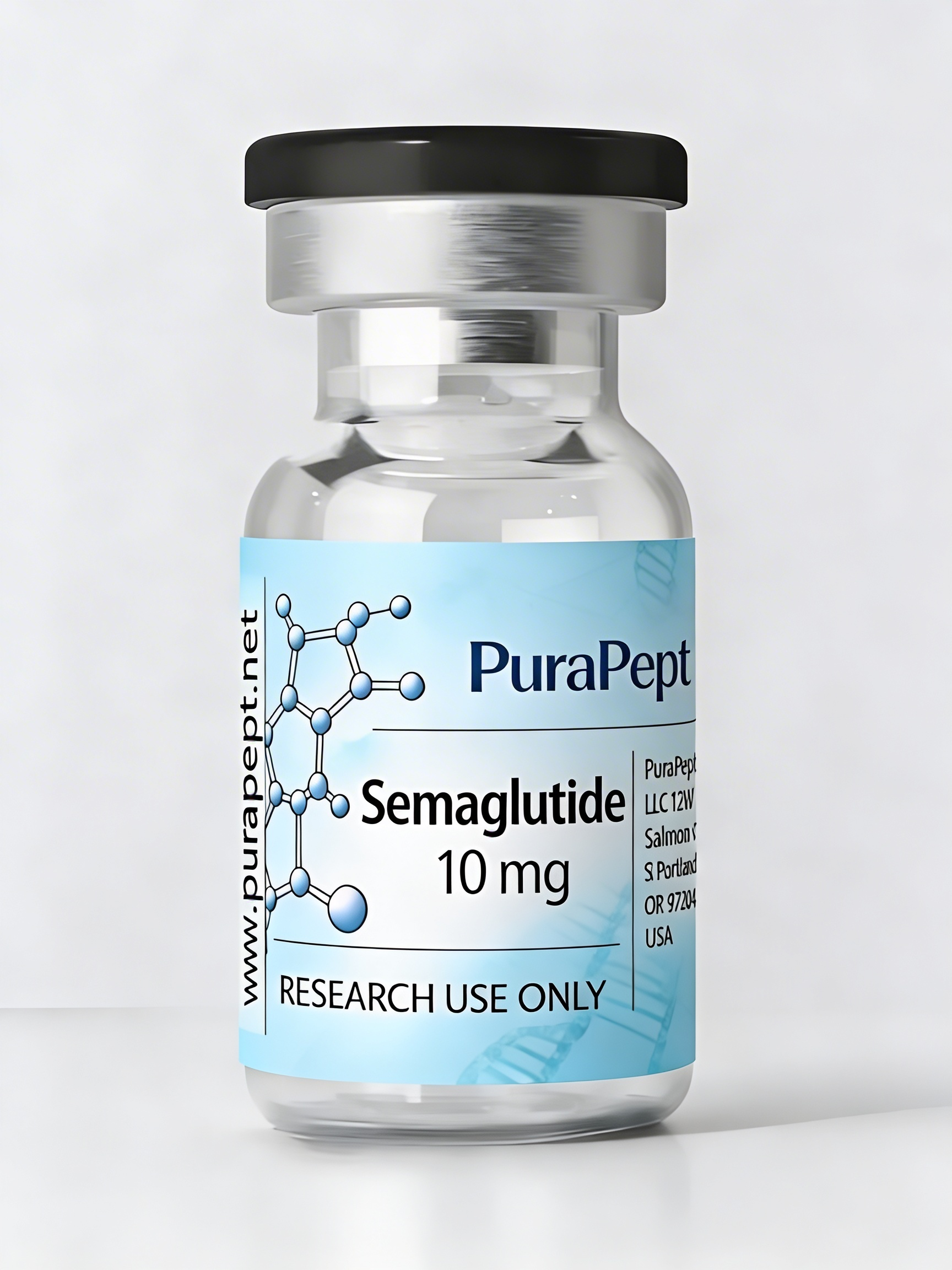
The two molecules as supplied by the manufacturer: cagrilintide and semaglutide.
For the composition question behind the weight number, semaglutide and lean mass is the companion page on this desk. That page ships with the 06.10 wave and is live before this one is published, so the link resolves from day one.
What we supply
The cagrilintide and semaglutide preparations above, as supplied by the manufacturer, tracked, from inside the EU.
Research use only. This page summarises published studies for research reference. It is not medical advice, not a protocol, and not a suggestion for human use. Nothing we supply is for human or veterinary use.
References.
- Garvey EP, Blüher M, Osorto Contreras A, et al. Coadministered cagrilintide and semaglutide in adults with overweight or obesity. N Engl J Med 2025;393(7):635-647.
- Davies M, Bajaj V, Broholm C, et al. Cagrilintide-semaglutide in adults with overweight or obesity and type 2 diabetes. N Engl J Med 2025;393(7):648-659.
- Frias JP, Deenadayalan S, Erichsen C, et al. Efficacy and safety of co-administered once-weekly cagrilintide 2.4 mg with once-weekly semaglutide 2.4 mg in type 2 diabetes: a multicentre, randomised, double-blind, active-controlled, phase 2 trial. Lancet 2023;402(10403):720-730.
- Enebo PB, Berthelsen SM, Kankam M, et al. Safety, tolerability, pharmacokinetics, and pharmacodynamics of concomitant administration of multiple amounts of cagrilintide with semaglutide 2.4 mg for weight management: a randomised, controlled, phase 1b trial. Lancet 2021;397(10286):1736-1748.
- Lau DCW, Erichsen L, Francisco AM, et al. Once-weekly cagrilintide for weight management in people with overweight and obesity: a multicentre, randomised, double-blind, placebo-controlled and active-controlled, dose-finding phase 2 trial. Lancet 2021;398(10317):2160-2172.
- Dutta D, Nagendra L, Harish BG, et al. Efficacy and safety of cagrilintide alone and in combination with semaglutide (CagriSema) as anti-obesity medications: a systematic review and meta-analysis. Indian J Endocrinol Metab 2024;28(5):436-444.