Epithalon and NAD+: what the aging research claims
The two are sold as a pair. PubMed holds no record that links them, the human supplementation record for NAD+ and its precursors is ten trials and 489 people, and the epithalon side of the story is cultured fetal fibroblasts and mice.
6 October 2026 · 5 min read
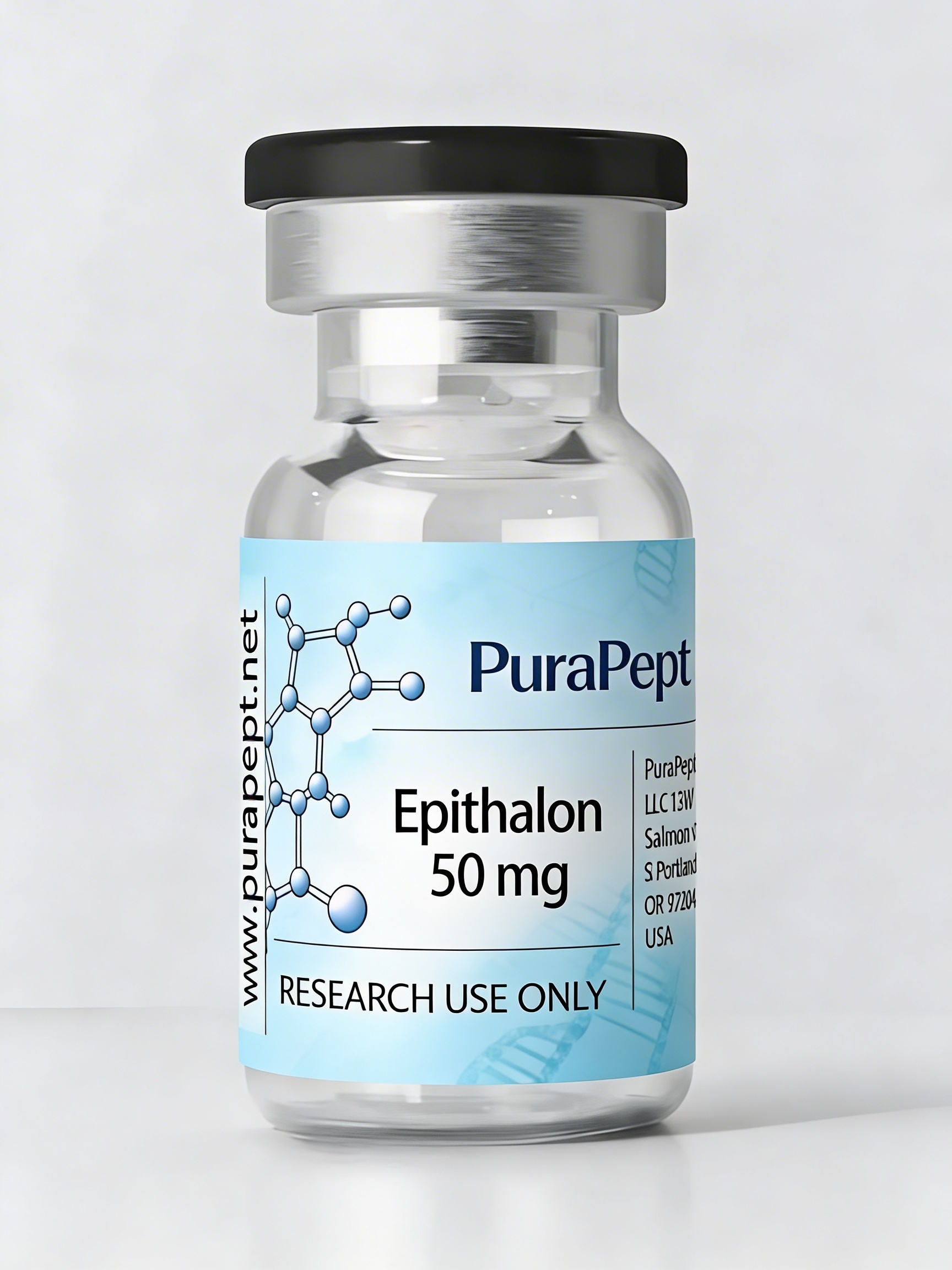 Epithalon 50 mg
The pairing is the claim. Epithalon and NAD+ appear together as an ageing stack: one to keep telomeres long, one to keep the cofactor up. They have never been tested together, because there is no record that puts them in the same study.
The first search returns nothing, and that is the finding
epithalon[tiab] AND (nad[tiab] OR nicotinamide[tiab]) on PubMed, run 1 October 2026, re-run 2 October 2026, checked a third time on 4 October 2026 and a fourth on 5 October 2026 — the same
day this page was audited: zero records, all four times. Not a weak result — none. Whatever else is true about these two compounds, the literature does not describe them as a combination, and no trial has administered them as one.
The human NAD+ record is ten trials
The best single synthesis of NAD+ and NADH as supplements is a 2024 systematic review: 10 studies, 489 participants in total, covering chronic fatigue syndrome, older adults, Parkinson’s disease, overweight, postmenopausal prediabetes and Alzheimer’s disease. It reports that supplementation with NADH and precursors was well tolerated, with observations of lower anxiety, lower maximum heart rate after a stress test, increased muscle insulin sensitivity and insulin signalling, and quality-of-life and fatigue measures in chronic fatigue syndrome. It also catalogues side effects across every study — muscle pain, nervous disorders, fatigue, sleep disturbance and headaches — and closes with the sentence that matters for anyone reading a product page: future investigations are needed to evidence the clinical benefits regarding specific diseases and the amounts administered (Gindri et al., PMID 37971292).
Note what that review is actually about: NADH and precursors. Most of the human evidence for “NAD+” is evidence for other compounds that raise it.
What the strongest human trials measured
Two randomised human studies define the credible edge of this field, and neither measured ageing.
In postmenopausal women with prediabetes who were overweight or obese, a 10-week randomised, placebo-controlled, double-blind trial found that insulin-stimulated glucose disposal by hyperinsulinemic-euglycemic clamp, and skeletal muscle insulin signalling through AKT and mTOR phosphorylation, increased after nicotinamide mononucleotide and did not change after placebo (Yoshino et al., PMID 33888596). That is a metabolic result in one population, not an ageing result. In 22 healthy older adults in a randomised, placebo-controlled crossover trial of oral nicotinamide riboside at 500 mg twice daily for six weeks, NAD+ rose and levels of Aβ42, pJNK and pERK1/2 fell in plasma extracellular vesicles enriched for neuronal origin (Vreones et al., PMID 36515353). The authors are careful about what that means — the vesicles are a blood-based window, not a brain measurement.
Neither study administered NAD+ itself. Both administered precursors.
The one human study that measured NAD+ in a brain deserves its own paragraph, because it is the field’s real high point. In a double-blinded phase I trial, 30 newly diagnosed, treatment-naive Parkinson’s patients received 1,000 mg of nicotinamide riboside or placebo daily for 30 days. It was well tolerated and produced a significant but variable rise in cerebral NAD, measured by 31-phosphorus magnetic resonance spectroscopy, with related metabolites in cerebrospinal fluid. Recipients whose brain NAD rose showed altered cerebral metabolism on FDG-PET, associated with mild clinical improvement; inflammatory cytokines fell in serum and cerebrospinal fluid. The authors conclude the data nominate nicotinamide riboside for further investigation in larger trials (Brakedal et al., PMID 35235774). Thirty people, thirty days, phase I, and the authors themselves call for larger trials.
What actually raises NAD+ in people: training
The clearest human result in this area involves no product. In 57 people, NAMPT abundance in skeletal muscle correlated negatively with age, VO2 peak was its best predictor, and 12 weeks of training raised NAMPT abundance by 12 % and 28 % in young and older participants after aerobic work and by 25 % and 30 % after resistance work. No other protein measured changed, and in a separate cohort abdominal subcutaneous adipose tissue was unaffected by age or by six weeks of high-intensity interval training (de Guia et al., PMID 31207144).
The mouse lifespan data follows the same shape as a supplement claim, in a preprint rather than a journal. Long-term nicotinamide mononucleotide in mice delayed frailty and altered the microbiome, improved metabolic health in males but not females, and in females but not males increased median lifespan by 8.5 % (Kane et al., PMID 38979132). That is a non-peer-reviewed preprint, in rodents, with a sex-dependent effect — three qualifiers in one sentence.
And the framing itself has moved. The 2023 consensus paper on ageing proposes twelve hallmarks, from genomic instability and telomere attrition through deregulated nutrient-sensing and chronic inflammation to dysbiosis. NAD+ is not among the twelve by name (López-Otín et al., PMID 36599349).
The epithalon half of the stack is a cell culture and a mouse microarray
The much-quoted epithalon finding is from 2003: in telomerase-negative human fetal fibroblast culture, the peptide induced expression of the telomerase catalytic subunit, telomerase enzymatic activity and telomere elongation (Khavinson et al., PMID 12937682). The follow-up followed fetal pulmonary fibroblasts from a 24-week fetus that lost proliferative potential at the 34th passage; with epithalon they made 10 extra divisions and reached 44 passages, with telomeres back to early-passage length (Khavinson et al., PMID 15455129).
That is cells in a dish. In vivo, the measurable output is gene expression. In mouse heart, DNA microarray over 15,247 clones found 98 clones modulated by epithalon alone, and across epithalon treatments alone or combined with Vilon the largest activation was 6.61-fold (Anisimov et al., PMID 12360356). In old female rhesus monkeys, epithalon stimulated evening melatonin production and normalised circadian cortisol rhythms — measured hormones, in monkeys (Goncharova et al., PMID 11550036). A 2026 orthopaedics review that lists epithalon among recovery-enhancing agents targeting circadian and mitochondrial regulators states in the same paragraph that although preclinical studies are promising, there is a current lack of clinical trials (Rahman et al., PMID 41490200).
What the data do not show
Nothing here shows that either compound slows ageing in a person, and nothing links them to each other in any study. This page does not read ten extra cell divisions as ten extra years, does not carry a mouse median-lifespan figure to people, does not present biomarker changes in plasma vesicles as an outcome in a brain, and does not describe precursor trials as evidence for administered NAD+.
What the record supports is narrower. NAD+ biology in ageing is real and measurable in human muscle, and human trials of precursors exist. Epithalon has a reproducible cell-culture result and a mouse transcriptional footprint. Neither has a human ageing trial, and the combination sold on these two shelves has never been studied.
Sourcing note
Internal links for the SEO Specialist to confirm: the Epithalon human-record page, the sleep and GH axis page where epithalon appears, and the NAD/NMN work on the peptheon store.
Research use only. This page describes published human and animal literature. It is not medical advice, not a treatment recommendation, and not a suggestion for human use. Nothing we supply is for human or veterinary use.
References.
- Gindri IM, Ferrari G, Pinto LPS, Bicca J, et al. Evaluation of safety and effectiveness of NAD in different clinical conditions: a systematic review. Am J Physiol Endocrinol Metab 2024;326(4):E417-E427. PubMed record (PMID 37971292).
- Yoshino M, Yoshino J, Kayser BD, Patti GJ, et al. Nicotinamide mononucleotide increases muscle insulin sensitivity in prediabetic women. Science 2021;372(6547):1224-1229. PubMed record (PMID 33888596).
- Vreones M, Mustapic M, Moaddel R, Pucha KA, et al. Oral nicotinamide riboside raises NAD+ and lowers biomarkers of neurodegenerative pathology in plasma extracellular vesicles enriched for neuronal origin. Aging Cell 2023;22(1):e13754. PubMed record (PMID 36515353).
- Brakedal B, Dölle C, Riemer F, Ma Y, et al. The NADPARK study: a randomized phase I trial of nicotinamide riboside supplementation in Parkinson's disease. Cell Metab 2022;34(3):396-407.e6. PubMed record (PMID 35235774).
- de Guia RM, Agerholm M, Nielsen TS, Consitt LA, et al. Aerobic and resistance exercise training reverses age-dependent decline in NAD+ salvage capacity in human skeletal muscle. Physiol Rep 2019;7(12):e14139. PubMed record (PMID 31207144).
- Kane AE, Chellappa K, Schultz MB, Arnold M, et al. Long-term NMN treatment increases lifespan and healthspan in mice in a sex dependent manner. bioRxiv 2024:2024.06.21.599604 (preprint, not peer reviewed). PubMed record (PMID 38979132).
- López-Otín C, Blasco MA, Partridge L, Serrano M, et al. Hallmarks of aging: an expanding universe. Cell 2023;186(2):243-278. PubMed record (PMID 36599349).
- Khavinson VKh, Bondarev IE, Butyugov AA. Epithalon peptide induces telomerase activity and telomere elongation in human somatic cells. Bull Exp Biol Med 2003;135(6):590-2. PubMed record (PMID 12937682).
- Khavinson VKh, Bondarev IE, Butyugov AA, Smirnova TD. Peptide promotes overcoming of the division limit in human somatic cell. Bull Exp Biol Med 2004;137(5):503-6. PubMed record (PMID 15455129).
- Goncharova ND, Khavinson BK, Lapin BA. Regulatory effect of Epithalon on production of melatonin and cortisol in old monkeys. Bull Exp Biol Med 2001;131(4):394-6. PubMed record (PMID 11550036).
- Anisimov SV, Bokheler KR, Khavinson VKh, Anisimov VN. Studies of the effects of Vilon and Epithalon on gene expression in mouse heart using DNA-microarray technology. Bull Exp Biol Med 2002;133(3):293-9. PubMed record (PMID 12360356).
- Rahman OF, Lee SJ, Seeds WA. Therapeutic Peptides in Orthopaedics: Applications, Challenges, and Future Directions. J Am Acad Orthop Surg Glob Res Rev 2026;10(1):e25.00236. PubMed record (PMID 41490200).