CJC-1295 without DAC: which molecule the studies describe
Two catalogue entries, one name in the literature. The pharmacokinetic study everyone quotes characterises a long-acting analogue with a five-to-eight day half-life; the 2026 reviews list the DAC and no-DAC forms as separate agents. This page is about telling them apart.
14 October 2026 · 4 min read
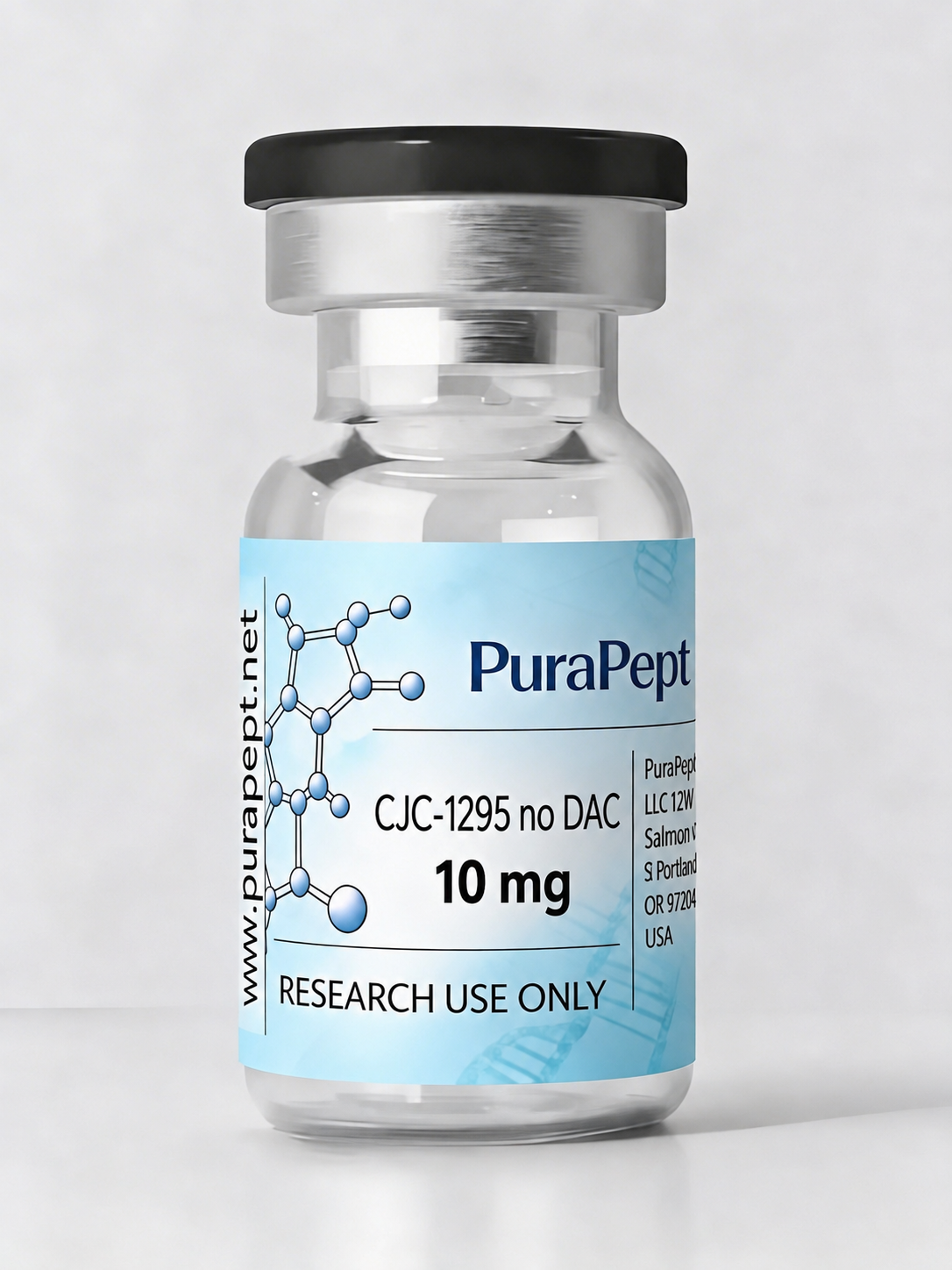 CJC-1295 no DAC 10 mg
CJC-1295 appears on this shelf in two versions, and the version you are looking at is the one whose name most often gets attached to a study that did not test it. That is a bookkeeping problem rather than a scientific one, but it matters, so this page starts there.
Two catalogue rows, one name in the literature
This catalog carries CJC-1295 no-DAC in two strengths. The DAC — the drug affinity complex, the fatty-acid chain that binds albumin and extends the plasma residence time — is a separate form, sold separately.
The distinction is not cosmetic. A 2026 narrative review in Frontiers in Endocrinology lists CJC-1295 with DAC and CJC-1295 without DAC as two distinct agents among the growth hormone-releasing hormone analogues encountered in practice and in online self-administration protocols, alongside sermorelin, tesamorelin, GHRP-2, GHRP-6, hexarelin, ipamorelin, the HGH 176-191 fragment and the IGF-1 analogues. Its stated purpose is to stratify peptides into evidence tiers from regulatory-grade randomised trial data down to a complete absence of human studies, and to make explicit “the absence of regulatory approval for physique- or performance-related indications and the uncertainty surrounding product composition, dose, and stacking practices in unregulated supply chains”.
Now the pharmacokinetic study. The 2006 paper in the Journal of Clinical Endocrinology & Metabolism is the one quoted whenever CJC-1295 is discussed. It ran two randomised, placebo-controlled, double-blind ascending-dose trials in healthy adults aged 21-61, of 28 and 49 days. After a single subcutaneous injection, mean plasma GH rose 2- to 10-fold for six days or more, and mean plasma IGF-I rose 1.5- to 3-fold for nine to eleven days. The estimated half-life of CJC-1295 was 5.8 to 8.1 days. After multiple doses, mean IGF-I remained above baseline for up to 28 days. No serious adverse reactions were reported; the compound was safe and relatively well tolerated, particularly at 30 or 60 µg/kg, and there was a cumulative effect after multiple doses.
A five-to-eight day half-life is what the DAC is for. The abstract itself does not state which of the two forms was administered, and this page will not guess. What can be said without guessing: a sustained multi-day exposure profile is not a property attributed to the no-DAC form in any abstract cited here, and the papers on this page that distinguish the two forms do so precisely because the profile differs.
What the 2026 reviews say about the whole class
Two reviews published in 2026 give the current state of play, and they are unusually direct.
The JBJS Reviews structured narrative review covered injectable peptides relevant to orthopaedics and sports medicine, searching from January 2020 to August 2025, and graded itself Level V. Its finding for the growth hormone axis: CJC-1295, ipamorelin and tesamorelin are listed as secretagogues that “remain investigational, with uncertain safety profiles, product quality concerns, and widespread antidoping restrictions.” The only class it identifies as supported by reproducible randomised evidence of symptomatic improvement is the GLP-1 receptor agonists in knee osteoarthritis, and even there it notes the benefits are mediated primarily by clinically meaningful weight loss while structural cartilage modification remains unproven. Its closing instruction is that clinical use should be confined to approved metabolic agents for indicated conditions and to rigorously designed research protocols.
A separate 2026 review in the International Journal of Molecular Sciences reviewed 106 articles, prioritising systematic reviews, meta-analyses and randomised controlled trials, on therapeutic peptides across metabolic and endocrine conditions. Its conclusion: peptides are a promising tool for type 2 diabetes and obesity, for skin rejuvenation, and as hormone analogues for specific conditions — but “further studies are needed before most new peptides can be used safely in humans.”
Both reviews name CJC-1295. Neither produces a lean-mass, strength or recomposition outcome for it.
What the data do not show
They do not show a human body-composition result for the no-DAC form. The pharmacokinetic and pharmacodynamic data on this page are GH and IGF-I concentrations — hormones, not tissue. A rise in circulating IGF-I is not a measured change in muscle, and the review literature on this page is careful to describe putative benefits as unproven.
They do not show that the no-DAC form has the profile of the study. The multi-day GH and IGF-I elevation, the 5.8-8.1 day estimated half-life, the cumulative effect on repeat dosing: none of that is attributed to the no-DAC molecule in any abstract cited here, and the 2026 review lists the two forms separately for exactly this reason.
They do not show an approved indication. The Frontiers review states the absence of regulatory approval for physique- or performance-related indications as a framing condition, not a footnote. The JBJS review restricts clinical use to approved metabolic agents and formal research protocols.
They do not show a quantified adverse-effect rate. The Frontiers review lists the reported effects across the class — endocrine and metabolic disturbances including prolactin and cortisol elevations, appetite changes and dysglycaemia, fluid retention, myalgia and arthralgia, and injection-site reactions — and then says plainly that many effects remain unknown, that concurrent use of multiple compounds is a major obstacle to attribution, and that the framework it proposes exists to support history-taking and triage “without legitimising off-label peptide regimens”. That last clause is the review’s own position on the gap between this literature and this shelf.
Where this sits on the shelf
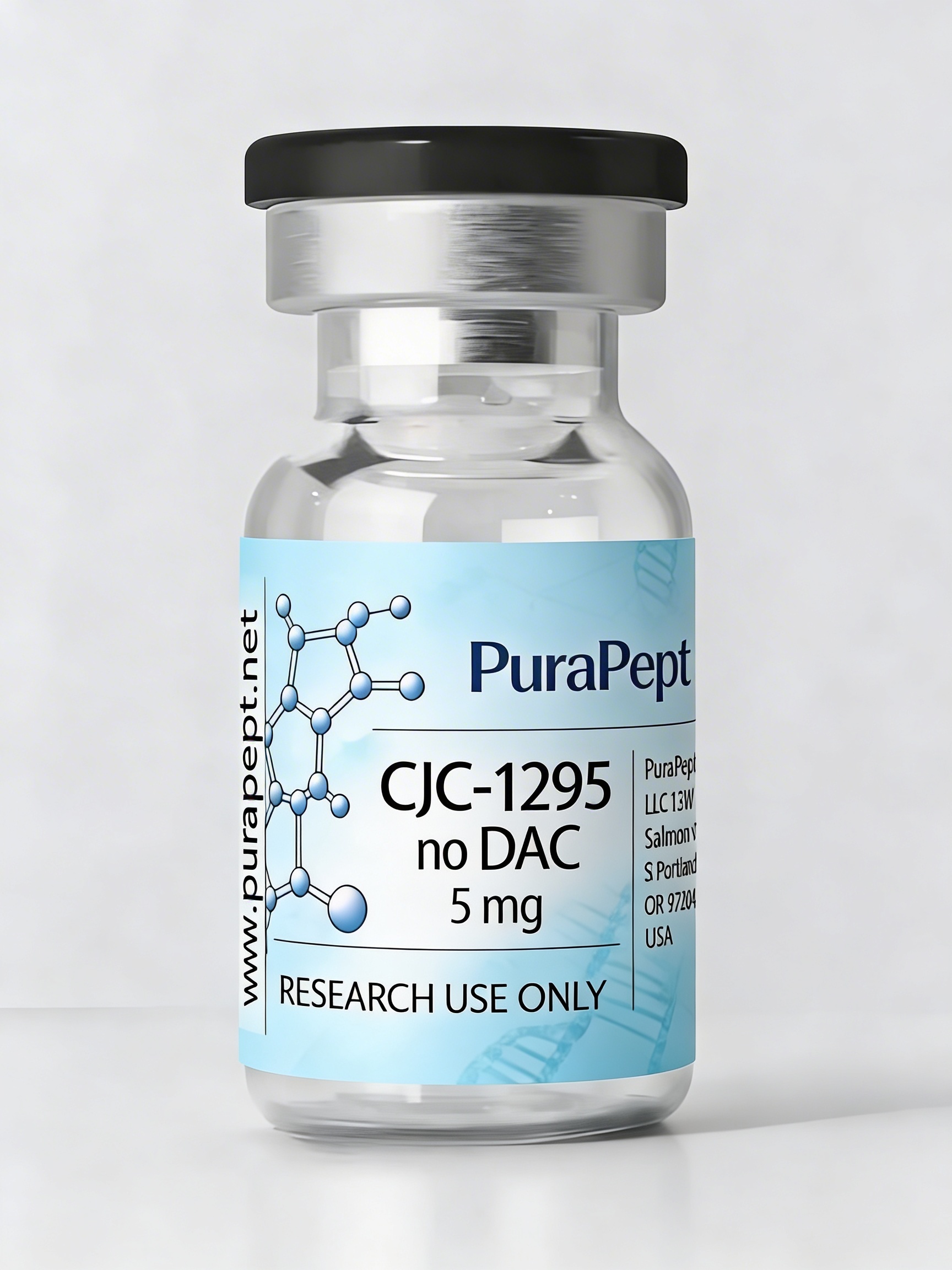
The compound as supplied by the manufacturer: CJC-1295 no DAC 10 mg · CJC-1295 no DAC 5 mg
What we supply
The CJC-1295 no-DAC preparations above, as supplied by the manufacturer, tracked, from inside the EU.
Research use only. This page summarises published studies for research reference. It is not medical advice, not a protocol, and not a suggestion for human use. Nothing we supply is for human or veterinary use.
References.
- Teichman SL, Neale A, et al. Prolonged stimulation of growth hormone (GH) and insulin-like growth factor I secretion by CJC-1295, a long-acting analog of GH-releasing hormone, in healthy adults. J Clin Endocrinol Metab 2006;91(3):799-805.
- Dominikowski A, Rękoś Z, et al. The emerging landscape of performance-enhancing peptides modulating GH-IGF1 axis: bridging the gap between clinical evidence and patient self-administration. Front Endocrinol (Lausanne) 2026;17:1822475.
- Villegas Meza AD, Nocek M, et al. Injectable Peptides in Sports Medicine: A Structured Narrative Review of Evidence, Safety, and Antidoping Implications. JBJS Rev 2026;14(5):e26.00027.
- Renke G, Chinellato L, et al. Therapeutic Peptides in Aesthetic, Metabolic and Endocrine Conditions: Effects, Safety, Clinical Applications, and Future Perspectives. Int J Mol Sci 2026;27(9):3890.