DSIP: the peptide named for sleep, and what it was measured doing
Isolated from rabbit blood in 1977 and named for slow-wave sleep, DSIP reduced slow-wave sleep in cats when it was actually tested. The sleep hypothesis has been described in the peer-reviewed literature as extremely poorly documented and still weak.
10 October 2026 · 4 min read
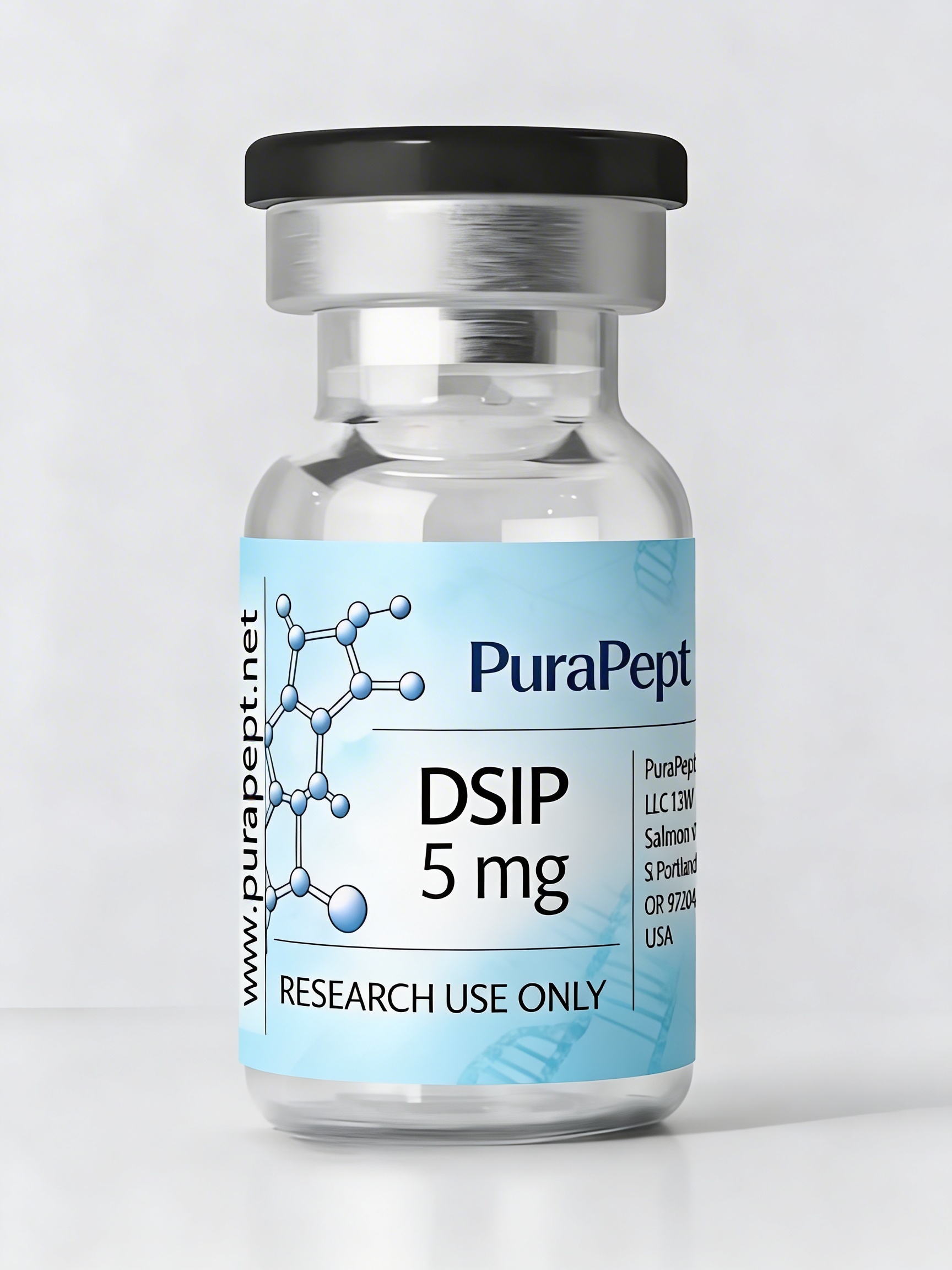 DSIP 5 mg
Most peptide names are marketing that happens to be true. This one is the exception, and the exception runs the other way: DSIP was isolated from rabbit cerebral venous blood in 1977, named for the slow-wave sleep it was associated with at the time, and then spent five decades failing to demonstrate the thing it is named after.
What the name came from
The 2006 mini-review in the Journal of Neurochemistry is the most useful paper on this compound, and its title is the summary: DSIP, a still unresolved riddle. The Basel group that isolated it in 1977 treated it as a candidate sleep-promoting factor. The review is blunt about how far that has come. The link between DSIP and sleep has never been characterised. The gene has not been isolated, the protein has not been isolated, and no receptor has been found. The hypothesis that DSIP is a sleep factor is described in the abstract as extremely poorly documented and still weak.
The same review argues that the compound on the shelf may not be the compound that matters. It proposes that a DSIP-like peptide, with a different distribution and different behaviour, is what produces the DSIP-like immunoreactivity and the biological activity that laboratory work has attributed to DSIP. The evidence offered for that is structural, and it is worth reading closely because it is not about an artificial analogue. A naturally occurring dermorphin-decapeptide structurally similar to DSIP in five of the nine positions promotes slow-wave sleep in rabbits, and that peptide’s optical isomer suppresses it. The review’s own emphasis is the parenthesis it puts on a separate line: artificial DSIP structural analogues promote slow-wave sleep in rabbits and rats, but DSIP itself does not.
Nobody has published a human trial of DSIP that measures sleep. A 2026 review of therapeutic peptides in orthopaedics lists it among the recovery-enhancing agents that target circadian and mitochondrial regulators, and then says the same thing in one clause about the whole class: although the preclinical studies are promising, there is a current lack of clinical trials.
The one experiment that cut against the name
This is the part worth reading twice, because it is the compound being tested rather than discussed. In 1985 a research group gave cats 30 nanomoles per kilogram of DSIP intraperitoneally and recorded EEG, EMG and EOG for ten hours afterwards, which is the right way to score a hypnotic.
DSIP reduced the amount of sleep. Specifically, it reduced light slow-wave sleep and it reduced REM sleep, and it increased REM sleep latency. The authors’ reading was that in cats with a sleep surplus, DSIP increases wakefulness at the cost of light slow-wave sleep, and that it also has a specific REM-suppressing effect.
A cat study is not a clinical trial, and the compound has never been given to a person and scored against a polysomnogram. But it is the direct test of the founding claim, it ran in the right species for a sleep question, and the direction of the result is the opposite of the name.
The repair claim, and where it comes from
DSIP also shows up in stroke and tissue-repair work, and that literature is newer. In a 2021 paper in Molecules, SD rats with a focal stroke from middle cerebral artery occlusion received intranasal DSIP for eight days, with behavioural testing at 1, 3, 7, 14 and 21 days. Brain infarct volume was smaller than in vehicle-treated animals, and the difference was not significant. Motor performance on the rotarod did recover significantly.
So: no significant infarct effect, a significant behavioural effect, in rats, with a nanoscale formulation nobody has reproduced in a person. A 2026 review lists DSIP alongside epithalon and pinealon as a recovery-enhancing agent acting on circadian and mitochondrial regulators. In that same review BPC-157, TB-500 and GHK-Cu sit in a different list, the wound-healing peptides, so DSIP’s placement rests on the preclinical work rather than on anything measured.
Some of the language that surrounds the compound comes from a surprising place. A 2014 paper in Materials Science and Engineering C is about trapping DSIP in charged porous polymers so that it can be released in saline. It describes the compound as having abilities in burn treatment and neuronal protection. Those are properties of a formulation study, and they are the sentences that travel furthest.
What the data do not show
They do not show that DSIP puts anyone to sleep, because no human trial of it exists, and the one direct animal test of the hypnotic claim moved in the opposite direction. They do not show a human effective dose, a human pharmacokinetic profile or a human safety profile, because none has been published. They do not show a confirmed mechanism: the compound has no isolated gene, protein or receptor, and the 2006 review argues the active entity may be a different peptide altogether.
They do not show stroke recovery in a person. The 2021 rat study is the strongest recent result and its infarct effect was not statistically significant. And they do not show neuroprotection or burn treatment, because the clearest published source for those words is a biomaterials paper about how to keep a peptide in a polymer matrix.
They also do not show that DSIP is inert. As with any compound this poorly characterised, the correct reading is an empty human record, not a demonstrated absence of activity. The 1977 isolation is real, the structure is real, the material on the shelf is that structure. What is missing is any measurement of it in a person, in either direction.
Where this sits on the shelf
The compound as supplied by the manufacturer: DSIP.
What we supply
The DSIP preparation above, as supplied by the manufacturer, tracked, from inside the EU.
Research use only. This page summarises published studies for research reference. It is not medical advice, not a protocol, and not a suggestion for human use. Nothing we supply is for human or veterinary use.
References.
- Kovalzon VM, Strekalova TV. Delta sleep-inducing peptide (DSIP): a still unresolved riddle. J Neurochem 2006;97(2):303-309.
- Sommerfelt L. Reduced sleep in cats after intraperitoneal injection of delta-sleep-inducing peptide (DSIP). Neurosci Lett 1985;58(1):73-77.
- Tukhovskaya EA, et al. Delta Sleep-Inducing Peptide Recovers Motor Function in SD Rats after Focal Stroke. Molecules 2021;26(17):5173.
- Sukhanova TV, et al. Delta-sleep inducing peptide entrapment in the charged macroporous matrices. Mater Sci Eng C Mater Biol Appl 2014;42:461-465.
- Pollard BJ, Pomfrett CJ. Delta sleep-inducing peptide. Eur J Anaesthesiol 2001;18(7):419-422.
- Rahman OF, Lee SJ, Seeds WA. Therapeutic Peptides in Orthopaedics: Applications, Challenges, and Future Directions. J Am Acad Orthop Surg Glob Res Rev 2026;10(1):e25.00236.