GHRP-6 and ipamorelin: the human record counted
Counting the human records for these two growth-hormone secretagogues gives one retrospective chart review of GHRP-6 in men on testosterone and one phase 2 trial of ipamorelin that missed its primary endpoint.
5 October 2026 · 6 min read
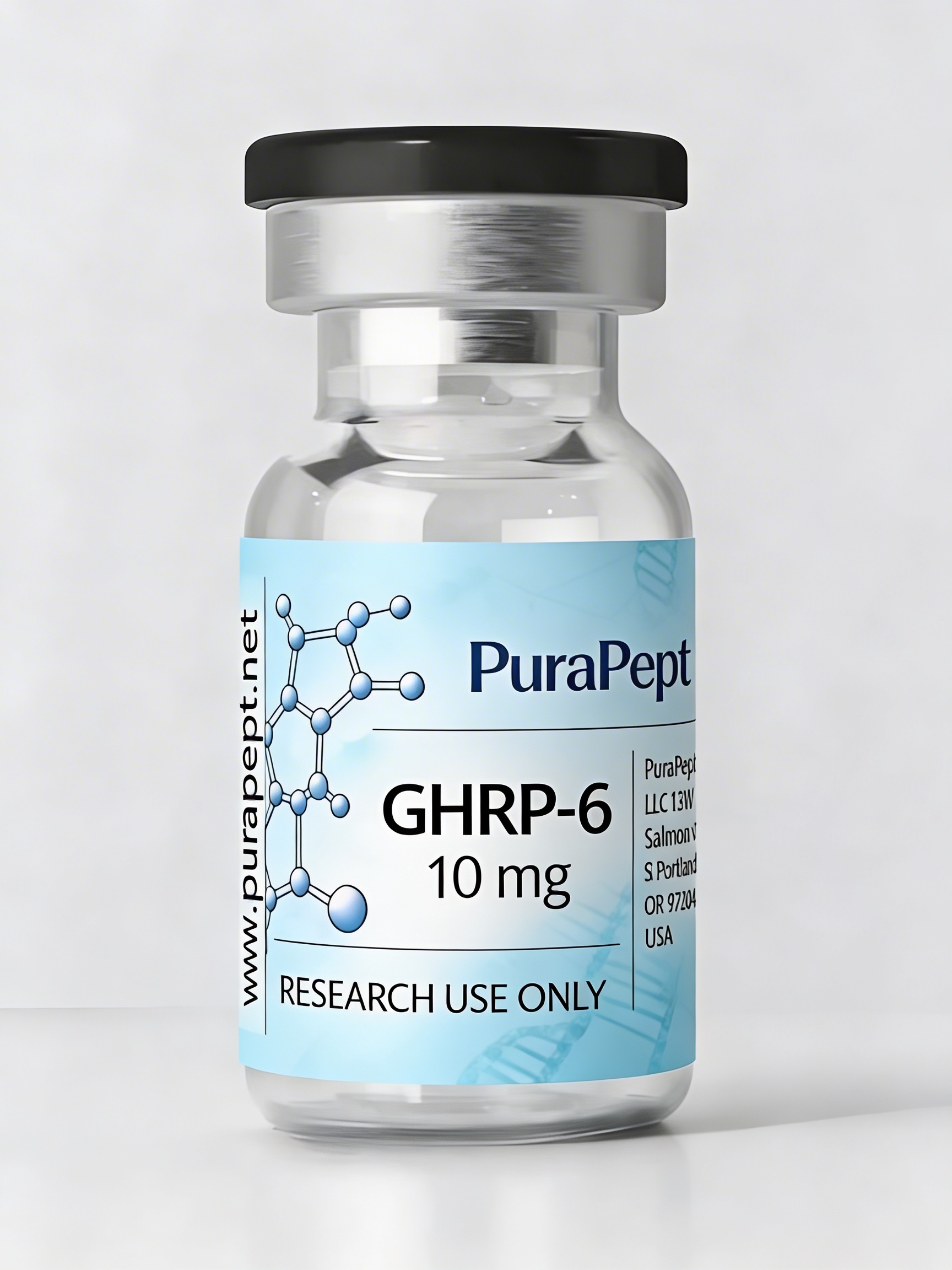 GHRP-6 10 mg
Both compounds on this page — GHRP-6 and ipamorelin — are sold on one shared claim: raise growth hormone, and the rest follows. The interesting part is not that the evidence is thin. It is where it lives.
What the index holds
"GHRP-6"[tiab] returns 638 records on PubMed and ipamorelin[tiab] returns 50 (re-run 5 October 2026, every term tagged to title and abstract). Filtering each by (randomized[tiab] OR randomised[tiab] OR trial[tiab] OR patients[tiab] OR placebo[tiab] OR “healthy volunteers”[tiab]) leaves 113 and 10. Both queries can be pasted back into PubMed to check; the counts move as records are added.
GHRP-6 in people is a diagnostic reagent
The consistent finding across the human literature is that GHRP-6 ended up as a stimulant in a GH stimulation test. In children of short stature and adults with diagnosed growth hormone deficiency, the GH response to GHRP-6 was lower than in normal children, but with “a considerable degree of overlap” between the two groups on an individual basis — the paper’s own words (Pombo et al., PMID 8887178). A companion review put it more plainly: there is “a large variability in the stimulatory action of GHRH contrasted with the reproducibility of action of GHRPs” (Popovic et al., PMID 8887173).
The metabolic context matters. In 16 women with polycystic ovary syndrome and 22 controls, GHRP-6 90 µg intravenously produced no difference in GH peak or area under the curve between obese and non-obese PCOS groups, while GHRH alone did separate them (Micić et al., PMID 8959075). Current guidance treats the insulin tolerance test as the reference standard, with a GH peak below 3 µg/l defining severe deficiency, and names GHRH-plus-arginine or GHRP-6 as reliable alternatives with defined cut-offs that are independent of age and gender — while warning the response is negatively correlated with body mass index, so cut-offs must match lean, overweight and obese subjects (Corneli et al., PMID 17429591; Abs, PMID 12670294).
So the human use of GHRP-6 the literature supports is measuring a pituitary reserve — not what the product page implies.
Two human records where GHRP-6 was given for its hormone effect
One is a retrospective chart review. Of 105 men on testosterone prescribed 100 µg of GHRP-6, GHRP-2 or sermorelin three times daily, only 14 met strict inclusion criteria. Mean age was 33.2 (SD 2.9) years; treatment ran 134 (SD 88) days on average; IGF-1 rose from 159.5 (SD 26.7) to 239.0 (SD 54.6) ng/mL (p < .0001). Three of the 14 were on an aromatase inhibitor or tamoxifen beforehand and four more received one during treatment. The endpoint evaluated was a serum marker (Sigalos et al., PMID 28830317). Lean mass and fat loss are named in that paper as what the men were after; they are not the outcomes it reports.
The second is an acute metabolic challenge. Ten healthy non-obese men were studied under two conditions, three days of fasting and the fed state, five men each. In the fed arm, GHRP-6 1 µg/kg under GH-receptor blockade by pegvisomant caused an increase in serum insulin — the abstract prints 10.3 (SD 2.1) against 81.3 (SD 25.4) mU/L, p < 0.001 — and glucose, 4.2 (SD 0.3) against 6.0 (SD 0.6) mmol/L, p < 0.05. The same infusion changed nothing without the blockade or during fasting (Muller et al., PMID 11158013). The authors’ reading of their data is the part worth keeping: GHRP-6-mediated metabolic changes “are characterized by an increase in fat mass and a decrease in lean body mass.”
Why ipamorelin exists at all
Ipamorelin was built to fix a problem with its class. In conscious swine, GHRP-2 and GHRP-6 both raised plasma ACTH and cortisol; ipamorelin did not, and that separation held even at more than 200-fold the ED50 for GH release. None of the secretagogues tested moved FSH, LH, prolactin or TSH. The authors called it the first GHRP-receptor agonist with GH-release selectivity similar to GHRH (Raun et al., PMID 9849822). The pharmacokinetics were worked out in rats: ipamorelin’s systemic clearance ran 5-fold lower than GHRP-6’s, went mainly to urine where GHRP-6 went to bile, and gave roughly 20 % bioavailability intranasally against about 50 % for GHRP-2 (Johansen et al., PMID 9879640).
The two human ipamorelin records
In healthy male volunteers, ipamorelin reliably moved growth hormone. An escalating design with eight subjects per level and five infusion rates gave a terminal half-life of 2 hours, clearance of 0.078 L/h/kg, a GH peak at 0.67 hours at every level, and a half-maximal concentration of 214 nmol/L. Inter-individual variability was larger for the hormone response than for the pharmacokinetics (Gobburu et al., PMID 10496658) — and, on its own, an outcome.
The therapeutic trial came later and did not succeed. In a multicentre, double-blind, placebo-controlled phase 2 study after bowel resection (NCT00672074), 117 patients were enrolled and 114 formed the safety and modified intent-to-treat populations. Median time from first administration to tolerance of a solid meal was 25.3 hours on ipamorelin and 32.6 hours on placebo, p = 0.15. Treatment-emergent adverse events were 87.5 % and 94.8 % respectively. The authors’ conclusion: well tolerated, with “no significant differences between ipamorelin and placebo in the key and secondary efficacy analyses” (Beck et al., PMID 25331030).
The animal work is substantial, and it runs the other way on body fat
In adult female rats given methylprednisolone for three months, adding ipamorelin significantly increased maximum tetanic tension of the calf muscle and raised the periosteal bone formation rate four-fold against glucocorticoid alone (Andersen et al., PMID 11735244) — in rats, under a steroid-damage model. GHRP-6 has its own protective effect in rats given doxorubicin, preserving left-ventricular systolic function (Berlanga-Acosta et al., PMID 38873418), and pituitary cells in vitro release GH in response to GHRP-6 without the rise in intracellular cAMP that GHRP-2 produces (Wu et al., PMID 8699133).
The fat data point the other way. In mice, two weeks of twice-daily secretagogue treatment with ipamorelin or GHRP-6 increased relative body fat on dual-energy X-ray absorptiometry, and raised food intake and leptin, while growth hormone itself reduced relative fat mass in the deficient animals only (Lall et al., PMID 11162489). In diabetic rats, insulin improved hyperglycaemia and GHRP-6 did not; together they increased weight gain and visceral fat (Granado et al., PMID 20219977). A secretagogue is a hormone-axis drug, not a fat-loss drug.
One more trap: [D-Lys3]-GHRP-6 is not GHRP-6. It is a selective receptor antagonist, widely employed as a blocking tool, and the muscle-autophagy findings attached to it (Yu et al., PMID 25450862) say nothing about the agonist.
What a proper absence search returns
Searched 5 October 2026, every term tagged. "GHRP-6"[tiab] AND ("body composition"[tiab] OR "lean mass"[tiab] OR "fat mass"[tiab]) returns 8: two reviews (PMIDs 32257855, 10193871), four rodent or mouse experiments, one of them on the antagonist rather than the agonist (PMIDs 20219977, 15191362, 11162489, 28903914), and two human studies that report no body composition at all — an acute metabolic challenge in ten men, five of them the fed arm (PMID 11158013) and an oral-priming GH-response study in seven women aged 65–82 (PMID 7952160). ipamorelin[tiab] AND (muscle[tiab] OR strength[tiab] OR "body composition"[tiab] OR lean[tiab]) returns 7: five reviews and primers (PMIDs 42578445, 42160466, 41880199, 41476424, 32257855) and two rat experiments (PMIDs 27186127, 11735244). Both also appear in a validated anti-doping assay covering nine growth-hormone-releasing peptides, with detection limits of 2–10 pg/mL (Thomas et al., PMID 22901302).
What the data do not show
Nothing here shows GHRP-6 or ipamorelin increasing lean mass in a person, because no indexed human study measured that. This page does not carry the rat tetanic-tension result across to people, does not treat a raised IGF-1 as a body-composition outcome, and does not present a missed primary endpoint as a near miss — 25.3 against 32.6 hours at p = 0.15 is a null result in 114 patients.
What the record does support is narrower: both compounds are credible laboratory tools, GHRP-6 with an established place in GH testing and ipamorelin with a documented selectivity for GH release over cortisol. A 2020 review of secretagogues in hypogonadal men calls the clinical data a “paucity” that limits understanding of their role (Sinha et al., PMID 32257855). The body-composition literature around them is mouse and rat work, and where it has been measured in humans it has not pointed the way the marketing does.
Sourcing note
Internal links for the SEO Specialist to confirm: the growth hormone in older adults page and the sleep and GH axis page.
Research use only. This page describes published human and animal literature. It is not medical advice, not a treatment recommendation, and not a suggestion for human use. Nothing we supply is for human or veterinary use.
References.
- Pombo M, Leal-Cerro A, Barreiro J, Peñalva A, et al. Growth hormone releasing hexapeptide-6 (GHRP-6) test in the diagnosis of GH-deficiency. J Pediatr Endocrinol Metab 1996;9 Suppl 3:333-8. PubMed record (PMID 8887178).
- Popovic V, Micic D, Damjanovic S, Djurovic M, et al. Evaluation of pituitary GH reserve with GHRP-6. J Pediatr Endocrinol Metab 1996;9 Suppl 3:289-98. PubMed record (PMID 8887173).
- Micić D, Kendereski A, Popović V, Sumarac M, et al. Growth hormone response to GHRH, GHRP-6 and GHRH + GHRP-6 in patients with polycystic ovary syndrome. Clin Endocrinol (Oxf) 1996;45(4):385-90. PubMed record (PMID 8959075).
- Corneli G, Gasco V, Prodam F, Grottoli S, et al. Growth hormone levels in the diagnosis of growth hormone deficiency in adulthood. Pituitary 2007;10(2):141-9. PubMed record (PMID 17429591).
- Abs R. Update on the diagnosis of GH deficiency in adults. Eur J Endocrinol 2003;148 Suppl 2:S3-8. PubMed record (PMID 12670294).
- Sigalos JT, Pastuszak AW, Allison A, Ohlander SJ, et al. Growth Hormone Secretagogue Treatment in Hypogonadal Men Raises Serum Insulin-Like Growth Factor-1 Levels. Am J Mens Health 2017;11(6):1752-1757. PubMed record (PMID 28830317).
- Muller AF, Janssen JA, Hofland LJ, Lamberts SW, et al. Blockade of the growth hormone (GH) receptor unmasks rapid GH-releasing peptide-6-mediated tissue-specific insulin resistance. J Clin Endocrinol Metab 2001;86(2):590-3. PubMed record (PMID 11158013).
- Raun K, Hansen BS, Johansen NL, Thøgersen H, et al. Ipamorelin, the first selective growth hormone secretagogue. Eur J Endocrinol 1998;139(5):552-61. PubMed record (PMID 9849822).
- Johansen PB, Hansen KT, Andersen JV, Johansen NL. Pharmacokinetic evaluation of ipamorelin and other peptidyl growth hormone secretagogues with emphasis on nasal absorption. Xenobiotica 1998;28(11):1083-92. PubMed record (PMID 9879640).
- Gobburu JV, Agersø H, Jusko WJ, Ynddal L. Pharmacokinetic-pharmacodynamic modeling of ipamorelin, a growth hormone releasing peptide, in human volunteers. Pharm Res 1999;16(9):1412-6. PubMed record (PMID 10496658).
- Beck DE, Sweeney WB, McCarter MD, Beart R, et al. Prospective, randomized, controlled, proof-of-concept study of the Ghrelin mimetic ipamorelin for the management of postoperative ileus in bowel resection patients. Int J Colorectal Dis 2014;29(12):1527-34. PubMed record (PMID 25331030).
- Andersen NB, Malmlöf K, Johansen PB. The growth hormone secretagogue ipamorelin counteracts glucocorticoid-induced decrease in bone formation of adult rats. Growth Horm IGF Res 2001;11(5):266-72. PubMed record (PMID 11735244).
- Greenwood-Van Meerveld B, Tyler K, Mohammadi E. Efficacy of ipamorelin, a ghrelin mimetic, on gastric dysmotility in a rodent model of postoperative ileus. J Exp Pharmacol 2012;4:149-55. PubMed record (PMID 27186127).
- Lall S, Tung LY, Ohlsson C, Jansson JO, et al. Growth hormone (GH)-independent stimulation of adiposity by GH secretagogues. Biochem Biophys Res Commun 2001;280(1):132-8. PubMed record (PMID 11162489).
- Granado M, García-Cáceres C, Frago LM, Argente J, et al. The positive effects of growth hormone-releasing peptide-6 on weight gain and fat mass accrual depend on the insulin/glucose status. Endocrinology 2010;151(5):2008-18. PubMed record (PMID 20219977).
- Berlanga-Acosta J, Cibrian D, Valiente-Mustelier J, Suárez-Alba J, et al. Growth hormone releasing peptide-6 (GHRP-6) prevents doxorubicin-induced myocardial and extra-myocardial damages by activating prosurvival mechanisms. Front Pharmacol 2024;15:1402138. PubMed record (PMID 38873418).
- Yu AP, Pei XM, Sin TK, Yip SP, et al. [D-Lys3]-GHRP-6 exhibits pro-autophagic effects on skeletal muscle. Mol Cell Endocrinol 2015;401:155-64. PubMed record (PMID 25450862).
- Wu D, Chen C, Zhang J, Bowers CY, et al. The effects of GH-releasing peptide-6 (GHRP-6) and GHRP-2 on intracellular adenosine 3',5'-monophosphate (cAMP) levels and GH secretion in ovine and rat somatotrophs. J Endocrinol 1996;148(2):197-205. PubMed record (PMID 8699133).
- Thomas A, Walpurgis K, Krug O, Schönzer W, et al. Determination of prohibited, small peptides in urine for sports drug testing by means of nano-liquid chromatography/benchtop quadrupole orbitrap tandem-mass spectrometry. J Chromatogr A 2012;1259:251-7. PubMed record (PMID 22901302).
- Sinha DK, Balasubramanian A, Tatem AJ, Rivera-Mirabal J, et al. Beyond the androgen receptor: the role of growth hormone secretagogues in the modern management of body composition in hypogonadal males. Transl Androl Urol 2020;9(Suppl 2):S149-S159. PubMed record (PMID 32257855).
- Scacchi M, Pincelli AI, Cavagnini F. Growth hormone in obesity. Int J Obes Relat Metab Disord 1999;23(3):260-71. PubMed record (PMID 10193871).
- Tung YL, Hewson AK, Dickson SL. Glucocorticoid-dependent stimulation of adiposity and appetite by a ghrelin mimetic in the rat. Eur J Endocrinol 2004;150(6):905-11. PubMed record (PMID 15191362).
- Mosa R, Huang L, Li H, et al. Long-term treatment with the ghrelin receptor antagonist [d-Lys3]-GHRP-6 does not improve glucose homeostasis in nonobese diabetic MKR mice. Am J Physiol Regul Integr Comp Physiol 2018;314(1):R71-R83. PubMed record (PMID 28903914).
- Ghigo E, Arvat E, Rizzi G, et al. Growth hormone-releasing activity of growth hormone-releasing peptide-6 is maintained after short-term oral pretreatment with the hexapeptide in normal aging. Eur J Endocrinol 1994;131(5):499-503. PubMed record (PMID 7952160).
- Tewari K, Liu TP, Im C, et al. Peptide Supplements and Their Therapeutic Applications in Sports Medicine. Am J Sports Med 2026, ahead of print. PubMed record (PMID 42578445).
- Villegas Meza AD, Nocek M, Mitchell BC, et al. Injectable Peptides in Sports Medicine: A Structured Narrative Review of Evidence, Safety, and Antidoping Implications. JBJS Rev 2026;14(5):e26.00027. PubMed record (PMID 42160466).
- Coutinho LFD, De Oliveira Neves LF, Camilo RP. A new era of doping? Use of peptide and peptide-analog drugs in recreational and professional sport and bodybuilding: a critical review. J Sports Med Phys Fitness 2026;66(7):880-885. PubMed record (PMID 41880199).
- Mayfield CK, Bolia IK, Feingold CL, et al. Injectable Peptide Therapy: A Primer for Orthopaedic and Sports Medicine Physicians. Am J Sports Med 2026;54(1):223-229. PubMed record (PMID 41476424).