Epithalon: the human record counted, and where it actually stops
Eight indexed papers. The telomerase and telomere findings are human fetal fibroblasts in a dish, not people. The lifespan findings are mice and fruit flies. The one human observation on this page is improved visual function in patients with pigmental retinal degeneration, reported inside a 2002 review. A 2026 orthopaedics review lists epithalon among recovery-enhancing peptides and states in the same breath that there is a current lack of clinical trials.
21 October 2026 · 5 min read
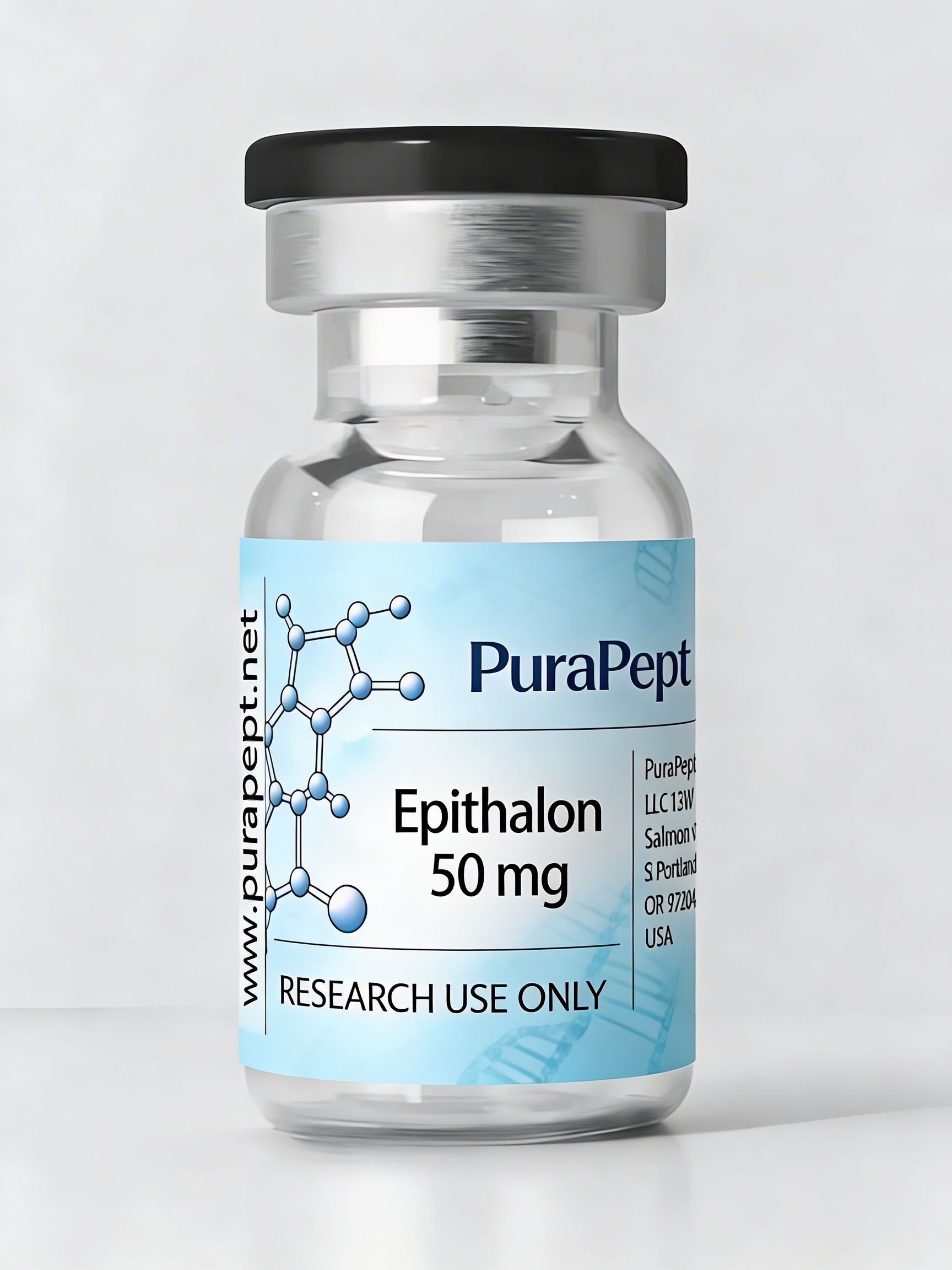 Epithalon 50 mg
Epithalon is a tetrapeptide, Ala-Glu-Asp-Gly. It was designed on the back of the amino acid composition of Epithalamin, an extract of bovine pineal gland, and it is sold on the strength of what is described as its geroprotective action. This page counts what has been measured, in what, and in whom.
The two cell-culture papers
The 2003 paper in Bulletin of Experimental Biology and Medicine is the one usually quoted. Epithalon was added to telomerase-negative human fetal fibroblast culture, and it induced expression of the catalytic subunit of telomerase, enzymatic activity of telomerase, and telomere elongation. The authors interpret this as reactivation of the telomerase gene in somatic cells and as indicating the possibility of prolonging the lifespan of a cell population and of the whole organism.
The “human” in that sentence is the cell. The cells came from a fetus, they were cultured, they were dosed in a dish, and the endpoints were expression, enzyme activity and telomere length.
The 2004 companion paper pushed the same culture further and produced the most concrete number in the whole epithalon literature. Primary pulmonary fibroblasts derived from a 24-week fetus lost proliferative potential at the 34th passage, and their mean telomere size was appreciably lower than during early passages, cited as passage 10. Adding epithalon to aging cells induced elongation of their telomeres to a size comparable to the early passages. The treated cells with elongated telomeres made 10 extra divisions, reaching 44 passages, compared with the control, and continued dividing. The authors conclude that epithalon prolonged the vital cycle of normal human cells by overcoming the Hayflick limit.
Ten extra divisions in a dish. That is the finding, and it is a real finding.
The animal papers
A 2003 paper from the same group reports the retinoprotective effect in Campbell rats of various ages, with epithalon given to the offspring during postnatal ontogeny and to mothers before mating and during pregnancy. After treatment, the morphological structure and functional activity of the retina were preserved for a longer period than in control rats, described as 2 times longer, and longer by 30% than in animals that received the peptide only during postnatal ontogeny.
A 2004 paper looks at thymocytes. Vilon stimulated, and epithalon suppressed, the expression of argyrophilic proteins in the nucleolar organizer regions of thymocytes and epithelial cells, which the authors relate to the formation, assembly and transport of ribosomes into the cytoplasm and thus to the intensity of protein synthesis in those cells. Vilon also showed a direct mitogenic effect, promoting thymocyte transformation into proliferating blast cells.
The one review that carries the human claims
The 2002 Neuro Endocrinology Letters review, running from page 11 to page 144 of volume 23, Supplement 3, is where the lifespan claims live. Within it, epithalon is reported to increase the lifespan of mice and fruit flies, and to restore the circadian rhythms of melatonin and cortisol production in old rhesus monkeys. The same passage reports that epithalon prolongs the functional integrity of the eye retina in Campbell rats with hereditary retinitis pigmentosa and improves visual functions in patients with pigmental retinal degeneration.
Set the two findings side by side. In monkeys the measured endpoint is a hormone rhythm. In people the measured endpoint is vision. There is no report here of lifespan in human beings, no report of a clinical trial with a control arm, and no report of any outcome other than vision in the one patient group named.
A 2024 review in Advances in Gerontology from the Saint-Petersburg Institute of Bioregulation and Gerontology adds the molecular layer on the human side. The polypeptide complex of the epiphysis and the AEDG peptide revealed an effect on human circadian rhythms and an increase in melatonin secretion in elderly people and in those with reduced melatonin-producing function. The proposed mechanism is regulation of the expression of genes involved in circadian rhythms — Cry2, AANAT, ASMT and CLOCK — reduction in the synthesis of proteins promoting apoptosis — p16, p21 and p53 — and regulation of markers of functional cell activity — TERF-1, prohibitin, SIRT1 and SIRT6. The same review notes that buccal epithelium is used as the diagnostic marker in this line of work, and calls the prioritisation of Russian scientists in studying it a point on which much of the world has since followed.
What the two modern reviews add
The 2025 review in the International Journal of Molecular Sciences describes the last 25 years of work as extensive and conducted in vitro, in vivo and in silico, and reports significant geroprotective and neuroendocrine effects arising from antioxidant, neuroprotective and antimutagenic mechanisms. It also states the limits plainly: it remains uncertain whether the mechanisms it lists are the sole mechanisms, and the quantity of physico-chemical and structural investigation of this peptide remains quite limited.
The 2026 review in the Journal of the American Academy of Orthopaedic Surgeons Global Research and Reviews lists epithalon, alongside delta sleep-inducing peptide and pinealon, among agents described as targeting circadian and mitochondrial regulators. It then says the thing that settles the question of where this compound sits today: although preclinical studies are promising, there is a current lack of clinical trials.
A note on who measured it
Five of the eight records here share an author, and the 2024 buccal-epithelium review names the Saint-Petersburg Institute of Bioregulation and Gerontology, which is the same group behind the cell-culture and monkey work. That is not a criticism of the science; it is a fact a reader needs when weighing a literature in which the same laboratory produced the mechanism, the cell model, the animal model and the human observation. An independent replication is the missing piece, and the 2026 review’s own sentence says as much.
What the data do not show
They do not show that epithalon lengthens a human life. Lifespan data are mice and fruit flies; the human work is cultured fetal cells and one reported patient group.
They do not show a clinical trial. The most recent review on this page, from January 2026, states that there is a current lack of clinical trials.
They do not show ten extra years of division in a person. They show ten extra passages in a fibroblast culture from a 24-week fetus.
They do not show a mechanism that is settled. The 2025 review says the mechanisms it lists may not be the whole set, and that physico-chemical and structural study of the peptide is still limited.
Where this sits on the shelf
The compound as supplied by the manufacturer: Epithalon 50 mg
What we supply
The Epithalon preparation above, as supplied by the manufacturer, tracked, from inside the EU.
Research use only. This page summarises published studies for research reference. It is not medical advice, not a treatment, and not a suggestion for human use. Nothing we supply is for human or veterinary use.
References.
- Araj SK, Brzezik J, Madra-Gackowska K, et al. Overview of Epitalon-Highly Bioactive Pineal Tetrapeptide with Promising Properties. Int J Mol Sci 2025;26(6):2691.
- Khavinson VKh, Bondarev IE, Butyugov AA, et al. Epithalon peptide induces telomerase activity and telomere elongation in human somatic cells. Bull Exp Biol Med 2003;135(6):590-2.
- Khavinson VKh, Bondarev IE, Butyugov AA, et al. Peptide promotes overcoming of the division limit in human somatic cell. Bull Exp Biol Med 2004;137(5):503-6.
- Khavinson VKh. Peptides and Ageing. Neuro Endocrinol Lett 2002;23 Suppl 3:11-144.
- Khavinson VKh, Razumovsky MI, Trofimova SV, et al. Retinoprotective effect of Epithalon in campbell rats of various ages. Bull Exp Biol Med 2003;135(5):495-8.
- Raikhlin NT, Bukaeva IA, Smirnova EA, et al. Expression of argyrophilic proteins in the nucleolar organizer regions of human thymocytes and thymic epitheliocytes under conditions of coculturing with vilon and epithalon peptides. Bull Exp Biol Med 2004;137(6):588-91.
- Ivko OM, Trofimova SV, Trofimov AV, et al. Peptidergic regulation of expression of cellular aging marker proteins in buccal epithelium. Adv Gerontol 2024;37(5):516-524.
- Rahman OF, Lee SJ, Seeds WA, et al. Therapeutic Peptides in Orthopaedics: Applications, Challenges, and Future Directions. J Am Acad Orthop Surg Glob Res Rev 2026;10(1):e24.