Gonadorelin: the pulse, not the level
GnRH is the signal the reproductive axis runs on, and continuous exposure turns it off while pulsatile exposure turns it on. Four papers on the down-regulation mechanism, the flare-up, the antagonist comparison, and what a native decapeptide in a vial can and cannot tell you.
13 October 2026 · 4 min read
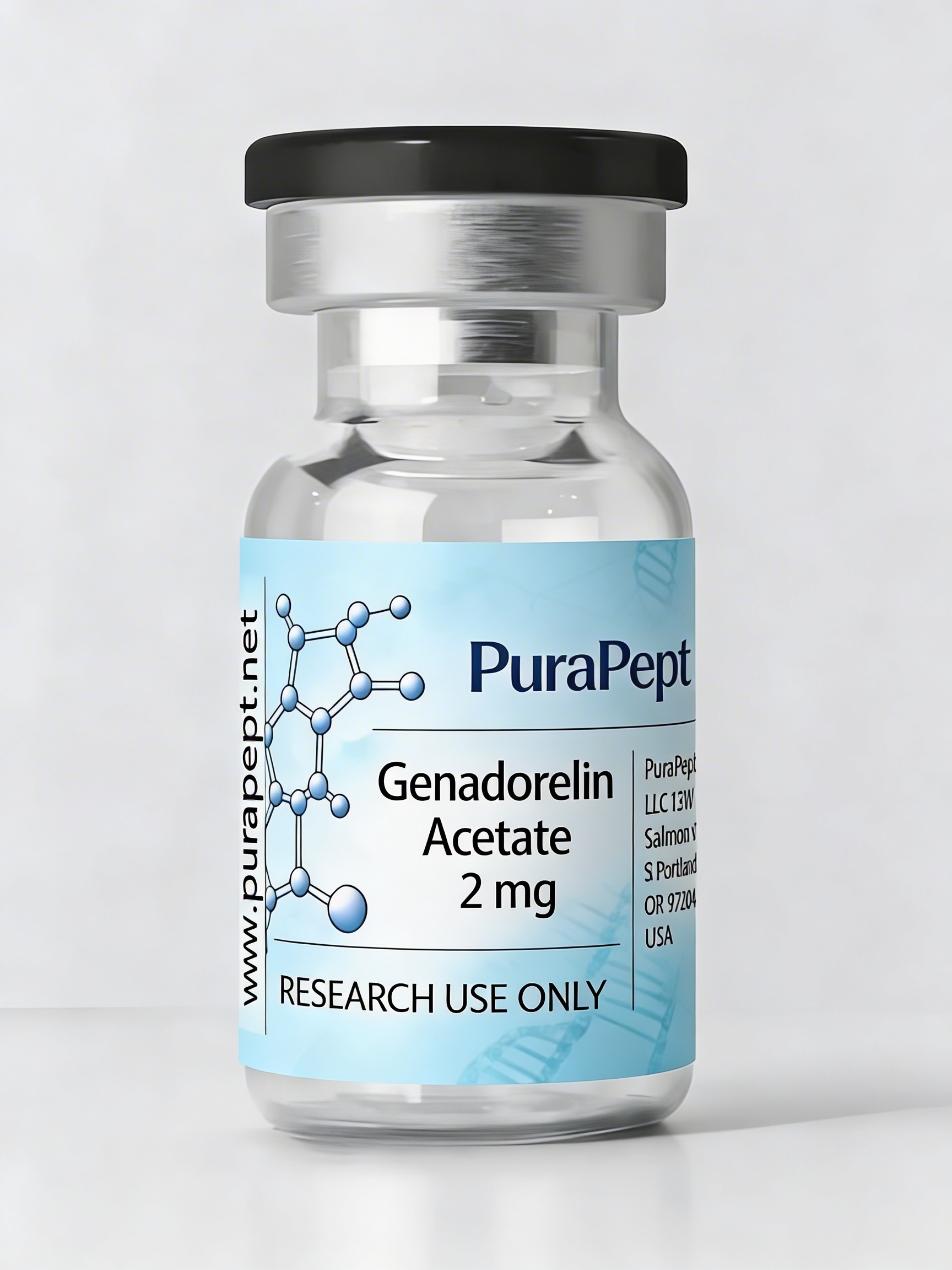 Gonadorelin Acetate 2 mg
Gonadorelin is the native hypothalamic decapeptide — the same molecule, chemically, as the GnRH agonists and antagonists that sit in fertility programmes. It is also the molecule that sets the rule the rest of this category follows, and the rule is counter-intuitive enough that it deserves its own page: the signal that starts the reproductive axis switches that axis off if you keep giving it.
The paradox, stated by the literature
The 2005 Archives of Gynecology and Obstetrics review puts the established mechanism plainly: suppression of sex steroid production in a variety of clinical conditions is based on desensitisation and down-regulation of pituitary GnRH receptors by agonistic GnRH analogues, resulting in blockage of gonadotropin release from the anterior pituitary. GnRH antagonists work differently — they compete with endogenous GnRH for the pituitary binding sites — and because they have no intrinsic activity, “the characteristic initial ‘flare-up’ effect of GnRH-agonist administration is absent.”
That flare-up is the key. Give a GnRH agonist and the pituitary is stimulated before it is suppressed: LH rises, and the testosterone or oestrogen it drives rises with it, and then everything falls. That is why agonists need a lead-in period before a surgical or stimulated-cycle protocol begins, and why the antagonist route gives faster suppression — which the review says is what enables shorter treatment regimens in ovarian hyperstimulation.
The pulse requirement is described in the adolescent endocrinology literature. A 2005 review in Pediatric Endocrinology Reviews describes puberty as beginning with nocturnal pulsatile GnRH secretion that increases gradually over a four-year period and eventually occurs throughout the day, and that pulsatile GnRH secretion stimulates pituitary LH and FSH, which induces gonadal steroid secretion, ovulation and oogenesis. The same review argues that data are accumulating to support more physiological hormone regimens to induce puberty.
So: the axis needs a rhythm, not a level. That is the entire pharmacological problem, and it is why the drug class around gonadorelin has spent forty years being delivered by pumps, depot implants and timed protocols rather than by a straightforward injection.
What the down-regulation actually looks like
A 2005 paper in the Endocrine Journal is a clean head-to-head, in ovariectomised rats, of a GnRH antagonist (cetrorelix, 333 µg/kg/day) against a GnRH agonist (leuprolide depot, 333 µg/kg), looking at LH response to exogenous GnRH, pituitary LH content, LH beta subunit mRNA and GnRH receptor mRNA at 2, 5, 24, 72 hours and 7 days.
The results are asymmetric in an instructive way. The antagonist significantly decreased serum LH, the pituitary’s LH response to exogenous GnRH, and pituitary LH content; the agonist significantly increased serum LH. The antagonist also diminished the agonist-induced flare-up when the two were combined. Both reduced LH beta mRNA and GnRH receptor mRNA, but the antagonist’s reduction was significantly smaller than the agonist’s out to 72 hours. Only with prolonged treatment did the antagonist produce the same marked inhibition, and only over seven days did the combination reduce the mRNA levels as much as either alone.
The authors conclude that the mechanism by which the antagonist down-regulates pituitary receptor mRNA is similar to the agonist’s, and that the agonist’s suppression is maximal by seven days — further treatment adding nothing. This is a paper about mechanism, in rats, with no endocrine endpoint in a human on this page.
The male-fertility framing
A 1991 review in Medicinal Research Reviews on male-fertility-regulating agents gives the wider frame. The ideal male antifertility agent, it says, would inhibit spermatogenesis at the level of the Sertoli cells without affecting endogenous androgen production by the Leydig cells, which are needed for libido and potency. It notes that GnRH agonists and antagonists were being researched in combination with androgens, with some success, and that the antagonists available at the time had low activity or caused histamine-related side effects at higher doses.
The review also records that the agents in this field generally required a new route, such as a long-acting implant, to overcome the need for daily injections. That is a thirty-five-year-old observation about delivery, and it still describes the problem.
What the data do not show
They do not show a human outcome for gonadorelin itself. Every mechanism paper cited here is in rats, and the human papers are reviews of agonist and antagonist classes in fertility programmes. The native decapeptide is not the compound any of the four studies administered.
They do not show that a prepared vial reproduces a pulse. The evidence base on this page describes an axis that requires pulsatile secretion, depot formulations that create a deliberate and sustained signal, and a per-second mismatch between what the physiology does and what any injection schedule can do. A 2005 review calling for “more physiological hormone regimens” is a statement about how far the field was still from the physiology, not a description of a routine.
They do not show that more gonadorelin is better. The one result in the rat head-to-head that runs opposite to intuition is the agonist increasing serum LH. The axis is not a tap that opens; it is a feedback loop with a gain control, and pushing it harder is not the same as keeping it open.
They do not show a fertility, testosterone or reproductive-health effect on this page. No such endpoint is printed in any abstract cited here, and the honest position is that the evidence around the native peptide is dominated by class-level mechanism work in animals and clinical reviews of different molecules.
Where this sits on the shelf
The compound as supplied by the manufacturer: Gonadorelin Acetate 2 mg
What we supply
The gonadorelin preparation above, as supplied by the manufacturer, tracked, from inside the EU.
Research use only. This page summarises published studies for research reference. It is not medical advice, not a protocol, and not a suggestion for human use. Nothing we supply is for human or veterinary use.
References.
- Murase M, Uemura T, et al. GnRH antagonist-induced down-regulation of the mRNA expression of pituitary receptors: comparisons with GnRH agonist effects. Endocr J 2005;52(1):131-137.
- Griesinger G, Felberbaum R, Diedrich K. GnRH-antagonists in reproductive medicine. Arch Gynecol Obstet 2005;273(2):71-78.
- Rubin K. Hypogonadism in adolescent females: new insights and rationale supporting the use of physiologic regimens to induce puberty. Pediatr Endocrinol Rev 2005;2(4):645-652.
- Ray S, Verma P, Kumar AA. Development of male-fertility-regulating agents. Med Res Rev 1991;11(5):437-472.