HGH fragment 176-191: does not bind the GH receptor
The growth hormone C-terminal lipolytic fragment is the premise behind two claims — that you can get growth hormone's fat-loss effect without its growth effect, and without insulin resistance. The rodent papers that support both print the same thing: the fragment does not compete for the hGH receptor and does not induce cell proliferation, unlike hGH. The best-numbered study is obese Zucker rats. There is no human fat-loss trial of the fragment in the record cited here.
28 October 2026 · 3 min read
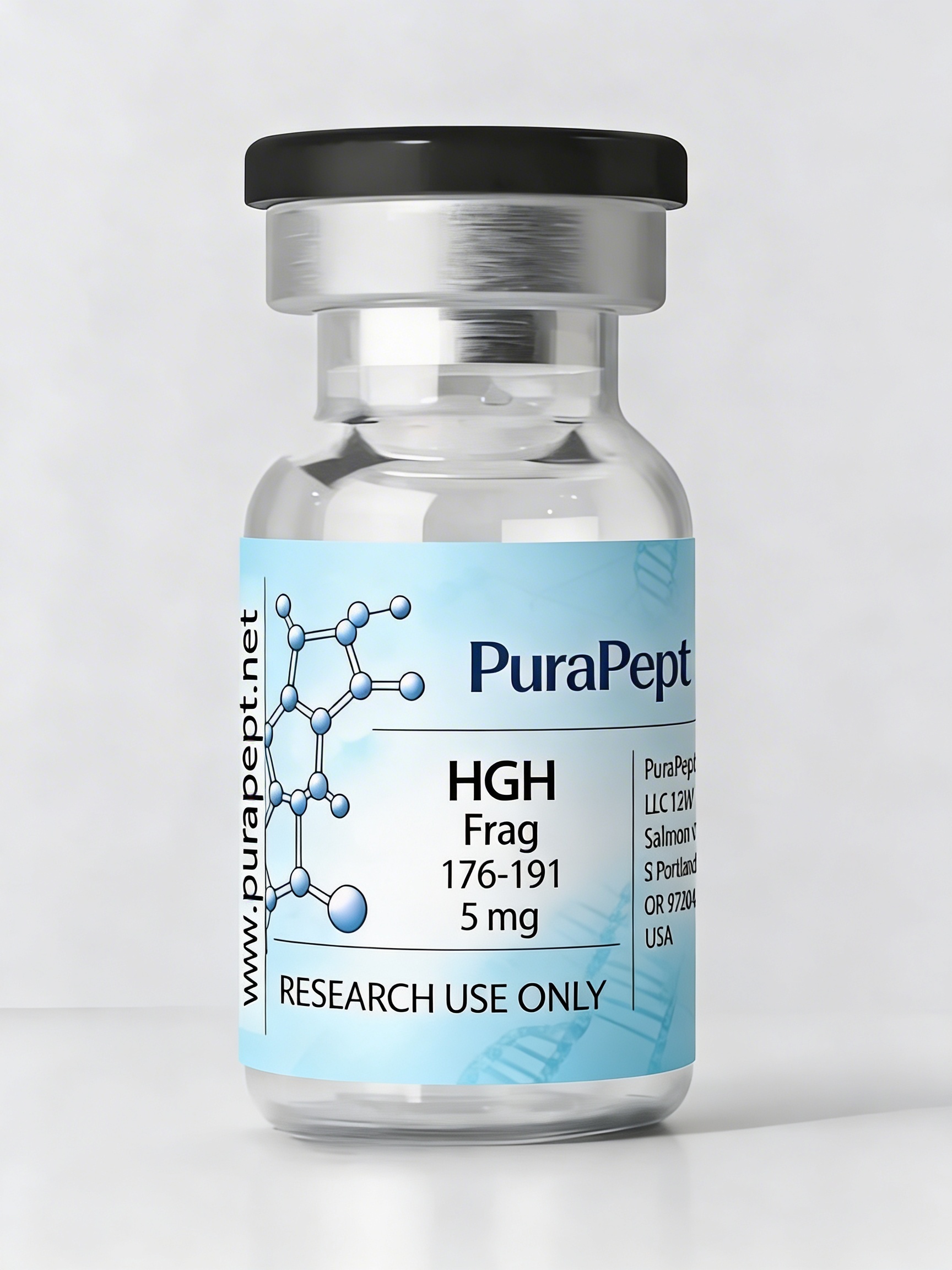 HGH Frag 5 mg
This site has a separate younglab page on AOD-9604, the patented lipolytic domain. This one is about the underlying idea — the C-terminal lipolytic fragment of human growth hormone — and the specific claim that travels with it: that you can keep growth hormone’s fat effect and drop its receptor. The two rodent papers below are the ones that test that claim, and they both answer it the same way.
The receptor-independence result
The 2001 International Journal of Obesity paper treated obese and lean mice with hGH, AOD9604 or saline for 14 days using mini-osmotic pumps, measuring body weight, caloric intake, resting energy expenditure, fat oxidation, glucose oxidation, and plasma glucose, insulin and glycerol before and after treatment. In vitro, BaF-BO3 cells transfected with the hGH receptor were used to measure 125I-hGH receptor binding and cell proliferation.
Both hGH and AOD9604 significantly reduced body weight gain in obese mice, associated with increased in vivo fat oxidation and increased plasma glycerol levels as an index of lipolysis. Unlike hGH, AOD9604 did not induce hyperglycaemia or reduce insulin secretion. And then the sentence the whole peptide is built on:
AOD9604 does not compete for the hGH receptor and nor does it induce cell proliferation, unlike hGH.
The authors read this as confirming the concept of hGH behaving as a pro-hormone, and conclude that fragments of hGH can act in a manner novel to traditional hGH-stimulated pathways.
That is a real, measured dissociation. It is also a dissociation in a mouse cell line and a mouse. The same paper’s own framing — “manner novel to traditional hGH-stimulated pathways” — is a statement about the mechanism being different, not about it being established in people.
The dose and the weight gain, in obese Zucker rats
The 2000 Hormone Research paper is the best-numbered metabolic study of the fragment. It used obese Zucker rats and a daily oral dose of AOD9604 at 500 microg/kg body weight for 19 days, which reduced the body weight gain of the animals by more than half, 15.8 ± 0.6 g against 35.6 ± 0.8 g in the control. Adipose tissue lipolytic activity increased. In contrast to chronic treatment with intact hGH, chronic AOD9604 showed no adverse effect on insulin sensitivity by euglycemic clamp.
The species is named, the route is named, the duration is named, and both directions of the result are printed: the fat effect, and the absence of the glucose effect that intact growth hormone causes. The authors conclude the analogue “may have the potential to be developed into an orally usable and safe therapeutic agent for obesity” — “may have the potential”, which is a prediction, not a result.
The knock-out mouse result
The 2001 Endocrinology paper adds the mechanism test. Fourteen days of chronic intraperitoneal hGH or AOD9604 in obese mice reduced body weight and fat and raised beta(3)-AR RNA to lean-mouse levels. In beta(3)-AR knock-out mice the weight and lipolysis change was gone, while an acute dose still raised energy expenditure and fat oxidation.
That is the paper that establishes the fragment is working through a beta(3)-adrenergic receptor pathway, and a knock-out is a stronger mechanistic result than a correlation.
What a 2026 orthopaedics review says about the clinical state
A 2026 review of therapeutic peptides in orthopaedics names the growth hormone secretagogues and writes that although preclinical studies are promising, “there is a current lack of clinical trials.” It is the shortest, most direct statement of where this compound class stands, and it is dated this year.
What the data do not show
They do not show a human fat-loss trial of the fragment. The three metabolic papers above are in obese mice and obese Zucker rats, and the 2026 review states the clinical trial situation directly.
They do not show a human dose, a human route or a human half-life. The 500 microg/kg for 19 days figure is an oral rat dose.
They do not show a receptor-independent effect in people. The “does not compete for the hGH receptor” result is from BaF-BO3 cells transfected with the receptor.
They do not show a growth effect, and that is the point of the compound rather than a limitation of the data: the mechanism papers describe a fragment that does not engage the growth hormone receptor and does not induce cell proliferation.
Where this sits on the shelf
The compound as supplied by the manufacturer: the HGH fragment 5 mg presentation
What we supply
The HGH fragment preparation above, as supplied by the manufacturer, tracked, from inside the EU.
Research use only. This page summarises published studies for research reference. It is not medical advice, not a protocol, and not a suggestion for human use. Nothing we supply is for human or veterinary use.
References.
- Heffernan MA, Thorburn AW, Fam B, Summers R, Conway-Campbell B, Waters MJ, Ng FM. Increase of fat oxidation and weight loss in obese mice caused by chronic treatment with human growth hormone or a modified C-terminal fragment. Int J Obes Relat Metab Disord. 2001 Oct;25(10):1442-9.
- Ng FM, Sun J, Sharma L, Libinaka R, Jiang WJ, Gianello R. Metabolic studies of a synthetic lipolytic domain (AOD9604) of human growth hormone. Horm Res. 2000;53(6):274-8.
- Heffernan M, Summers RJ, Thorburn A, Ogru E, Gianello R, Jiang WJ, Ng FM. The effects of human GH and its lipolytic fragment (AOD9604) on lipid metabolism following chronic treatment in obese mice and beta(3)-AR knock-out mice. Endocrinology 2001;142(12):5182-5189.
- Rahman OF, Lee SJ, Seeds WA. Therapeutic Peptides in Orthopaedics: Applications, Challenges, and Future Directions. J Am Acad Orthop Surg Glob Res Rev 2026;10(1):e25.00236.