How to read a peptide certificate of analysis
A certificate of analysis is a claim about one lot made by one method. Here is what the chromatogram establishes, and the four things it cannot see.
30 September 2026 · 6 min read
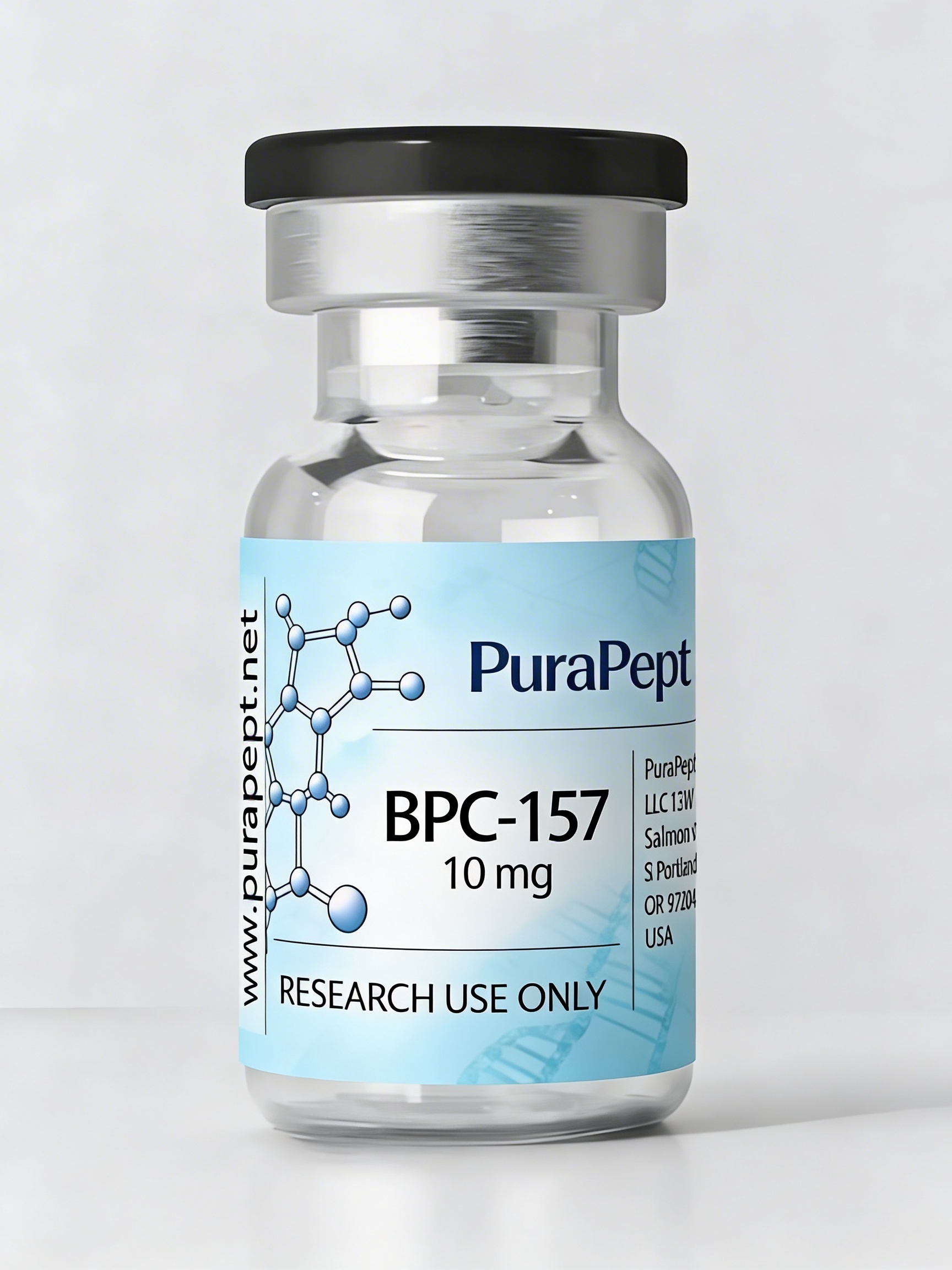 BPC-157 10 mg
A peptide vial arrives with a sheet of paper. It carries a percentage, names a method, and bears a date. That sheet is worth reading carefully, because it is the most technical document most buyers of research peptides will ever see and the easiest one to over-read. This page goes through what a third-party identity and purity test establishes, and — at more length — what it does not.
What a purity percentage is measuring
Almost every purity figure in this field comes from reverse-phase high-performance liquid chromatography with ultraviolet detection. The sample goes through a column, peaks emerge over time, and the main peak’s share of the total detector response is reported as a percentage. That is a real measurement. It is also narrower than the phrase suggests.
Kumar Kuril’s 2025 analysis in Analytical Chemistry makes the arithmetic explicit. Impurities in peptide drugs arise through insertion, truncation, deamidation, isomerization and oxidation, and they do not necessarily respond to the UV detector the way the parent peptide does, so each has its own relative response factor. Set every factor to 1 and the paper’s own conclusion is that the impurity estimate comes out over- or underestimated, in whichever direction the true factor happens to lie.
Two limits sit underneath that. The percentage is relative: a sample reading 98 % contains what the column eluted, not what was weighed into the vial. And anything the column cannot separate from the main peak is inside the number and invisible inside it. Xie and Sharp’s work on positional isomers of a peptide modification is a clean illustration of how much room lies between resolved and counted. Reverse-phase chromatography does separate peptides carrying the same modification at different sequence positions — and that very separation is what defeats simple quantification, so they had to change both the separation mode and the fragmentation chemistry to measure it.
The impurity list a peptide actually has
Peptide chemistry is unusually generous with ways to be slightly wrong. D’Hondt and colleagues’ review of related impurities in peptide medicines catalogues the standard families. In synthesis: amino-acid deletions and insertions from incomplete deprotection and excess reagent; racemization during Fmoc deprotection, which yields diastereomeric impurities; protection-group adducts; side-chain oxidation; dimers and oligomers. Also unwanted counterions, trifluoroacetate among them, carried in from the synthesis or from later purification, and contamination by unrelated peptides, which the review attributes to a lack of appropriate GMP. In handling and formulation: β-elimination, diketopiperazine, pyroglutamate and succinimide formation.
So a chromatogram showing one main peak at 97 % is not describing a molecule with three percent of nothing. It is describing a sample whose individual impurities have not been identified, and any of the above could be sitting in that three percent.
What the chromatogram cannot see
Kazarian and colleagues’ pharmaceutical assay is worth reading for one reason: it measures how much of a sample’s composition a conventional method simply does not reach. Their mixed-mode and hydrophilic-interaction setup resolved inorganic anions and cations, active ingredients, organic counterions, potential degradants and excipients — up to 23 chemically diverse solutes in a single run, developed on pharmaceutical products and applied to commercial cough syrups. A single reverse-phase chromatogram tells you very little of that. Whatever else a certificate says, it does not name the counterion, and the counterion is not a detail.
Nor does it give you the water. Chen and Topp measured moisture by Karl Fischer titration across relative humidities from 8 % to 78 % in lyophilized peptide solids, and found adducts with a mass increase of 18 Da attributable to reaction with water, alongside adducts increased by 16 Da that were attributable to neither water nor molecular oxygen. A lyophilized vial is a solid matrix with a variable water content. Gross weight is not net peptide content.
Nor does it settle sterility or endotoxin. Endotoxin is a separate test with its own method — the bacterial endotoxin test with limulus lysate — and its own interference check, because the judgment algorithms for that check still differ between pharmacopoeias. Pei and colleagues re-judged 1 748 samples under the Chinese, Japanese, European, US and Indian algorithms: 7.6 % needed an additional step under the Chinese rules and none did under the other four. A result that only exists after a separate assay does not live inside your purity percentage.
When a certificate and the vial disagree
Two published studies went and measured commercial vials instead of trusting the paperwork, and both found the paperwork wanting.
Choules and colleagues bought two custom synthetic peptides and ran quantitative proton NMR on a 60 MHz benchtop instrument. LC-based quality control, they write, depends largely on the detection mode and can be particularly blind to certain impurities. NMR found substantial amounts of mannitol as an undeclared constituent in both products, at 20 % and 43 % w/w. Mannitol is highly polar and UV-transparent, which is exactly why the standard method missed it. Their conclusion is the one to keep: experimental verification supersedes trust in both pharmaceutical and research quality control.
Breindahl and colleagues bought melanotan II from three online shops. Unknown impurities ran from 4.1 % to 5.9 % in two of them and sat below the quantification limit in the third. Total peptide per vial ranged from 4.32 mg to 8.84 mg, against 10 mg claimed on every listing.
Ashraf and colleagues did the same for semaglutide sold by online sellers without a prescription. The three vials they received tested at 7.7 % to 14.37 % purity against 99 % claimed, and their peptide content exceeded the labelled amount by 28.56 % to 38.69 %. Endotoxin was present in all three, between 2.1645 and 8.9511 EU/mg. Worth noting what they did not find: no peptide-like impurities were identified. The peptide was present and identifiable. What failed was the claim about how pure it was.
What a serious characterisation looks like
That is a known quantity, not a wish. McCarthy and colleagues describe how peptide reference standards are established: a mass-balance approach to value-assign a bulk material, that bulk material then used to value-assign the vialed material, plus content uniformity, identity testing by NMR, mass spectrometry and chromatography, and stability studies. They also note that features such as chiral or isobaric amino acids may require additional techniques for full characterization.
A short list, then, for any certificate you are asked to trust. Which method, on which instrument, at which detection wavelength. Whether identity was established by mass, and how, rather than by retention time alone. Whether relative response factors were measured or simply assumed to be 1. Whether counterion and water content were measured. Whether an endotoxin result exists as a separate line. And whether the lot number on the sheet is the lot number on the vial.
One sourcing note, since BPC-157 is what we are asked about most often and it appears here as BPC-157 10 mg. Two searches, both run on 30 September 2026, with every term tagged to title and abstract. The narrow one — "BPC-157"[tiab] AND ("certificate of analysis"[tiab] OR purity[tiab] OR analytical[tiab]) — returns a single result: the 2026 doping-detection workflow in The Analyst that lists BPC-157 among the peptides it identifies in blood, which is an assay on plasma samples, not on vial contents. The wide one — "BPC-157"[tiab] AND (quality[tiab] OR characterization[tiab] OR HPLC[tiab] OR assay[tiab]) — returns seventeen, and not one of them characterizes the material in a vial. Hyphenation is not the variable — PubMed indexes both spellings identically, 220 hits each. The distance between one result and seventeen is the distance between a demand for a purity certificate and a general interest in the compound. A compound that is easy to find in a database is not the same thing as a material that has been characterized.
What the data do not show
That any certificate is accurate, or that a purity percentage predicts what a compound does. Purity and evidence are separate questions, and a purity sheet answers the first one only partially. Nothing here establishes that BPC-157 heals a tendon in people: the 2019 review by Gwyer and colleagues in Cell and Tissue Research notes that the majority of BPC-157 studies have been performed in small rodent models and that efficacy is yet to be confirmed in humans. That is a separate finding, and on this page the two never merge.
Research use only. This page describes published analytical methods and published product-quality studies for research reference. It is not medical advice and not a suggestion for human use. Nothing we supply is for human or veterinary use.
References.
- Kumar Kuril A. The critical need for implementing RRF in the accurate assessment of impurities in peptide therapeutics. Anal Chem 2025;97(24):12480-12485. PubMed record (PMID 40499007).
- Xie B, Sharp JS. Relative quantification of sites of peptide and protein modification using size exclusion chromatography coupled with electron transfer dissociation. J Am Soc Mass Spectrom 2018;27(8):1322-1327. PubMed record (PMID 27075875).
- D'Hondt M, Bracke N, Taevernier L, Gevaert B, et al. Related impurities in peptide medicines. J Pharm Biomed Anal 2015;101:2-30. PubMed record (PMID 25044089).
- Kazarian AA, Nesterenko PN, Soisungnoen P, Burakham R, et al. Comprehensive analysis of pharmaceutical products using simultaneous mixed-mode and hydrophilic interaction liquid chromatography. J Sep Sci 2015;37(16):2138-2144. PubMed record (PMID 24890905).
- Chen Y, Topp EM. Photolytic labeling to quantify peptide-water interactions in lyophilized solids. Mol Pharm 2019;16(3):1053-1064. PubMed record (PMID 30721080).
- Pei Y, Cai T, Gao H, Tan D, et al. Comparison of result judgment algorithm of test for interfering factors in the bacterial endotoxins test among Chinese, Japanese, European, American and Indian pharmacopeias. Chin Med J 2015;127(15):2784-2788. PubMed record (PMID 25146614).
- Choules MP, Bisson J, Simmler C, McAlpine JB, et al. NMR reveals an undeclared constituent in custom synthetic peptides. J Pharm Biomed Anal 2020;178:112915. PubMed record (PMID 31671336).
- Breindahl T, Evans-Brown M, Hindersson P, et al. Identification and characterization by LC-UV-MS/MS of melanotan II skin-tanning products sold illegally on the internet. Drug Test Anal 2015;7(2):164-172. PubMed record (PMID 24771717).
- Ashraf AR, Mackey TK, Vida RG, Kulcsár G, et al. Multifactor quality and safety analysis of semaglutide products sold by online sellers without a prescription. J Med Internet Res 2024;26:e65440. PubMed record (PMID 39509151).
- McCarthy D, Han Y, Carrick K, Schmidt D, et al. Reference standards to support quality of synthetic peptide therapeutics. Pharm Res 2023;40(6):1317-1328. PubMed record (PMID 36949371).
- Mazzarino M, Colpaert T, Deventer K, Van Eenoo P. Rapid and harmonized analytical workflow for the determination of peptidic and non-peptidic doping agents in dried and liquid blood matrices. Analyst 2026. PubMed record (PMID 42328738).
- Gwyer D, Wragg NM, Wilson SL. Gastric pentadecapeptide body protection compound BPC 157 and its role in accelerating musculoskeletal soft tissue healing. Cell Tissue Res 2019;377(2):153-159. PubMed record (PMID 30915550).