Sermorelin: the approved GHRH analog that left the market
Sermorelin reached FDA approval in 1997 as a growth-hormone-releasing hormone fragment for GH deficiency, then vanished from the US label database. The trial record that remains includes a 60-child randomised comparison against growth hormone itself, with height velocities, antibody counts and an IGF-I curve that fell back to baseline.
30 September 2026 · 3 min read
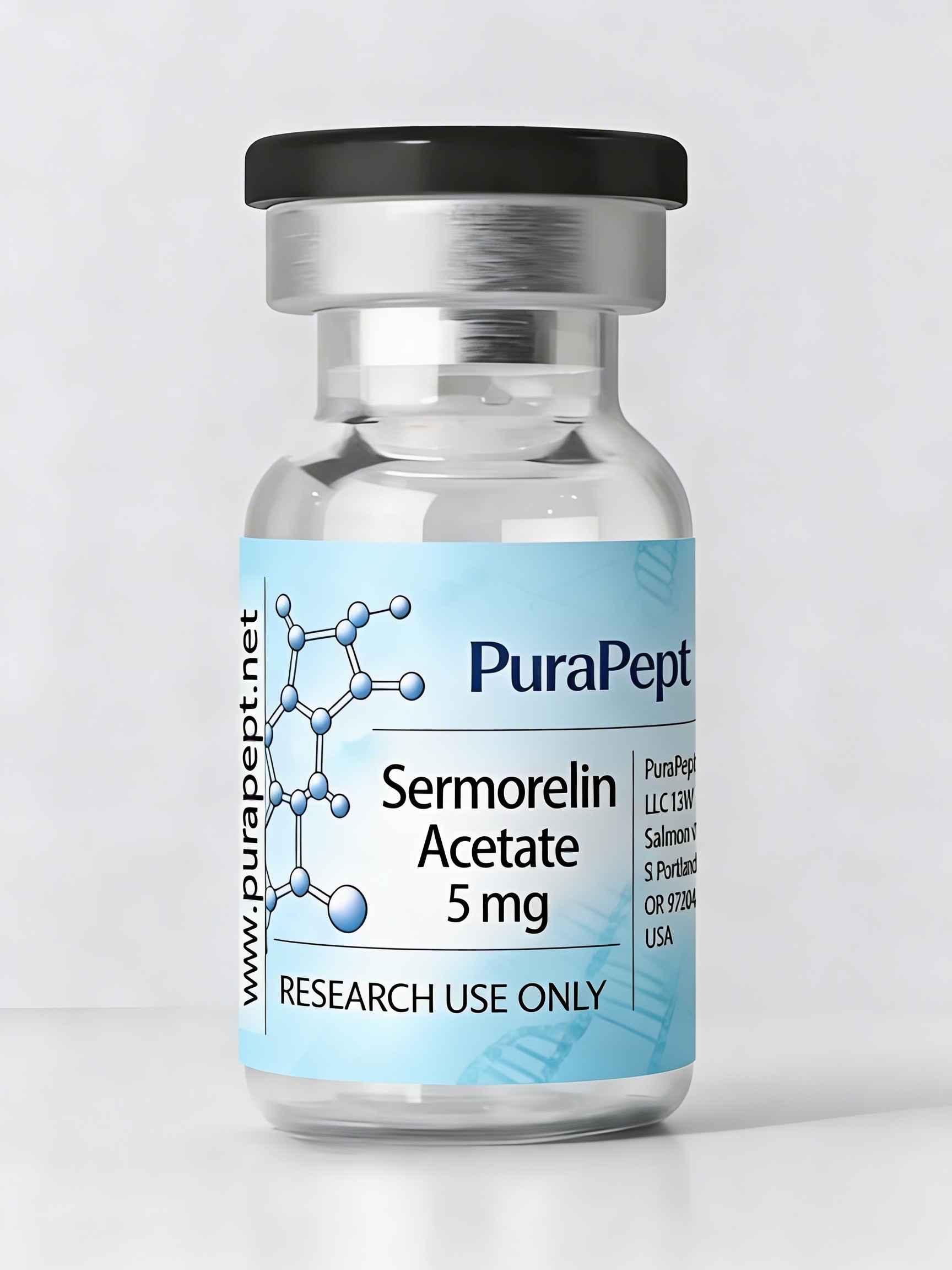 Sermorelin Acetate 5 mg
Most peptides in this catalogue never reached a regulator. Sermorelin did, which makes its absence more instructive than its presence. It was the first GHRH fragment to become a medicine for growth hormone deficiency, and today the US label database has no entry for it at all. The papers from its working life are still readable, and they read like a caution about the difference between releasing growth hormone and replacing it.
The approval and the exit
The Drugs@FDA record shows Geref, sermorelin acetate, sponsored by EMD Serono, with its original approval dated 26 September 1997. The Medical Letter reviewed the product in January 1999 under the plain title “Growth-hormone-releasing factor for growth hormone deficiency”, the kind of write-up a new medicine gets when prescribers are meeting it for the first time.
A current query of DailyMed, the National Library of Medicine database of marketed labels, returns zero listings for sermorelin or Geref. The product left the market years ago and no GHRH fragment has held a broad GH-deficiency indication since. Tesamorelin, the one GHRH analog with a modern phase 3 record, was approved for a single narrow population and never escaped it, as the tesamorelin piece on this site documents: the one GHRH analog with phase 3 data, in one population. Sermorelin is the earlier chapter of the same story: approval, a defined population, then exit.
The trial that compared it against the real thing
Chen 1993 is the paper to read before any other, because it set the fragment against growth hormone itself. Sixty children with proven GH deficiency of hypothalamic origin were randomised into three equal groups: two received the GHRH(1-29) fragment at a lower or higher daily amount, and the third received growth hormone, all for six months.
Mean height velocities at six months were 9.2 centimetres per year on the lower fragment amount, 9.3 on the higher, and 14.6 on growth hormone. The two fragment groups did not differ from each other; the hormone group beat both at P under 0.01. Serum IGF-I rose at first on the fragment, then fell back to values similar to before treatment. Antibodies against the fragment appeared in all 20 children on the higher amount and 19 of 20 on the lower, then had almost disappeared nine months after stopping, with no correlation between antibody levels and growth gained. Three children reported mild irritation at the injection site, and no serious side effects were seen.
The authors’ own conclusion is the honest abstract of the whole field: six months of the fragment was unlikely to match growth hormone for promoting growth in GH deficiency. Releasing the hormone through a deficient axis is not the same as supplying it.
One catalogue note for researchers: the preparation on this page is Sermorelin, the acetate salt of the 29-amino-acid fragment. Read the figures above as data on the compound in deficient children, not as characteristics of any preparation and not as adult pharmacology.
What the data do not show
An adult indication, a longevity rationale, or any result that survives the fragment-to-hormone comparison. What exists is narrower and still useful: a 1997 approval for paediatric GH deficiency, a 60-child randomised trial in which the fragment grew children at roughly two-thirds the velocity of the hormone itself, an IGF-I response that faded within the treatment period, and near-universal antibody formation that also faded. Everything else is other research that has not been run.
Research use only. This page summarises the approval record and published randomised trials for research reference. It is not medical advice and not a suggestion for human use. Nothing we supply is for human or veterinary use.
References.
- openFDA Drugs@FDA record: Geref (sermorelin acetate), EMD Serono, original approval 26 Sep 1997
- DailyMed current-label database: no active listing for sermorelin or Geref (queried 29 Sep 2026)
- Growth-hormone-releasing factor for growth hormone deficiency. Med Lett Drugs Ther 1999 (approval-era review). PubMed record (PMID 9924487).
- Chen RG, et al. A comparative study of growth hormone (GH) and GH-releasing hormone(1-29)-NH2 for stimulation of growth in children with GH deficiency. Acta Paediatr Suppl 1993. PubMed record (PMID 8329830).