Kisspeptin: every IVF trial used the 54-amino-acid form
Kisspeptin is the signal the reproductive axis runs on, and its clinical programme as an egg-maturation trigger has a clean record: 60 women, no moderate or severe OHSS, live birth 45 per transfer. Every one of those trials used kisspeptin-54. This page reads the numbers and states plainly what they do not cover.
16 October 2026 · 5 min read
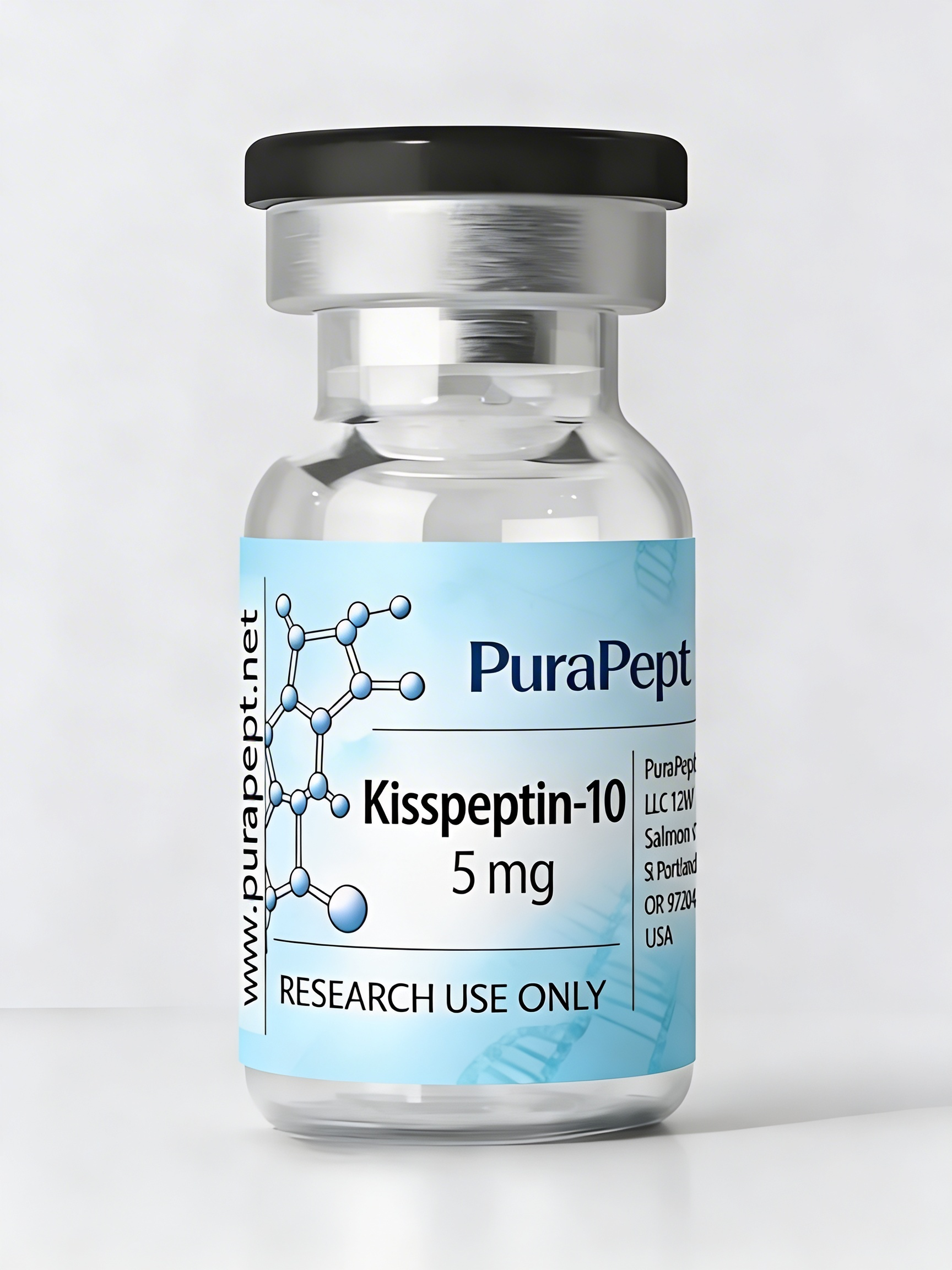 Kisspeptin-10 5 mg
Kisspeptin is the peptide the hypothalamus uses to decide whether the reproductive axis runs at all. The 2022 review of its role in the hypothalamic-pituitary-gonadal axis is direct about the mechanism: kisspeptin binds its receptor KISS1R to promote GnRH secretion, kisspeptin neurons in the arcuate nucleus co-express neurokinin B and dynorphin — the KNDy neurons — and those neurons carry the positive and negative feedback from oestrogen onto GnRH. The same review lists what goes wrong when the system fails: mutations in KISS1 or KISS1R are implicated in idiopathic hypogonadotropic hypogonadism, central precocious puberty and female infertility.
That is a real biological signal with real human genetics behind it. It also has a clinical programme that has been run, and this page reads that programme rather than the mechanism paper, because the clinical papers contain the numbers a reader actually wants.
The dose-finding trial: 60 women, four amounts
The 2015 phase 2 open-label randomised trial enrolled 60 women at high risk of ovarian hyperstimulation syndrome during IVF, at Hammersmith Hospital in London. After a standard recombinant FSH protocol with GnRH antagonist, patients were assigned to a single injection of kisspeptin-54 at one of four amounts, with oocytes retrieved 36 hours later.
The results read like a well-behaved phase 2. Oocyte maturation occurred in 95% of women. The highest oocyte yield was 121% at the top amount of 12.8 nmol/kg, which was 69% (95% CI −16 to 153%) greater than at the lowest amount. Per transfer in the 51 women with a transfer, biochemical pregnancy was 63%, clinical pregnancy 53% and live birth 45%. The highest rates were seen at 9.6 nmol/kg: 85%, 77% and 62%. No woman developed moderate, severe or critical OHSS.
Two things are worth holding onto. The confidence interval on the yield difference runs from −16 to +153, so the yield comparison between the lowest and highest amount is not a tight result. And the pregnancy rates are per transfer in a selected group, not per randomised patient.
The randomised placebo-controlled follow-up
The 2017 phase 2 randomised controlled trial from the same group asked a narrower question: does a second injection help? Sixty-two women at high risk of OHSS, all given one injection of kisspeptin-54 at 9.6 nmol/kg 36 hours before retrieval, were randomised 1:1 to a second injection 10 hours later or to saline. Patients, embryologists and IVF clinicians were all blinded.
A higher proportion reached an oocyte yield of at least 60%: 14 of 31 (45%) with one injection against 21 of 31 (71%) with two, an absolute difference of 26% (95% CI 2 to 50%, P = 0.042). Moderate OHSS occurred in 1 of 31 (3.2%) in the single-dose group and in none in the double-dose group.
The authors’ own limitation statement is the honest reading: further studies are warranted to directly compare kisspeptin-54 to more established triggers of oocyte maturation. That comparison — kisspeptin against hCG or a GnRH agonist as the trigger — is not what this trial did.
What it did to the ovary
The 2018 granulosa lutein cell study asked what the trigger does at tissue level, in 48 women: 12 received hCG, 12 received a GnRH agonist and 24 received kisspeptin-54, half of them with one injection and half with two.
Cells from the kisspeptin group showed higher gene expression for the machinery of ovarian steroidogenesis: FSHR 14-fold, CYP19A1 3.6-fold against hCG and 4.5-fold against GnRH agonist, STAR 3.4-fold and 1.8-fold, HSD3B2 7.5-fold and 2.5-fold, inhibin A 2.5-fold in both comparisons. Markers of vascular permeability and oocyte growth factors — VEGFA, SERPINF1, CDH5, amphiregulin, epiregulin — were unchanged, and treating the cells in vitro with kisspeptin-54 produced no significant direct effect on either OHSS genes or steroidogenic genes. The authors note most women in the study had PCOS.
So the honest mechanism statement is: the gonadotropin profile after a kisspeptin trigger resembles the natural cycle more closely than hCG, and the downstream gene changes are in the direction of progesterone synthesis. The direct ovarian action of kisspeptin itself was not demonstrated.
The PCOS literature: levels, not interventions
There is a substantial body of work on circulating kisspeptin in polycystic ovary syndrome, and it is uniformly observational. A 2019 meta-analysis with diagnostic test accuracy pooled 12 studies and found women with PCOS had significantly higher circulating KISS-1 levels (SMD 0.47, P = 0.002), with a pooled diagnostic odds ratio of 13.71 and an area under the curve of 0.835. A 2026 meta-analysis of 20 studies with 670 participants found higher serum kisspeptin (SMD 0.511, 95% CI 0.376 to 0.646, I² = 0%), with BMI as a significant moderator. A third, also from 2026, pooled 30 studies with 1,932 PCOS patients and 1,641 controls (SMD 0.67, 95% CI 0.36 to 0.97) and added Mendelian randomisation suggesting a causal link from higher kisspeptin to PCOS risk (OR 1.12, 95% CI 1.03 to 1.22, P = 0.0065).
None of that is a treatment study, and a biomarker with an area under the curve of 0.835 is a correlation, not a mechanism for intervention.
The obesity finding is in rats
The 2024 Metabolism paper on obesity-induced hypogonadism is the one place where kisspeptin appears as something being manipulated rather than measured. In male rats, the miR-137/325 tandem repressed human KISS1 in vitro and reduced hypothalamic kisspeptin content, while both were altered in the medio-basal hypothalamus of obese rats. Target-site blockers against the kisspeptin transcript enhanced kisspeptin content and reversed central hypogonadism in obese rats on an obesogenic diet, along with glucose intolerance, insulin resistance and inflammatory markers. The authors report that this reversal was more effective than chronic kisspeptin or testosterone treatment in obese rats — an animal result, at doses and routes a vial cannot reproduce.
The same axis is now a drug target in humans for other reasons. The 2026 review of idiopathic hypogonadotropic hypogonadism notes that KNDy neurons were identified as the GnRH pulse generator and that this understanding produced fezolinetant, an NK3 receptor antagonist approved for menopausal vasomotor symptoms. That approval is for a different receptor in a different population, and it is worth naming because it is the clearest demonstration that this pathway is pharmacologically real in people.
What the data do not show
They do not show a human trial of the decapeptide. Every clinical study on this page administered kisspeptin-54, the 54-amino-acid form. Kisspeptin-10 is the shortest fragment the body makes from the same precursor, and no abstract cited here administered it to a person for any indication.
They do not show an approved product. Kisspeptin-54 as a maturation trigger has been tested in phase 2 trials at one centre, with the authors themselves calling for direct comparison against established triggers. The 2018 review reaches the same conclusion: a promising method, with further studies desirable.
They do not show anything about fertility, libido, testosterone or body composition in men. The male and metabolic literature on this page is genetics reviews, human biomarker studies in women, and rodent work.
Where this sits on the shelf
The compound as supplied by the manufacturer: Kisspeptin-10 5 mg
What we supply
The kisspeptin preparation above, as supplied by the manufacturer, tracked, from inside the EU.
Research use only. This page summarises published studies for research reference. It is not medical advice, not a protocol, and not a suggestion for human use. Nothing we supply is for human or veterinary use.
References.
- Xie Q, et al. The Role of Kisspeptin in the Control of the Hypothalamic-Pituitary-Gonadal Axis and Reproduction. Front Endocrinol (Lausanne) 2022;13:925206.
- Abbara A, et al. A second dose of kisspeptin-54 improves oocyte maturation in women at high risk of ovarian hyperstimulation syndrome: a Phase 2 randomized controlled trial. Hum Reprod 2017;32(9):1915-1924.
- Abbara A, et al. Efficacy of Kisspeptin-54 to Trigger Oocyte Maturation in Women at High Risk of Ovarian Hyperstimulation Syndrome (OHSS) During In Vitro Fertilization (IVF) Therapy. J Clin Endocrinol Metab 2015;100(9):3322-3331.
- Owens LA, et al. The direct and indirect effects of kisspeptin-54 on granulosa lutein cell function. Hum Reprod 2018;33(2):292-302.
- Kasum M, et al. Kisspeptin as a promising oocyte maturation trigger for in vitro fertilisation in humans. Gynecol Endocrinol 2017;33(8):583-587.
- Varikasuvu SR, et al. Circulatory metastin/kisspeptin-1 in polycystic ovary syndrome: a systematic review and meta-analysis with diagnostic test accuracy. Reprod Biomed Online 2019;39(4):685-697.
- Siahaan SC, et al. Serum kisspeptin levels in women with polycystic ovary syndrome: A systematic review and meta-analysis. Med J Malaysia 2026;81(2):321-326.
- Zheng Z, et al. Associations between kisspeptin hormone level and its genetic polymorphisms with polycystic ovary syndrome. Int J Gynaecol Obstet 2026;172(1):383-395.
- Avendano MS, et al. The evolutionary conserved miR-137/325 tandem mediates obesity-induced hypogonadism and metabolic comorbidities by repressing hypothalamic kisspeptin. Metabolism 2024;157:155932.
- Topaloglu AK, et al. Genetics of Idiopathic Hypogonadotropic Hypogonadism. J Clin Res Pediatr Endocrinol 2026;18(2):203-223.