LL-37 and cathelicidin: what the human studies measured
Human LL-37 is measurable in blood and in tissue, tracks with infection severity in some cohorts, and has never been given to a human as a therapy in a trial that printed a result. This page reads four papers, three of them in people and one in mice.
12 October 2026 · 5 min read
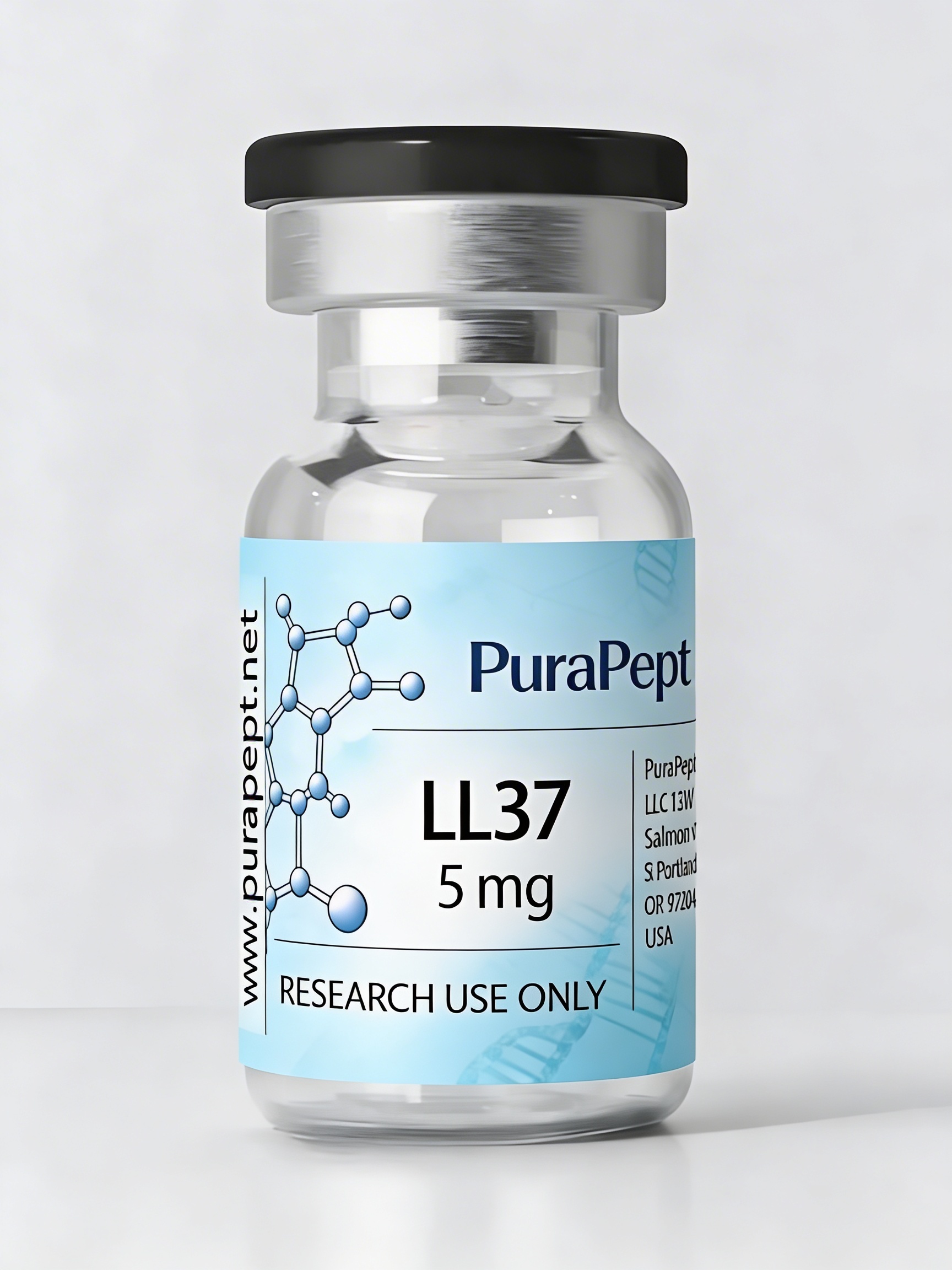 LL37 5 mg
LL-37 is the only member of the human cathelicidin antimicrobial peptide family, and it is not something a laboratory invented. It is made by your own cells, it is measurable in your blood, and the literature around it is genuinely interesting. It is also a compound for which the gap between what has been measured in people and what has been given to people is very wide, and this page is mostly about that gap.
The mechanism, and the part that surprises people
LL-37 kills bacteria, fungi and viruses by binding their membranes — the cationic character that comes from its arginine and lysine residues is what does the work. But a 2014 paper in The Journal of Immunology makes the more interesting point: at an inflammatory site the peptide is exposed to peptidyl arginine deiminase, an enzyme released by inflammatory cells, which citrullinates those arginine residues. The authors’ finding is that citrullinated LL-37 was at least 40 times less efficient at neutralising the pro-inflammatory activity of endotoxin, and that its ability to quench macrophage responses to lipoteichoic acid and poly(I:C) was significantly reduced.
Then the line that makes the paper worth an hour: unlike native LL-37, the citrullinated peptide completely lost the ability to prevent morbidity and mortality in a mouse model of endotoxin shock, and administering the modified peptide with endotoxin actually made sepsis worse, by raising serum IL-6. Serum from septic mice showed increased PAD activity that correlated with the level of citrullination, so the modification happens in vivo. The authors’ conclusion is direct: because LL-37 is a potential treatment for sepsis, its administration should be preceded by careful analysis to ensure the citrullinated peptide is not generated in treated patients.
That is a peptide whose activity depends on its own chemical integrity. It is also, in that model, a molecule that becomes harmful under exactly the inflammatory conditions it is meant to be used in.
What was measured in people
A 2017 study in Clinical and Investigative Medicine measured serum LL-37 in 120 adults: 30 with pulmonary tuberculosis, 30 with Gram-positive pneumonia, 30 with Gram-negative pneumonia and 30 healthy controls. Mean serum LL-37 was 13.94±5.13 ng/mL in tuberculosis, 7.87±4.58 in Gram-positive pneumonia, 10.27±3.60 in Gram-negative pneumonia, and 1.75±0.71 in the healthy controls. The authors read this as LL-37 being an important element of host defence in respiratory bacterial disease, particularly with an intracellular pathogen.
That is an observational comparison of concentrations. It is not evidence that giving LL-37 to a healthy person would produce any of those concentrations, and it is not evidence that more LL-37 is better.
In tissue, the picture is less flattering. A 2012 paper in the Journal of Dermatological Science analysed 20 biopsies from grade 3 diabetic foot ulcers and 20 from healthy donors. β-defensins were overexpressed in the ulcers, whereas LL-37 had low or absent expression compared with healthy skin. Primary cell cultures from the ulcer biopsies infected with Staphylococcus aureus showed lower LL-37 expression than cultures from healthy donor skin. The authors’ conclusion is that although most antimicrobial peptides are expressed in diabetic foot ulcers, “this production is not appropriate to promote wound healing and contain secondary infections”.
A 2021 study in Review of Diabetic Studies looked at 118 patients with type 2 diabetes and Staphylococcus aureus nasal carriage. Forty-two, 35.6%, were colonised, and vitamin D deficiency was found in 69 patients, 65.7%. Median serum LL-37 was 0.89 ng/mL (range 0.05-8.62). Circulating LL-37 was higher in carriers than non-carriers, 1.25 against 0.72 ng/mL (p<0.001), and vitamin D supplementation was not associated with lower carriage (p=0.706). The authors conclude that expression of LL-37 may be induced by the carriage itself, and that the relationship between vitamin D and LL-37 inverts between the two groups — it was positive in non-carriers and inverse in carriers.
What has not happened
A 2018 review in Surgical Infections surveyed the antimicrobial peptide field for surgeons and reached a conclusion worth reading in full before anything else: peptides have considerable in vitro evidence supporting their use in preventing and treating surgical infections, but they appear to have in vivo activity only in limited animal studies, the experimental models need more clinical relevance, and the products in clinical evaluation at the time were limited in number and being evaluated primarily for topical applications.
There is also a mechanism detail that gets skipped. A 2014 study in the Asian Pacific Journal of Allergy and Immunology treated cultured human gingival epithelial cells with non-toxic concentrations of LL-37, 2-6 µM, and measured eleven Th1/Th2 cytokines. Exactly one moved significantly: IL-8 rose, with matching mRNA induction, cumulatively over 24 hours. IL-1β, IL-6 and TNF-α were only modestly induced. IL-8 is a neutrophil chemoattractant — so LL-37’s immunomodulatory signature in this system is a recruitment signal. That is a different job from “reducing inflammation”, and it is the reason the sepsis finding above is not a puzzle.
What the data do not show
They do not show a therapeutic human trial of LL-37. Not one of the papers on this page administers LL-37 to a person and reports an outcome. The three human studies are a serum concentration comparison, a tissue-expression analysis of biopsies, and a cross-sectional carriage study.
They do not show that more LL-37 is better. The one human result that runs against the intuition is the nasal carriage study, where the people who were colonised had the higher LL-37. The 2022 Frontiers review that proposes deliberately upregulating LL-37 as a COVID-19 strategy is explicit that it is a hypothesis paper built on that kind of reasoning.
They do not show that a vial of lyophilised LL-37 reproduces circulating peptide. Serum concentrations in the studies above are in the sub- to low-tens of nanograms per millilitre, and the 2021 diabetes study found a range of 0.05 to 8.62 ng/mL among 118 people. What a preparation in a vial does to those numbers is not a question the cited literature answers.
They do not show an antibiotic substitute. The 2018 review is explicit that this class is early, largely topical, and that better clinical-trial effort is needed. A peptide with an industrial-scale antimicrobial reputation and a 40-fold loss of function from a single post-translational modification is not a finished medicine, and presenting it as one would be misreading six papers that were careful not to.
Where this sits on the shelf
The compound as supplied by the manufacturer: LL37 5 mg
What we supply
The LL-37 preparation above, as supplied by the manufacturer, tracked, from inside the EU.
Research use only. This page summarises published studies for research reference. It is not medical advice, not a protocol, and not a suggestion for human use. Nothing we supply is for human or veterinary use.
References.
- Koziel J, Bryzek D, Sroka A, et al. Citrullination alters immunomodulatory function of LL-37 essential for prevention of endotoxin-induced sepsis. J Immunol 2014;192(11):5363-5372.
- Rivas-Santiago B, Trujillo V, et al. Expression of antimicrobial peptides in diabetic foot ulcer. J Dermatol Sci 2012;65(1):19-26.
- Majewski K, Żelechowska P, et al. Circulating cathelicidin LL-37 in adult patients with pulmonary infectious diseases. Clin Invest Med 2017;40(1):E34-E39.
- Plataki MN, Vamvoukaki R, Samonis G, et al. Vitamin D and Cathelicidin (LL-37) Status in Patients with Type 2 Diabetes and Staphylococcus aureus Nasal Carriage. Rev Diabet Stud 2021;17(1):30-37.
- Fry DE. Antimicrobial Peptides. Surg Infect (Larchmt) 2018;19(8):804-811.
- Montreekachon P, Nongparn S, Sastraruji T, et al. Favorable interleukin-8 induction in human gingival epithelial cells by the antimicrobial peptide LL-37. Asian Pac J Allergy Immunol 2014;32(3):251-260.
- Aloul KM, Nielsen JE, et al. Upregulating Human Cathelicidin Antimicrobial Peptide LL-37 Expression May Prevent Severe COVID-19 Inflammatory Responses and Reduce Microthrombosis. Front Immunol 2022;13:880961.