Melanotan I and II: three volunteers, one pigmented outcome, and the analogue that has the trials
The only human trial of melanotan II is a 1996 phase I pilot in three volunteers, where two developed increased pigmentation after five subcutaneous injections. The synthetic alpha-MSH analogue afamelanotide has two randomised trials in 168 patients and an FDA approval — but that is a different molecule. This page separates the two.
18 October 2026 · 4 min read
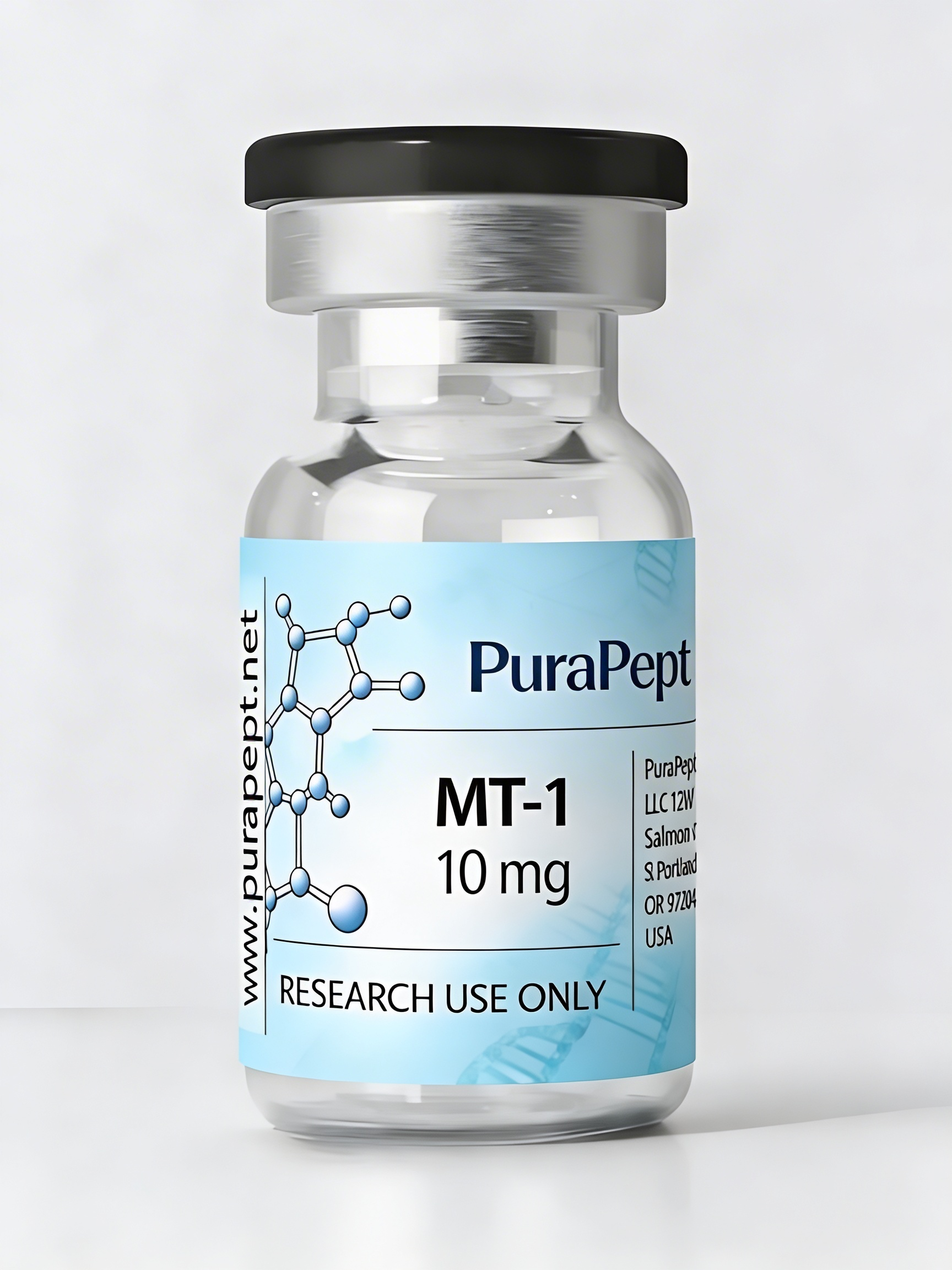 MT-1 (Melanotan I) 10 mg
Melanotan I and melanotan II are synthetic analogues of alpha-melanocyte-stimulating hormone, a peptide that acts on melanocortin receptors. MT-I is linear; MT-II is a cyclic truncated analogue, seven residues bridged into a lactam ring, described in the 1996 pilot paper as a “superpotent cyclic melanotropic peptide” with superpotent melanotropic activity in vitro.
The reason to write this page carefully is that the melanocortin-1 receptor pathway has one approved drug in it — and it is not either of the two compounds on this page.
The entire human trial record for MT-II
The 1996 Life Sciences paper is a single-blind, alternating-day, placebo-controlled design in three normal male volunteers, at a starting amount of 0.01 mg/kg, given subcutaneously Monday to Friday for two consecutive weeks. Two subjects were escalated in 0.005 mg/kg steps to 0.03 mg/kg and one to 0.025 mg/kg.
The measured results were these: the 0.03 mg/kg amount produced Grade II somnolence and fatigue in one of the two subjects on it; mild nausea not requiring an antiemetic was reported at most dose levels; a stretching and yawning complex appeared to correlate with the onset of spontaneous penile erections intermittently experienced for 1 to 5 hours after dosing, depending on the amount; and two of the three subjects had increased pigmentation in face, upper body and buttock, measured by quantitative reflectance and by visual perception, one week after dosing ended. The authors recommended 0.025 mg/kg per day as the single dose for future phase I studies.
Three volunteers. That is the human trial record for MT-II, and it is where any claim about this compound rests or falls.
Where MT-I and MT-II came from
The 2006 Peptides review of melanocortin therapeutics gives the field’s own history: two analogues, a linear peptide melanotan I and a cyclic truncated peptide melanotan II, were patented and tested clinically — MT-I for studies on tanning of the skin, and MT-II for the diagnosis and treatment of male erectile dysfunction. The same review records that a new MT-II analogue, PT-141, had initial phase I/II trials.
The split in the programmes is the interesting part. The skin-tanning programme is the one that ended up approved, and it did so under a different molecule. The erectile dysfunction branch produced a different drug, which is catalogued separately on this site.
The analogue that has the trials: afamelanotide
Afamelanotide is a synthetic alpha-MSH analogue approved by the FDA to increase pain-free sunlight exposure in adults with erythropoietic protoporphyria. Its 2015 New England Journal of Medicine paper reports two multicentre, randomised, double-blind, placebo-controlled trials of subcutaneous 16 mg implants: 74 patients in the European Union study and 94 in the United States, assigned 1:1 to implant or placebo every 60 days over 180 and 270 days respectively.
The primary endpoint was hours of direct sun exposure without pain. In the US study the median pain-free time at six months was 69.4 hours on afamelanotide against 40.8 on placebo (P = 0.04). In the European study at nine months it was 6.0 hours against 0.8 (P = 0.005), with fewer phototoxic reactions, 77 against 146 (P = 0.04). Quality of life improved in both trials, adverse events were mostly mild, and serious adverse events were not thought related to the study drug.
Afamelanotide also has randomised evidence in vitiligo. The 2015 JAMA Dermatology trial randomised 55 patients to narrowband UV-B alone or narrowband UV-B plus a monthly 16 mg afamelanotide implant. Repigmentation response was superior in the combination arm at day 56, with a significantly higher proportion reaching repigmentation on the face (41.0 against 61.0 days, P = .001) and upper extremities (46.0 against 69.0 days, P = .003), and repigmentation of 48.64% (95% CI 39.49 to 57.80) at day 168 against 33.26% (24.18 to 42.33) on phototherapy alone. The 2021 review notes randomised evidence in polymorphic light eruption as well, smaller studies in acne vulgaris, Hailey-Hailey disease and solar urticaria, and — the detail worth carrying — that diffuse hyperpigmentation is experienced by almost all patients.
What the data do not show
They do not show a randomised human trial of melanotan I or melanotan II for pigmentation. The MT-II evidence is three volunteers, single-blind, in one paper from 1996, and the pigment change was measured by reflectance and by eye, not by any patient-reported or clinical outcome.
They do not show safety data for either compound at commercial scale. The somnolence, fatigue, nausea and the erection-related stretching and yawning complex in the pilot are not a safety profile; they are three subjects’ worth of observations.
They do not let the afamelanotide data be borrowed. It is a different molecule, with a different design, an implant formulation, a photodermatology indication and its own regulatory approval. The honest reading of that literature is that the melanocortin-1 pathway is real and druggable — not that MT-I or MT-II reproduce anything measured there.
They do not show anything about melanoma risk. No trial cited here measured skin cancer outcomes, and one of the pigmentary-therapy reviews on this page notes how few large, well-designed randomised trials exist in that field.
Where this sits on the shelf
The compounds as supplied by the manufacturer: MT-1 10 mg · MT-2 10 mg
What we supply
The melanotan preparations above, as supplied by the manufacturer, tracked, from inside the EU.
Research use only. This page summarises published studies for research reference. It is not medical advice, not a protocol, and not a suggestion for human use. Nothing we supply is for human or veterinary use.
References.
- Dorr RT, et al. Evaluation of melanotan-II, a superpotent cyclic melanotropic peptide in a pilot phase-I clinical study. Life Sci 1996;58(20):1777-1784.
- Hadley ME, et al. Melanocortin peptide therapeutics: historical milestones, clinical studies and commercialization. Peptides 2006;27(4):921-930.
- Langendonk JG, et al. Afamelanotide for Erythropoietic Protoporphyria. N Engl J Med 2015;373(1):48-59.
- Lim HW, et al. Afamelanotide and narrowband UV-B phototherapy for the treatment of vitiligo: a randomized multicenter trial. JAMA Dermatol 2015;151(1):42-50.
- Wu J, et al. Afamelanotide: An Orphan Drug with Potential for Broad Dermatologic Applications. J Drugs Dermatol 2021;20(3):290-294.