Somatropin: the randomised GH-replacement endpoints, read carefully
The best randomised body-composition dataset in growth hormone is the REAL 1 trial, and it is easy to misread: it tested somapacitan, a once-weekly albumin-binding derivative, against placebo and against daily GH — not somatropin against placebo. The primary endpoint was truncal fat percentage, reduced by 1.53 percentage points against placebo at 34 weeks. The one-step-upstream GH-axis trial, GHRH in 31 men with HIV lipodystrophy, moved lean mass by 0.9 kg.
30 October 2026 · 3 min read
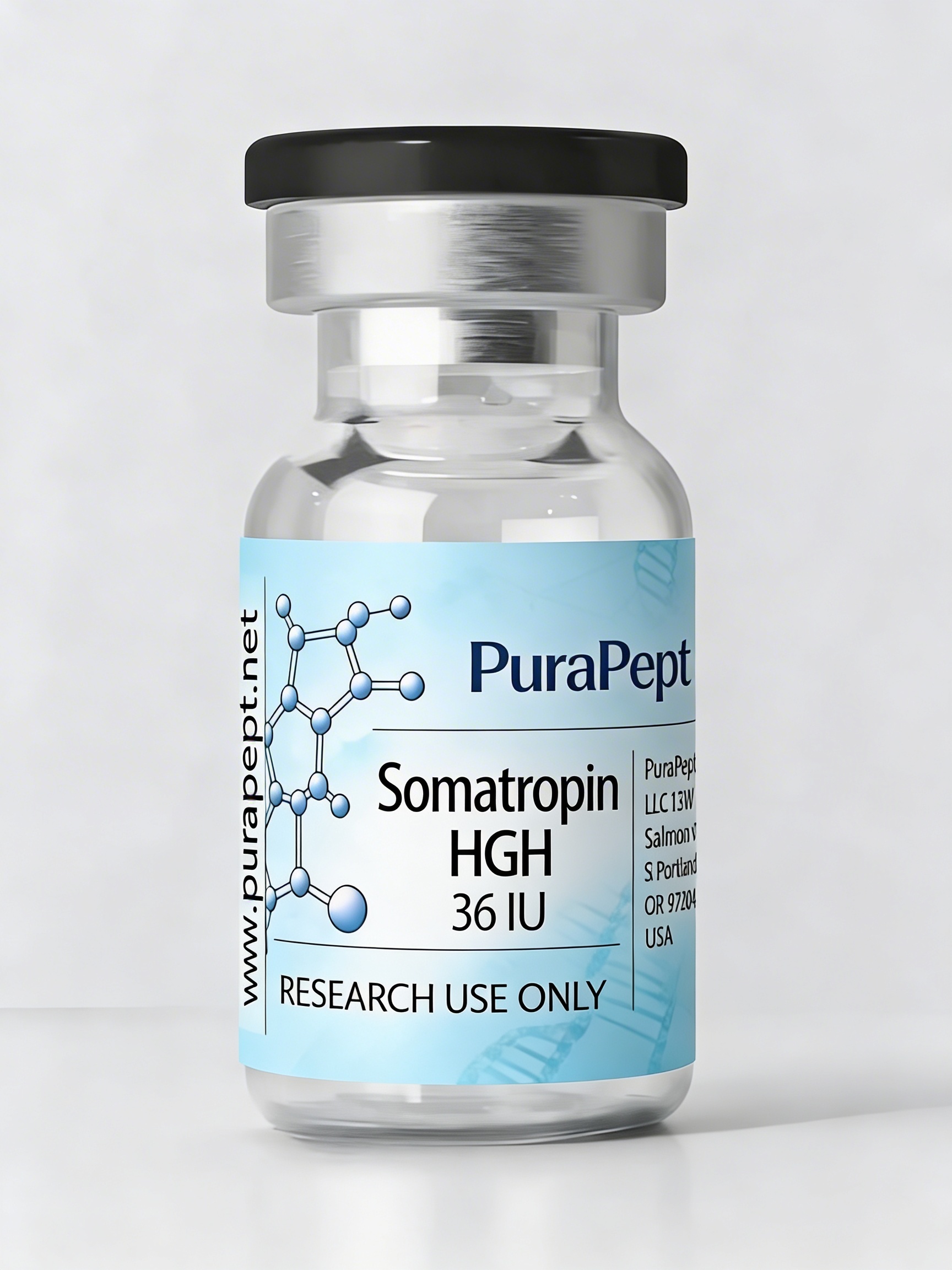 Somatropin 36 IU
Somatropin is recombinant human growth hormone. It is the reference molecule in its class, and the randomised literature on GH replacement is large. The two papers here are chosen because they are the ones that print a control arm and a body-composition endpoint — and because both need reading carefully before anything is claimed from them.
REAL 1: 301 adults, three arms, and it is not testing somatropin against placebo
The 2020 JCEM paper reports a randomised, parallel-group trial in 17 countries with 301 treatment-naïve adults with adult GH deficiency in the main study period and 272 in the extension period; 257 completed the trial. Patients were randomised 2:2:1 to once-weekly somapacitan, daily GH, or once-weekly placebo for 34 weeks, then continued into a 52-week extension. The primary endpoint was change in truncal fat percentage to week 34, measured by DXA, with IGF-I standard deviation score used to dose titrate.
The result: at 34 weeks somapacitan significantly reduced truncal fat percentage, estimated difference −1.53% (95% CI −2.68 to −0.38), P = 0.0090, demonstrating superiority over placebo, and improved other body composition parameters including visceral fat and lean body mass, and IGF-I SDS. At 86 weeks improvements were maintained with both somapacitan and daily GH, and the adverse event profile was similar to daily GH including injection-site reactions.
Now the part that matters for reading any claim made from this trial. The randomised intervention was somapacitan, a once-weekly reversible albumin-binding GH derivative — not somatropin. The mechanism of the trial’s convenience is that it binds albumin and circulates bound, which is exactly what somatropin does not do. The daily GH arm was an active comparator, open-label alongside a double-blind placebo. So REAL 1 establishes that GH replacement by any of these routes moves truncal fat by about 1.5 percentage points in GH-deficient adults; it does not isolate a somatropin-specific effect, and the abstract prints no separate somatropin figure.
That is a plausible reading of an active-comparator trial, and this page presents it as a reading rather than as a finding.
The GH axis one step upstream
The 2004 JAMA paper is a double-blind, placebo-controlled trial of GHRH — one step above somatropin on the axis — in 31 HIV-infected men aged 18 to 60 with evidence of lipodystrophy, at 1 mg subcutaneously twice daily for 12 weeks. The primary outcome was change in IGF-1 concentrations.
The results:
- Mean IGF-1 rose 104 (110) ng/mL with GHRH versus 6 (44) ng/mL with placebo, P = .004.
- Lean body mass by DXA increased 0.9 (1.3) kg with GHRH versus −0.3 (1.7) kg with placebo, P = .04.
- Trunk fat decreased −0.4 (0.7) kg versus 0.2 (0.6) kg, P = .03, and the ratio of trunk to lower extremity fat improved.
Thirty-one participants, twelve weeks, and a specific population with reduced GH concentrations. Those three facts sit next to the numbers on purpose: a 0.9 kg difference in lean body mass is small, and it is what a 12-week study in 31 people produced.
What the data do not show
They do not show a somatropin-versus-placebo randomised trial. The trial in a GH-deficient population used somapacitan as the randomised intervention, with daily GH as an active comparator.
They do not show an effect in people without GH deficiency. Both trials enrolled GH-deficient or GH-low populations — the GHRH trial specifically enrolled men with HIV lipodystrophy, a group with reduced GH concentrations.
They do not show a performance or body-composition outcome in healthy adults. Nobody on these two pages was studied for an athletic outcome, and this page makes no such claim.
They do not show a bone, cardiovascular or fracture endpoint. DXA body composition and IGF-1 are what is printed.
One catalogue note, stated as a limit rather than as guidance: the presentation on this site is 36 IU. Neither abstract prints an international-unit dose — REAL 1 randomised to the study drug by protocol and the JAMA trial used GHRH in milligrams — so this page cannot map 36 IU onto anything reported here.
Where this sits on the shelf
The compound as supplied by the manufacturer: Somatropin
What we supply
The somatropin presentation above, as supplied by the manufacturer, tracked, from inside the EU.
Research use only. This page summarises published studies for research reference. It is not medical advice, not a protocol, and not a suggestion for human use. Nothing we supply is for human or veterinary use.
References.
- Johannsson G, Gordon MB, Højby Rasmussen M, et al. Once-weekly Somapacitan is Effective and Well Tolerated in Adults with GH Deficiency: A Randomized Phase 3 Trial. J Clin Endocrinol Metab. 2020 Apr 1;105(4):e1358-e76.
- Koutkia P, Canavan B, Breu J, et al. Growth hormone-releasing hormone in HIV-infected men with lipodystrophy: a randomized controlled trial. JAMA. 2004 Jul 14;292(2):210-8.