PT-141 and the RECONNECT trials: what the effect size actually is
Two randomised phase 3 trials, 1267 women, 24 weeks. Desire scores rose 0.35 points against placebo, and the programme's responder work defines what counts as a meaningful change per endpoint without publishing the thresholds. Nausea reached 40.4% in the open-label extension. Four papers, including the one that keeps the rest in proportion.
2 October 2026 · 4 min read
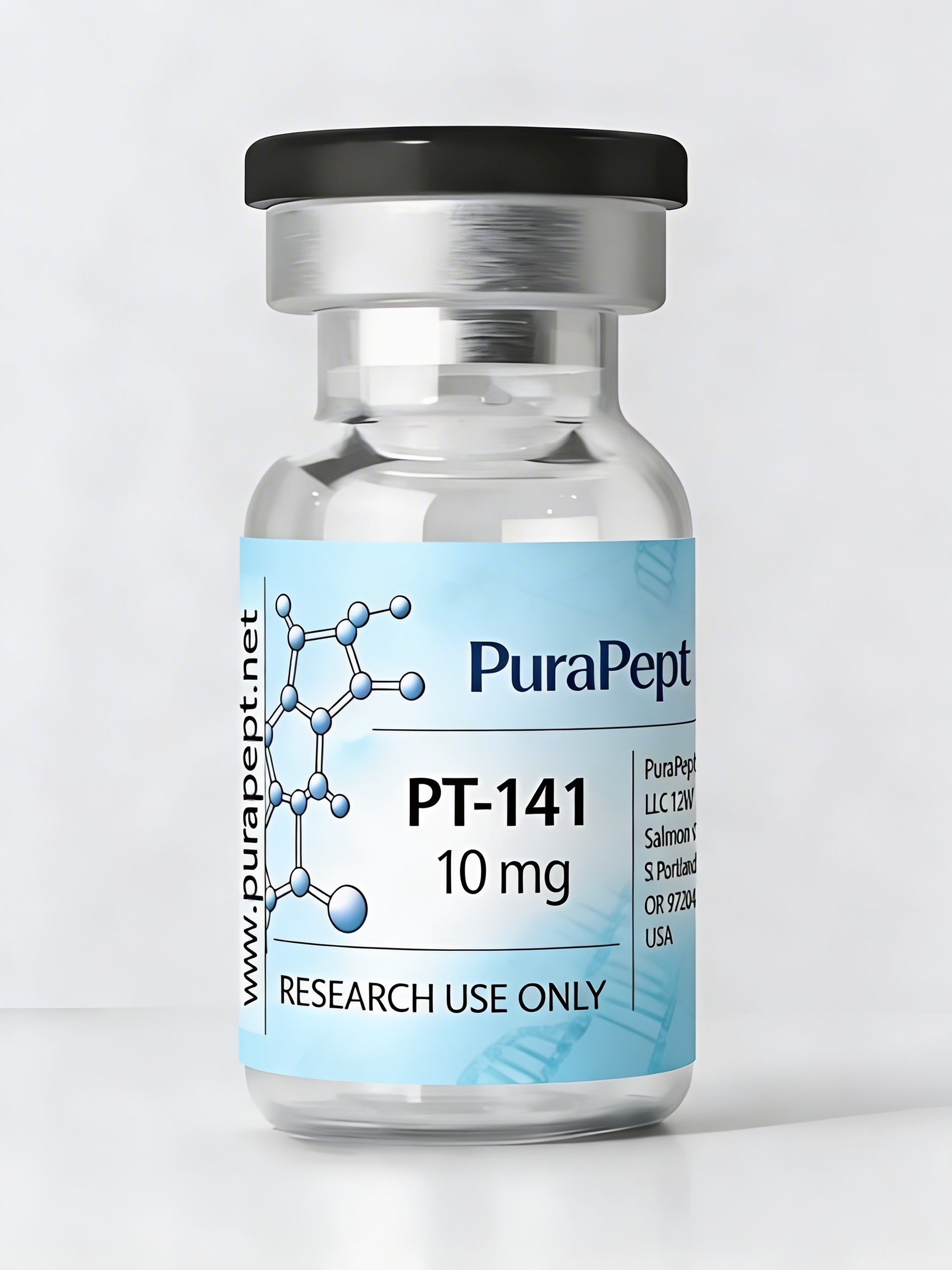 PT-141 (Bremelanotide) 10 mg
PT-141 is a melanocortin receptor agonist, and it is also the first drug with a phase 3 programme of its own in this field, which is why it appears on a research desk at all rather than in a fringe list. The programme is called RECONNECT. It is worth reading closely, because the interesting number in it is not the one usually quoted.
Four papers, in the order that keeps them honest.
The two phase 3 trials
Kingsberg and colleagues report two identically designed studies, 301 and 302, run from January 2015 to August 2016. Premenopausal women with hypoactive sexual desire disorder, randomised 1:1 to 24 weeks of bremelanotide 1.75 mg subcutaneous as needed, or placebo. Of 1267 women randomised, 1247 went into safety and 1202 into the efficacy analysis.
The results on the coprimary endpoints, integrated across both studies: the Female Sexual Function Index desire domain rose 0.35 points against placebo, P below 0.001. Study 301 alone gave 0.30, study 302 alone gave 0.42, both significant. Distress on the Female Sexual Distress Scale item 13 fell 0.33 points against placebo, also significant, with the weaker of the two trials at P = 0.005.
The population deserves a note: mean age 39, 85.6% white, 96.6% from US sites. This is a defined clinical population studied in one regulatory context, not a general finding about desire.
The paper that makes the 0.35 mean less alarming than it looks
The common objection to a 0.35-point difference is that it is small, and sometimes it is. But averages hide responders, and the programme ran a dedicated responder analysis to establish what counts as a meaningful change at all, which is what makes the phase 3 numbers interpretable.
Althof and colleagues took seven patient-reported endpoints from the phase 2b dose-ranging study and derived minimal clinically important differences from receiver operating characteristic curves, built so that changes attributable to the placebo effect do not count as responder events. Responder rates at the 1.75 mg dose reached statistical significance against placebo on all seven endpoints, P at or below 0.03.
One technical point keeps this honest: responder rates are proportions crossing a threshold, not average score differences. A significant responder rate does not make the mean shift larger. Both facts are true at once, and the honest sentence is that a meaningful subset responded. What none of these four abstracts prints is the size of the minimal clinically important difference itself, so this page puts no number on how far the threshold sits above the average effect. The paper defines those differences per endpoint rather than publishing one cut-off that applies to everything, so the rates cannot be translated back into a bigger average effect either. Anything that merges the two into a single boast is misreading the paper.
The year after
Simon and colleagues followed 856 patients who completed the 24-week core phase into a 52-week open-label extension. 684 enrolled. 272 completed it. That attrition is worth stating plainly, because it is the difference between a controlled comparison and an observational one.
The reported safety picture in the extension: treatment-related nausea in 40.4% of participants, flushing in 20.6%, headache in 12.0%, with nausea the only severe event to affect more than one participant in both studies and no new safety signals over the year. The efficacy figures run higher, in the region of 1.25 to 1.30 points on the desire domain, but they come from an open-label phase with no placebo comparator, and the authors describe every analysis as descriptive rather than inferential. Open-label improvements in a subjective endpoint are exactly where expectancy shows up.
Where it stops working
The prespecified subgroup analysis across the 1202 patients in the integrated population is generally reassuring: significant improvements across all age, weight and BMI subgroups and all baseline bioavailable testosterone quartiles, with few exceptions. The exception worth knowing is hormonal contraception. Desire rose significantly in participants not taking hormonal contraceptives; in those who were, the paper reports a numerical advantage rather than a significant one. Distress reduction held either way.
What the data do not show
They do not show a 0.35-point average shift meaning that most participants experienced a 0.35-point shift. The responder work behind the same programme derives clinically important differences from the phase 2b data, and it reports how significant the resulting rates were without publishing the thresholds themselves, so the typical result and the responder result are different quantities and should not be merged. The year-long figures are open-label, descriptive, and drawn from 272 of 856 eligible completers. The subgroup paper is prespecified but not powered for its comparisons. And the whole dataset is premenopausal women with a diagnosed disorder, mean age 39, overwhelmingly US sites. Nothing here is male data, nothing here is a mechanism claim for other populations, and nothing here was measured in anyone who took the compound without a diagnosis.
What we supply
PT-141 (Bremelanotide), as supplied by the manufacturer, sealed, tracked, from inside the EU. The age-trajectory argument for tracking hormones over time rather than in snapshots is covered separately in the MOTS-C and physical-decline summary. Where a batch carries laboratory documentation it is listed on the product page.
Research use only. This page summarises published clinical trials for research reference. It is not medical advice, not a protocol, and not a suggestion for human use. Nothing we supply is for human or veterinary use.
References.
- Kingsberg SA, et al. Bremelanotide for the Treatment of Hypoactive Sexual Desire Disorder: Two Randomized Phase 3 Trials. Obstet Gynecol 2019;134(5):899-908 (PMID 31599840).
- Simon JA, et al. Long-Term Safety and Efficacy of Bremelanotide for Hypoactive Sexual Desire Disorder. Obstet Gynecol 2019;134(5):909-917 (PMID 31599847).
- Simon JA, et al. J Womens Health 2022;31(3):391-400 — Prespecified and Integrated Subgroup Analyses from the RECONNECT Phase 3 Studies of Bremelanotide. (PMID 35230162).
- Althof S, et al. Responder Analyses from a Phase 2b Dose-Ranging Study of Bremelanotide. J Sex Med 2019;16(8):1226-1235 (PMID 31277966).