Ipamorelin vs the older secretagogues: what selectivity actually means
In rats and swine, ipamorelin released as much growth hormone as GHRP-6 but left ACTH and cortisol alone, which its predecessors did not. The human record is one pharmacokinetic study. Three papers, read in order.
1 October 2026 · 3 min read
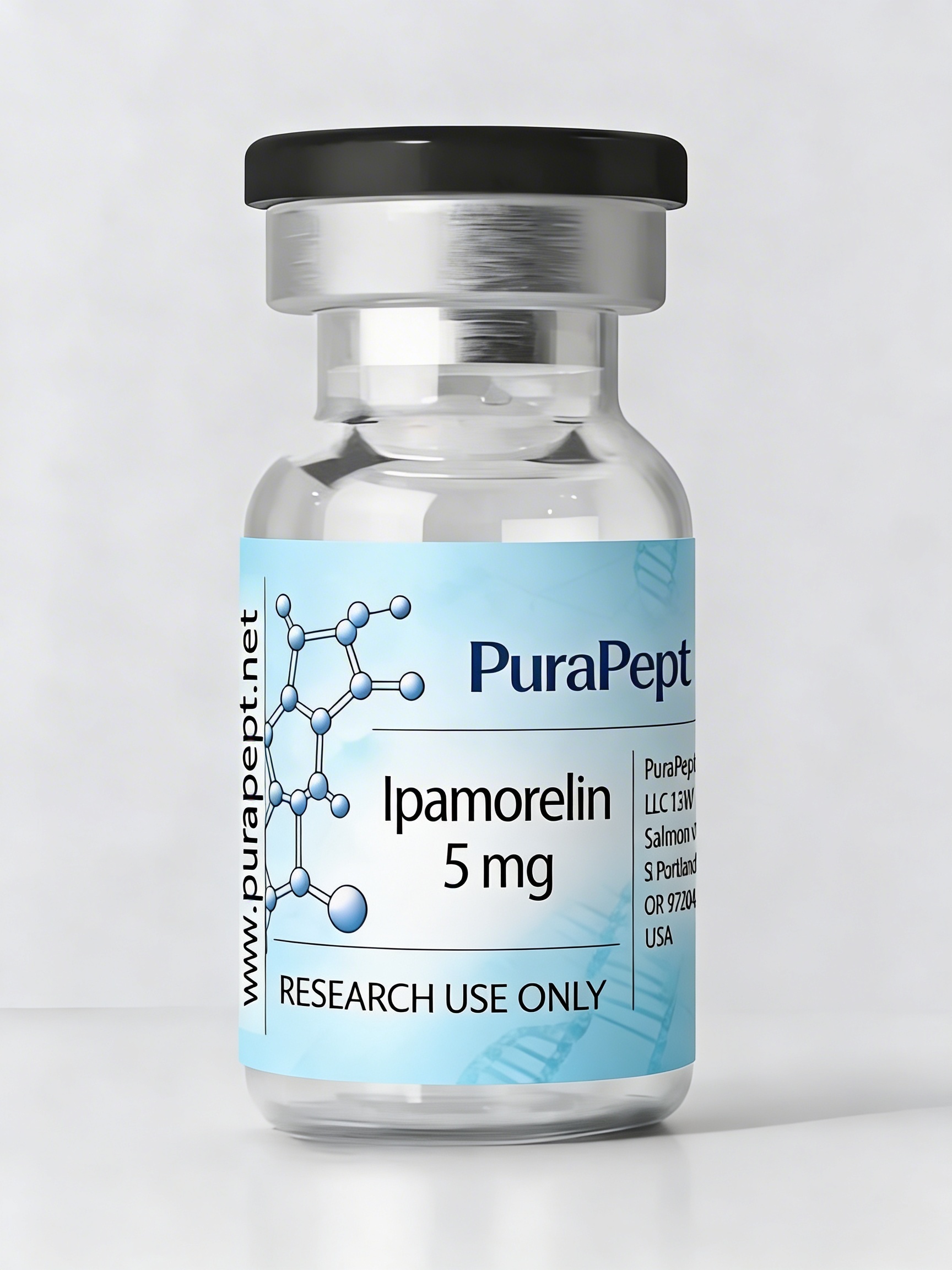 Ipamorelin 5 mg
Growth hormone secretagogues spent their first decade as orphans: synthetic molecules that released growth hormone through a receptor with no known natural ligand. Then the ligand turned up in the stomach, and the field split into an older generation that pulls several hormonal strings at once and a newer one designed to pull exactly one. Ipamorelin is the second kind. The preparation on this page is Ipamorelin 5 mg. The evidence for the selectivity claim sits in three papers, and they deserve a straight reading in order.
The receptor finally got its natural ligand
Kojima and colleagues reported in Nature in 1999 that they had purified the endogenous ligand of the secretagogue receptor from rat stomach. They named it ghrelin, from the Proto-Indo-European root for growth. It is a peptide of 28 amino acids carrying an n-octanoyl group on its third serine, and that acyl chain is not decoration: without octanoylation at serine 3, the activity disappears. The acylated form releases growth hormone in vivo and in vitro. Human ghrelin differs from the rat form by two amino acids.
That paper redefined every synthetic secretagogue at a stroke. GHRP-6, GHRP-2 and their cousins were suddenly visible as mimics of a stomach hormone, acting through its receptor rather than through the hypothalamic releasing-hormone pathway. Tesamorelin, covered elsewhere on this site, works the other route entirely, which is why the two classes read so differently: the one GHRH analog with phase 3 data, in one population.
Ipamorelin was built by deleting the promiscuous core
Raun and colleagues described ipamorelin in 1998 as the outcome of a chemistry programme that started from GHRP-1 and removed its central Ala-Trp dipeptide. The result is a pentapeptide, and profiling with receptor antagonists confirmed it stimulates growth hormone release through the same GHRP-like receptor as GHRP-6.
Potency and efficacy came out comparable across three systems. On primary rat pituitary cells, ipamorelin released growth hormone with an EC50 of 1.3 against 2.2 nmol per litre for GHRP-6, at 85% of its maximal effect. In anaesthetised rats the ED50 values were 80 against 115 nmol per kg with higher maximal output for ipamorelin. In conscious swine the ED50 values were 2.3 against 3.9 nmol per kg at similar maxima. GHRP-2 in the same swine model showed higher potency but lower efficacy than either.
Then the selectivity result, which is the whole point of the molecule. None of the tested secretagogues moved FSH, LH, prolactin or TSH in swine. But GHRP-6 and GHRP-2 both raised ACTH and cortisol, while ipamorelin did not, matching the profile of growth-hormone-releasing hormone itself. Same growth hormone output, no stress-axis spillover. In animals, that is a clean separation.
The human record is pharmacokinetics, not outcomes
Gobburu and colleagues ran ipamorelin in healthy volunteers in a dose-escalation design over five infusion rates with eight healthy men at each level, measuring both drug and growth hormone concentrations. The pharmacokinetics were dose-proportional with a short terminal half-life of 2 hours. Growth hormone responded as a single episode at every level, peaking at 0.67 hours and declining to negligible concentrations, with half-maximal stimulation at 214 nmol per litre.
That is a careful PK/PD model, and it is also the entire human record worth citing: disposition and pulse shape in healthy men, no patients, no body-composition endpoints, no functional outcomes, and no head-to-head comparison against GHRP-2 or GHRP-6 in people.
What the data do not show
An efficacy trial, a human comparison, or any result beyond healthy-volunteer pharmacology. The selectivity that defines ipamorelin was demonstrated in swine and rats, and borrowing those curves for human expectations skips the translation step the field never ran. The older secretagogues have broader human records; ipamorelin has the cleaner animal profile and the thinner human file. That asymmetry is the honest summary, and it runs in both directions.
What we supply
Ipamorelin 5 mg, alongside the GHRP-2 and GHRP-6 preparations discussed above, as supplied by the manufacturer, tracked, from inside the EU. Batch documentation for every product that carries any is explained in the COA guide linked from the product page.
Research use only. This page summarises published receptor pharmacology and human pharmacokinetics for research reference. It is not medical advice and not a suggestion for human use. Nothing we supply is for human or veterinary use.
References.
- Kojima M, Hosoda H, Date Y, et al. Ghrelin is a growth-hormone-releasing acylated peptide from stomach. Nature 1999;402(6762):656-660 (PMID 10604470).
- Raun K, Hansen BS, Johansen NL, et al. Ipamorelin, the first selective growth hormone secretagogue. Eur J Endocrinol 1998;139(5):552-561 (PMID 9849822).
- Gobburu JV, Agoram BM, Nociti A, Parenti M. Pharmacokinetic-pharmacodynamic modeling of ipamorelin, a growth hormone releasing peptide, in human volunteers. Pharm Res 1999;16(9):1412-1416 (PMID 10496658).