Selank: three small clinical studies, one fMRI crossover
A heptapeptide analogue of tuftsin, sold for anxiety, with 62, 60 and 70-patient studies published in one Russian journal and one 52-participant fMRI crossover in healthy volunteers. The controlled trials do not use placebo, do not report blinding, and do not print an amount in the abstract. This page counts what exists rather than asserting what it means.
17 October 2026 · 4 min read
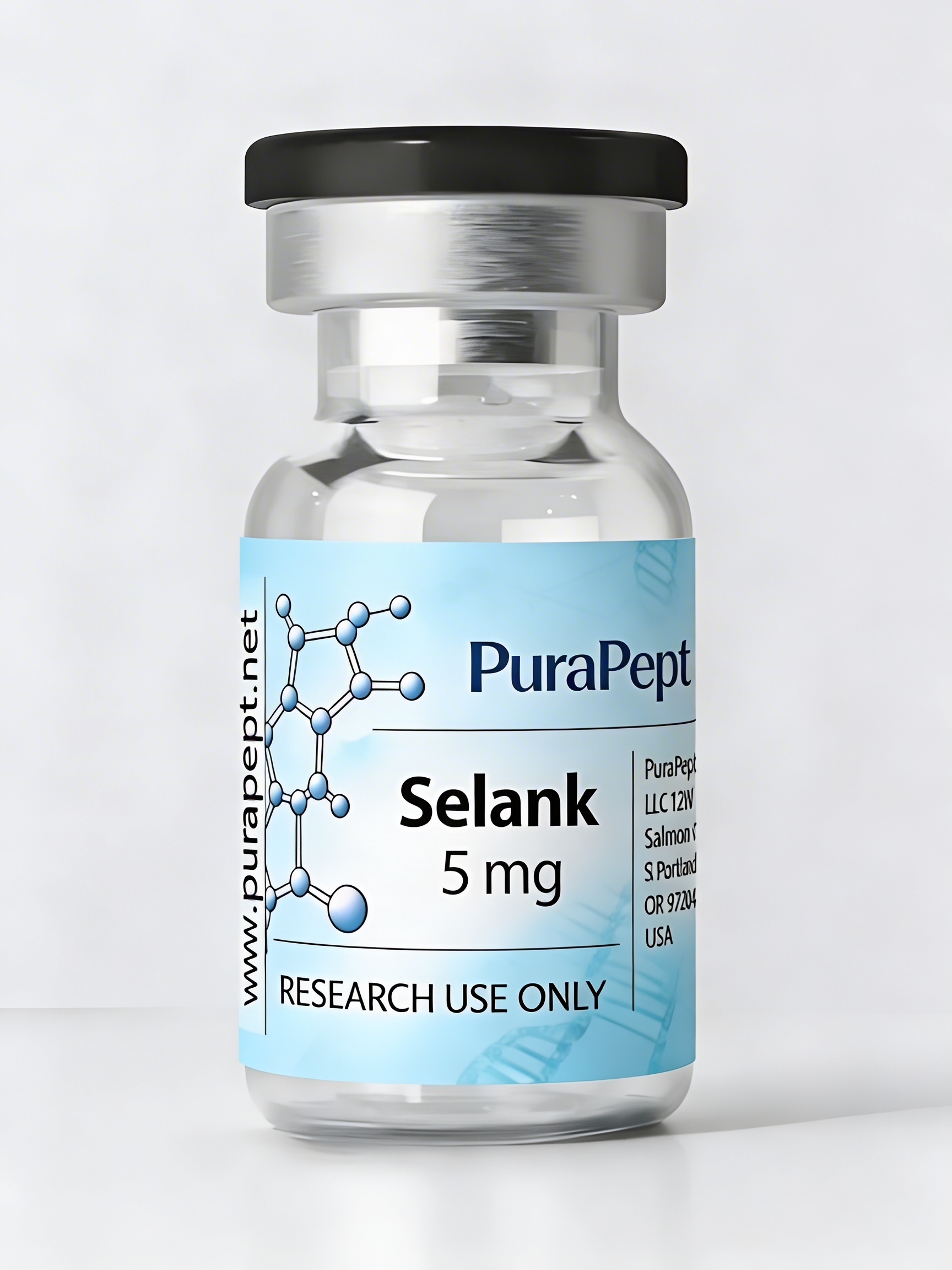 Selank 5 mg
Selank is a seven-amino-acid synthetic analogue of tuftsin, an immunomodulatory peptide, and it is marketed for anxiety. It is approved as a medicine in Russia. Almost none of the supporting literature is readable in English, and the part that is has a shape worth describing precisely, because “there is no evidence” and “the evidence is thinner than the claims” are different statements.
This page counts what exists. Three clinical studies, one imaging crossover, and a body of animal and cell work. That is what the record holds.
The three clinical studies, counted
The 2008 study compared selank against medazepam in 62 patients with generalised anxiety disorder and neurasthenia — 30 on selank, 32 on medazepam. Patients were assessed on Hamilton, Zung and CGI scales, and blood enkephalin activity was measured. The abstract reports similar anxiolytic effects for both drugs, with selank also showing antiasthenic and psychostimulant effects. It also reports a biological finding: patients had reduced tau(½) leu-enkephalin, correlated with disease duration, symptom severity and autonomic disturbance, and that parameter rose during selank treatment mostly in the GAD patients.
The 2014 study compared selank with phenazepam in 60 patients with phobic-anxiety and somatoform disorders. It reports pronounced anxiolytic and mild nootropic effects of selank, that the anxiolytic effect lasted for a week after the last administration of the peptide, and a positive impact on quality of life.
The 2015 study is an add-on design: 40 patients on selank combined with phenazepam against 30 on phenazepam alone, in anxiety-phobic, hypochondriac and somatoform disorders, assessed on HDRS, CGI and Spilberger scales with tolerability on the UKU scale and Stroop and verbal fluency testing. It reports that the combination achieved the positive effect of phenazepam earlier on HDRS and reduced the level of undesirable side effects of phenazepam — attention and memory impairment, asthenia, sedation, increased sleep duration, sexual disturbances, emotional indifference and orthostatic effects — during treatment and after withdrawal.
What none of those three abstracts reports is a placebo arm. All three are comparisons against an active benzodiazepine, the total enrolment across all of them is 192, and none of the three prints an amount of selank in the abstract. All three are published in the same Russian journal, Zhurnal Nevrologii i Psikhiatrii imeni S.S. Korsakova, with English translated abstracts.
The one study in healthy volunteers, and what it measured
The 2020 Doklady Biological Sciences paper is the only English-indexed human study with a placebo comparison. Fifty-two healthy participants received resting-state fMRI before, and 5 and 20 minutes after, an injection of semax, selank or placebo. Between-group and between-condition differences appeared in functional connectivity between the right amygdala and regions of the right fusiform, inferior, middle temporal and parahippocampal gyri; the authors describe post hoc analysis defining specific effects of selank and semax on the amygdala-temporal connection for the first time.
Read that carefully. It is a connectivity difference between groups in healthy people, in a design whose analysis plan the abstract does not describe in enough detail to judge. It is not an anxiety trial, and it did not measure symptoms.
The mechanism literature is animal and cell work
The GABA hypothesis is the one the literature keeps returning to. In rat frontal cortex, 84 genes involved in neurotransmission were analysed one and three hours after administration; 45 genes changed at one hour and 22 at three, with positive correlation between the changes seen after selank and after GABA. The authors propose allosteric modulation of the GABAergic system as a possible mechanism.
The follow-up in a human neuroblastoma cell line found something less supportive. Under selank alone there were no changes in the mRNA levels of the genes studied; the authors conclude that selank has no direct effect on GABAergic system gene mRNA in that model, while partially confirming the hypothesis that it may affect the interaction of GABA with GABA-A receptors.
Separately, in mouse spleen, selank and its fragments altered expression of genes involved in immune response. None of this is a human outcome.
What the data do not show
They do not show a placebo-controlled efficacy trial in people with anxiety. The three clinical studies are active-comparator comparisons in 192 patients total, without a placebo arm described in any abstract.
They do not show blinding, randomisation, or an amount of selank. The abstracts report none of these, which means the studies cannot be appraised for bias from the published record alone.
They do not show a human effect on enkephalin levels as a treatment target. The leu-enkephalin finding is a correlation within patients who were already receiving the compound.
They do not show a symptom endpoint in healthy volunteers, a cardiovascular outcome, or a safety profile in an adequately powered human sample.
Where this sits on the shelf
The compound as supplied by the manufacturer: Selank 5 mg
What we supply
The selank preparation above, as supplied by the manufacturer, tracked, from inside the EU.
Research use only. This page summarises published studies for research reference. It is not medical advice, not a protocol, and not a suggestion for human use. Nothing we supply is for human or veterinary use.
References.
- Zozulia AA, et al. Efficacy and possible mechanisms of action of a new peptide anxiolytic selank in the therapy of generalized anxiety disorders and neurasthenia. Zh Nevrol Psikhiatr Im S S Korsakova 2008;108(4):38-48.
- Medvedev VE, et al. A comparison of the anxiolytic effect and tolerability of selank and phenazepam in the treatment of anxiety disorders. Zh Nevrol Psikhiatr Im S S Korsakova 2014;114(7):17-22.
- Medvedev VE, et al. Optimization of the treatment of anxiety disorders with selank. Zh Nevrol Psikhiatr Im S S Korsakova 2015;115(6):33-40.
- Panikratova YR, et al. Functional Connectomic Approach to Studying Selank and Semax Effects. Dokl Biol Sci 2020;490(1):9-11.
- Volkova A, et al. Selank Administration Affects the Expression of Some Genes Involved in GABAergic Neurotransmission. Front Pharmacol 2016;7:31.
- Filatova E, et al. GABA, Selank, and Olanzapine Affect the Expression of Genes Involved in GABAergic Neurotransmission in IMR-32 Cells. Front Pharmacol 2017;8:89.
- Kolomin T, et al. Expression of inflammation-related genes in mouse spleen under tuftsin analog Selank. Regul Pept 2011;170:18-23.