Semax and the stroke file: one study, a lot of rat brain
Semax is an ACTH(4-10) analogue whose human ischaemia record rests substantially on a 1997 study of 30 patients against 80 historical controls. Alongside it sits a set of clean cell-culture and rodent experiments. Both halves are here, and the design of the human half is named explicitly.
15 November 2026 · 4 min read
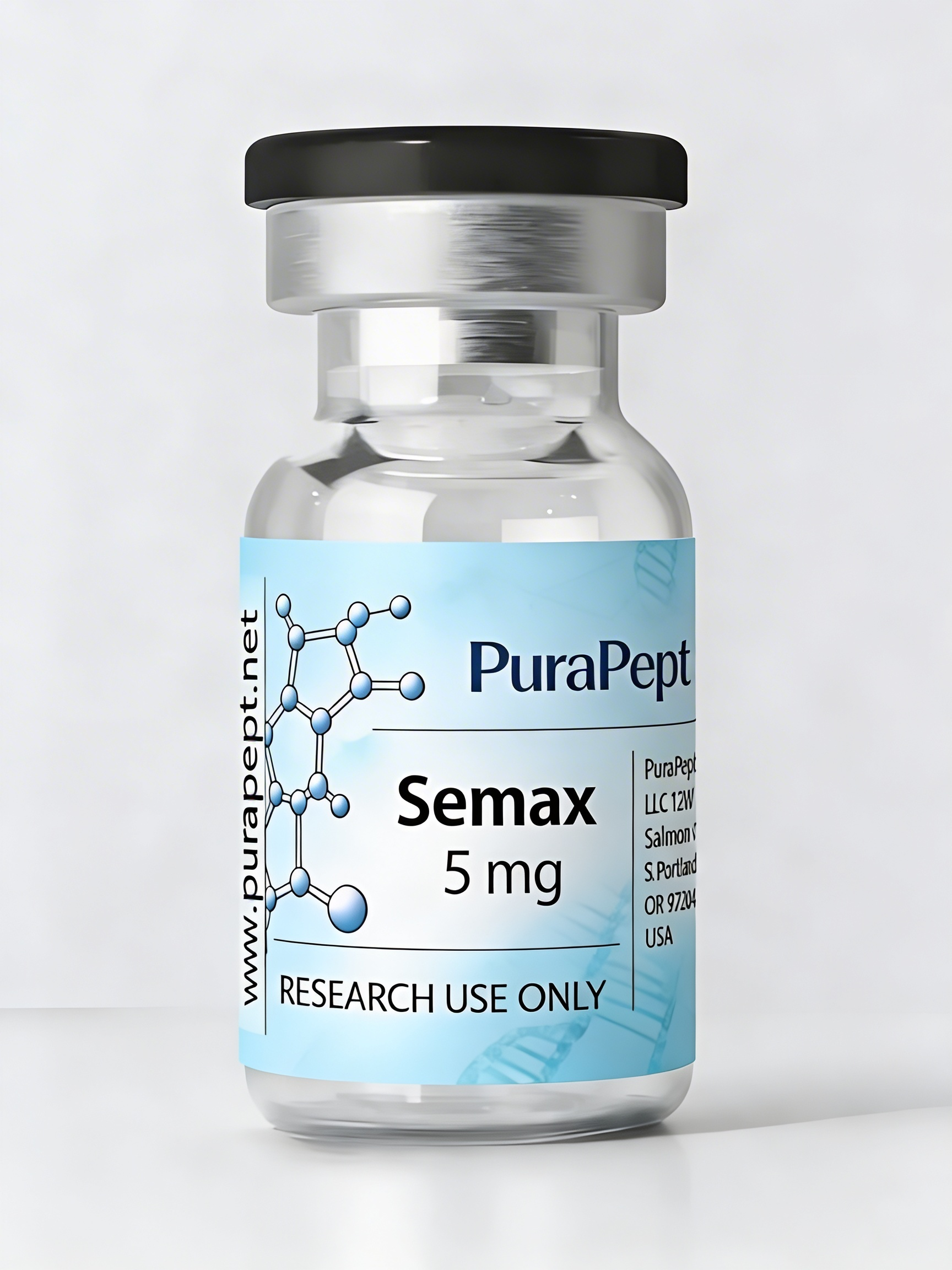
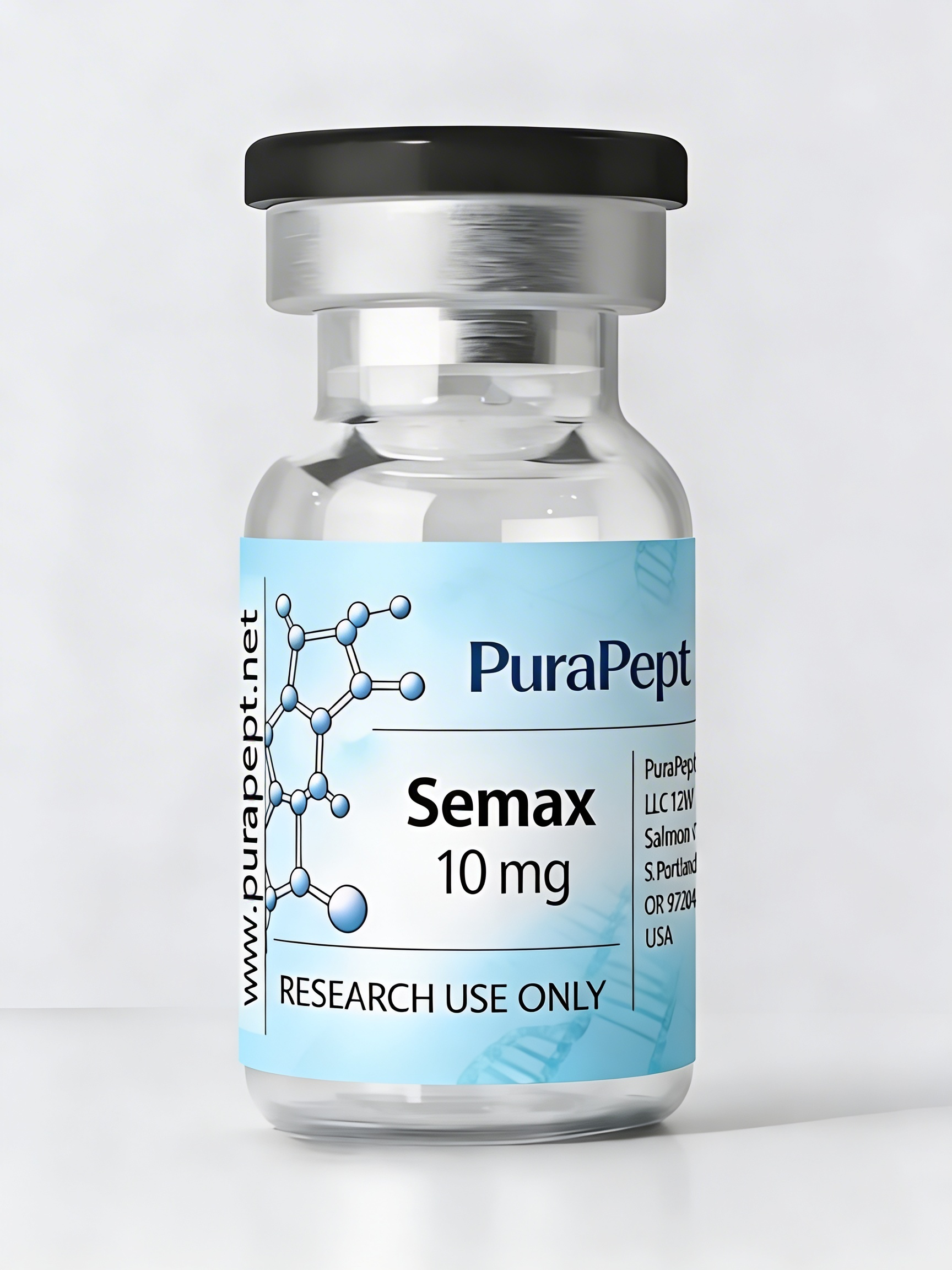 Semax 10 mg
 and Semax 5 mg are the same heptapeptide at two amounts — Met-Glu-His-Phe-Pro-Gly-Pro, an analogue of the N-terminal ACTH fragment 4-10. The compound has a real research literature, and the literature has a specific and lopsided shape: a small non-randomised human study, and a genuinely tidy set of cell and rodent experiments. This page lays out both and says which is which.
The human study, described as it was designed
The 1997 paper in Zhurnal Nevrologii i Psikhiatrii imeni S. S. Korsakova — published in Russian, with an English title in brackets — studied Semax in 30 patients in the acute period of hemispherical ischaemic stroke. The control group consisted of 80 patients with strokes analogous in severity and location of the damage, treated by conventional therapy.
That sentence is the whole design, and it needs no interpretation. Thirty exposed patients, eighty unexposed, and the control group was assembled to look comparable rather than randomised. Different clinical rating scales were used for both groups to objectivise severity and the degree of neurological deficit, and the functional control included EEG with mapping and repeated somatosensory evoked potentials with mapping.
The finding: including Semax in combined intensive therapy of acute ischaemic stroke had some influence on the rate of restoration of the damaged neurological functions, in terms of increasing the regression of general cerebral and focal, especially motor, disorders. The most effective daily doses reported were 12 mg for moderate-severity strokes and 18 mg for severe strokes, over courses of 5 and 10 days — reported here as the study’s own figures, not as anything to do with a product amount on this site.
Note the language the authors chose. “Some influence” on a rate of restoration, in a non-randomised comparison, with a control group selected for similarity. That is a real observation and a weak design, and a claim of a different order would be reading past it.
The rodent ischaemia experiment, which is the strong half
The 2001 paper in Brain Research is a properly controlled animal study and shows the compound at its clearest. The question was whether nitric oxide production and lipid peroxidation contribute to the pathophysiology of ischaemia, and whether glycine and Semax are neuroprotective through a mechanism involving regulation of nitric oxide and lipid peroxidation. The comparison compound was glycine, which is mechanistically adjacent — an ACTH(4-10) fragment itself.
The result: nitric oxide and indices of lipid peroxidation were elevated following global ischaemia. Glycine proved ineffective in reducing NO levels or ameliorating the neurological deficits. Semax proved highly effective in abating the rise in nitric oxide and restoring neurological functioning.
A built-in negative control, a defined biochemical mediator, and a functional endpoint. This is the best-designed paper in the file and it is still in rats.
The cell-culture result, and the caveat its authors left
The 2008 paper in Restorative Neurology and Neuroscience sits in primary cultures of rat basal forebrain, because cholinergic neurons of the basal forebrain degenerate in Alzheimer’s dementia. The authors note that although recent studies had concentrated on screening molecules that might reduce the concomitant cell loss, little was known about therapeutically promising ones, and that Semax is known to stimulate learning and memory and can be used for treatment of ischaemic stroke.
The findings: Semax may approximately 1.5- to 1.7-fold increase survival of cholinergic basal forebrain neurons in vitro; Semax at 100 nM stimulated choline acetyltransferase activity in dissociated basal forebrain tissue cultures; the numbers of GABA-ergic neurons and total neuron-specific-enolase neurons were not affected; and in concentrations from 1 nM to 10 µM Semax did not affect glial cell proliferation.
The authors’ closing sentence is the one to keep: implications of these findings with respect to Alzheimer’s disease remain to be clarified. A survival effect in a rat culture is a mechanism lead, and they said so.
The gene-expression time course, which is the most nuanced result
The 2010 paper in the Journal of Molecular Neuroscience is the one that resists a simple summary, and it is worth including for that reason. Male Wistar rats were treated with Semax and analysed at 20 minutes, 40 minutes, 90 minutes, 3 hours, 8 hours and 24 hours, with NGF and BDNF gene expression measured by real-time PCR in hippocampus, frontal cortex and retina.
What the authors found was multidirectional activation: both neurotrophin genes were decreased in rat hippocampus and retina 20 minutes after administration and increased in the frontal cortex. NGF expression levels remained practically constant in the retina at the initial stage, whereas BDNF expression levels were significantly increased 90 minutes after administration.
Read that as a time course with tissue-specific direction changes, at the level of gene transcription, over 24 hours. It is a real finding. It is also a reminder that “it modulates neurotrophin expression” is a much weaker sentence than the data.
What this record does not show
Not a randomised human result. The only human stroke study here compared 30 exposed patients against 80 non-randomised controls, and its own language is “some influence” on a rate of recovery.
Not a tissue-oxygenation or reperfusion result. Nothing here measures reperfusion time, infarct volume in humans, or functional outcome at scale.
Not an Alzheimer’s finding. The cholinergic-survival result is in rat primary culture, and its authors state the implications remain to be clarified.
Not a single-direction biological effect. The neurotrophin data are multidirectional across three tissues and six time points.
What we supply
Semax 10 mg and Semax 5 mg, as supplied by the manufacturer, tracked, from inside the EU. Batch documentation for any product that carries them is explained in the COA guide linked from the product page.
A weak human design alongside a strong mechanistic one is an unusual combination, and it is worth reading both rather than only the rat paper. Research use only. This page summarises published preclinical and clinical literature for research reference. It is not medical advice and not a suggestion for human use. Nothing we supply is for human or veterinary use.
References.
- Gusev EI, Skvortsova VI, Miasoedov NF, Nezavibat'ko VN, Zhuravleva EIu, Vanichkin AV. [Effectiveness of semax in acute period of hemispheric ischemic stroke (a clinical and electrophysiological study)]. Zh Nevrol Psikhiatr Im S S Korsakova 1997;97(6):26-34 (PMID 11517472).
- Bashkatova VG, Koshelev VB, Fadyukova OE, Alexeev AA, Vanin AF, Rayevsky KS, Ashmarin IP, Armstrong DM. Novel synthetic analogue of ACTH 4-10 (Semax) but not glycine prevents the enhanced nitric oxide generation in cerebral cortex of rats with incomplete global ischemia. Brain Res 2001;894(1):145-149 (PMID 11245825).
- Grivennikov IA, Dolotov OV, Zolotarev YA, Andreeva LA, Myasoedov NF, Leacher L, Black IB, Dreyfus CF. Effects of behaviorally active ACTH (4-10) analogue - Semax on rat basal forebrain cholinergic neurons. Restor Neurol Neurosci 2008;26(1):35-43 (PMID 18431004).
- Shadrina M, Kolomin T, Agapova T, Agniullin Y, Shram S, Slominsky P, Lymborska S, Myasoedov N. Comparison of the temporary dynamics of NGF and BDNF gene expression in rat hippocampus, frontal cortex, and retina under Semax action. J Mol Neurosci 2010;41(1):30-35 (PMID 19662538).