SS-31 and the anthracycline cardiotoxicity trials: the other half of the file
Elamipretide is the best-studied mitochondria-targeted peptide in clinical trials, and most of those trials are in inherited mitochondrial disease. The other file — protection against doxorubicin cardiotoxicity — is entirely animal and cellular, and it is the half the supplement marketing borrows.
12 November 2026 · 4 min read
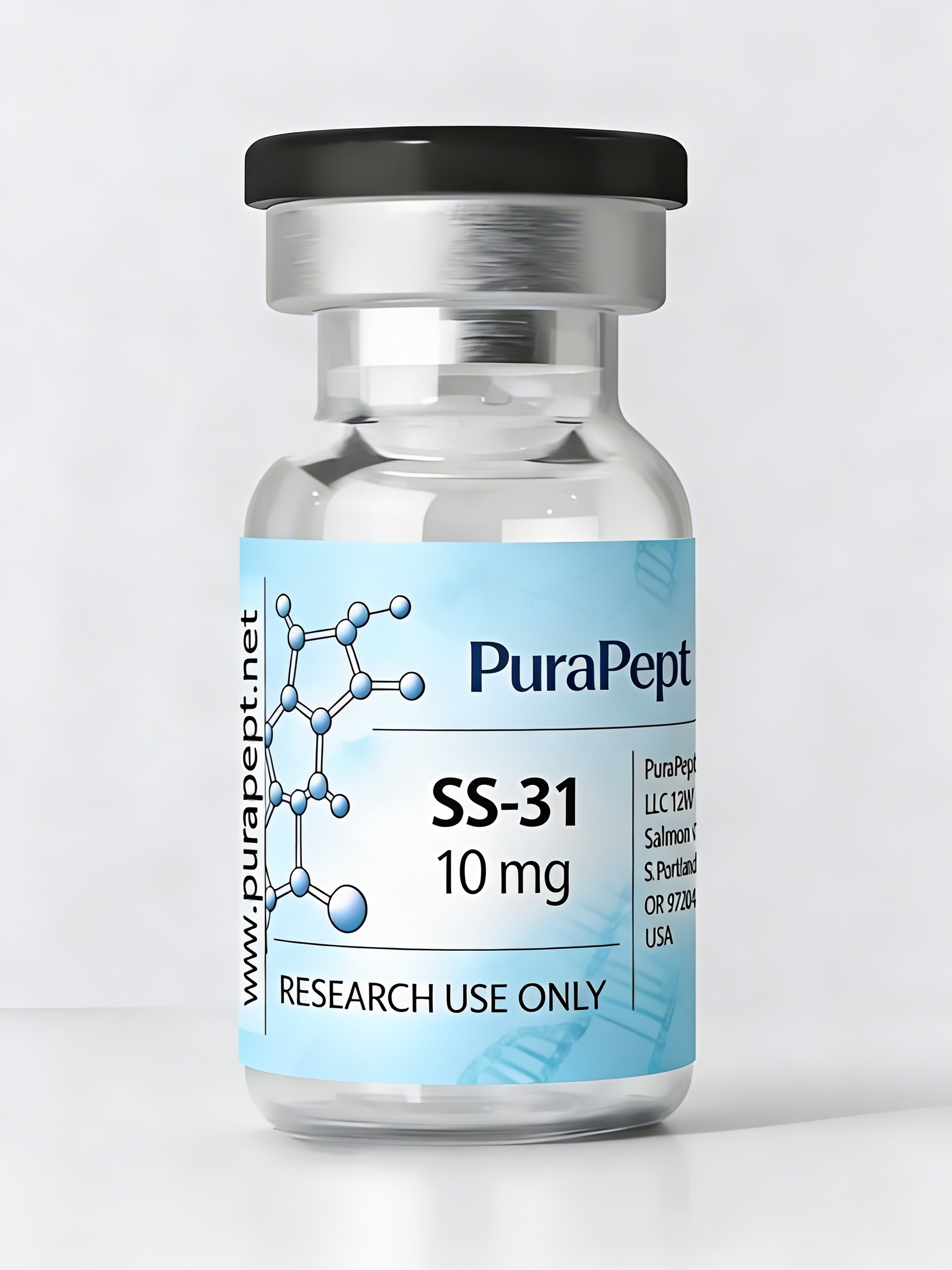 SS-31 10 mg
SS-31 is elamipretide, an aromatic-cationic tetrapeptide designed to cross the outer mitochondrial membrane and bind cardiolipin on the inner membrane. It has one of the more substantial translational files of any peptide in circulation, and this page is about the half of that file that is easiest to overstate: the anthracycline cardiotoxicity work.
The molecule, stated by the review that is most favourable to it
The 2022 review in Heart Failure Reviews describes elamipretide as a water-soluble, aromatic-cationic, mitochondria-targeting tetrapeptide that readily penetrates and transiently localizes to the inner mitochondrial membrane. It crosses the outer membrane and becomes associated with cardiolipin, a constituent phospholipid of the inner membrane. The stated mechanism is that therapy facilitates cell health by improving energy production and inhibiting excessive formation of reactive oxygen species, thereby alleviating oxidative stress.
The review’s clinical anchor is Barth syndrome — a rare, potentially fatal X-linked disease characterised by cardiomyopathy, skeletal muscle weakness, growth delays and cyclic neutropenia. It reports that elamipretide improves mitochondrial bioenergetics and morphology rapidly in induced pluripotent stem cells from Barth syndrome patients, and frames the evidence as supporting its use particularly where there is a confirmed diagnosis of cardiomyopathy. It is worth being clear about the kind of evidence that is: patient-derived cells, animal models, and a review arguing for further work. The same review is careful to describe the durability question as unresolved and to note the challenge of treating a disease this rare.
The anthracycline file, which is all preclinical
Doxorubicin is one of the most effective antitumour agents available and one of the most toxic to the heart. It localises to the inner mitochondrial membrane and promotes toxicity through enhanced mitochondrial reactive oxygen species production. That mechanism is precisely what a cardiolipin-binding peptide is designed to intercept, and two papers test exactly that.
The 2020 paper in the American Journal of Physiology used a mitochondria-targeted peptide as a cause-and-effect probe. Doxorubicin preferentially localises to the inner mitochondrial membrane, and the study asked whether the resulting ROS production is what drives pathological signalling through the autophagy/lysosomal system, the ubiquitin-proteasome pathway and the unfolded protein response. SS-31 was administered to doxorubicin-treated animals. The result was tissue-specific, and the specificity is the interesting part:
- In the heart, SS-31 prevented doxorubicin-induced proteolytic signalling through both the autophagy/lysosomal system and the ubiquitin-proteasome pathway.
- In the diaphragm, SS-31 inhibited the autophagy/lysosomal system but did not affect the proteasome pathway.
- Unfolded protein response signalling was activated at eIF2α S51 in both tissues and was attenuated with SS-31 in both.
- Downstream eIF2α signalling was diminished in the heart but upregulated in the diaphragm with doxorubicin.
So the peptide did not act as a single switch. The same intervention produced different proteolytic outcomes in heart and diaphragm, which is the finding an over-simple “protects the heart” claim cannot accommodate.
The 2021 paper goes further and asks about mechanism. In cardiomyocyte cells incubated with doxorubicin and in mice given a cumulative doxorubicin amount, SS31 exhibited a cardioprotective effect by attenuating ROS levels, stabilising the mitochondrial membrane potential, and ameliorating myocardial apoptosis and fibrosis following doxorubicin treatment. Mechanistically, the p38 MAPK signalling pathway was inhibited by SS31 in treated cells, and that inhibition was associated with the protective effect. The authors then performed the experiment that makes the mechanism claim falsifiable: a selective p38 MAPK agonist reversed the protective effects of SS31.
That is a well-built preclinical chain — intervention, target, and a rescue. It is also, entirely, in cells and mice.
What this record does not show
Not a clinical result in this indication. Both anthracycline papers are in animal models and cell lines. There is no human trial of elamipretide protecting a patient from doxorubicin cardiotoxicity in this file.
Not a uniform tissue effect. The same paper shows the proteasome arm was untouched in diaphragm while protected in heart.
Not a cardiotoxicity claim for a person receiving chemotherapy. Any such reading would be a leap from rodent models to an individual, and this page does not make it.
Not an approval. The review this page leans on most is itself an argument for further investigation in a rare inherited disease.
What we supply
SS-31 10 mg and SS-31 50 mg, as supplied by the manufacturer, tracked, from inside the EU. Batch documentation for any product that carries it is explained in the COA guide linked from the product page.
A peptide that blocks mitochondrial ROS and protects a mouse heart from doxorubicin is a real finding with a real rescue experiment. It is not the same thing as a treatment for a person on chemotherapy, and the two papers above are the reason to keep those apart. Research use only. This page summarises published mitochondrial pharmacology for research reference. It is not medical advice and not a suggestion for human use. Nothing we supply is for human or veterinary use.
References.
- Montalvo RN, Doerr V, Min K, Szeto HH, Smuder AJ. Doxorubicin-induced oxidative stress differentially regulates proteolytic signaling in cardiac and skeletal muscle. Am J Physiol Regul Integr Comp Physiol 2020;318(2):R227-R233 (PMID 31774307).
- Zhang L, Feng M, Wang X, Zhang H, Ding J, Cheng Z, et al. Peptide Szeto-Schiller 31 ameliorates doxorubicin-induced cardiotoxicity by inhibiting the activation of the p38 MAPK signaling pathway. Int J Mol Med 2021;47(4):63 (PMID 33649779).
- Sabbah HN. Elamipretide for Barth syndrome cardiomyopathy: gradual rebuilding of a failed power grid. Heart Fail Rev 2022;27(5):1911-1923 (PMID 34623544).