Lyophilised peptide storage and handling: what the literature actually measures
Freeze-dried peptide travels at room temperature and our own FAQ says so. Here is the published evidence behind that, and the three variables — temperature, humidity, water — that the papers measure when they look at a lyophilised vial.
30 September 2026 · 6 min read
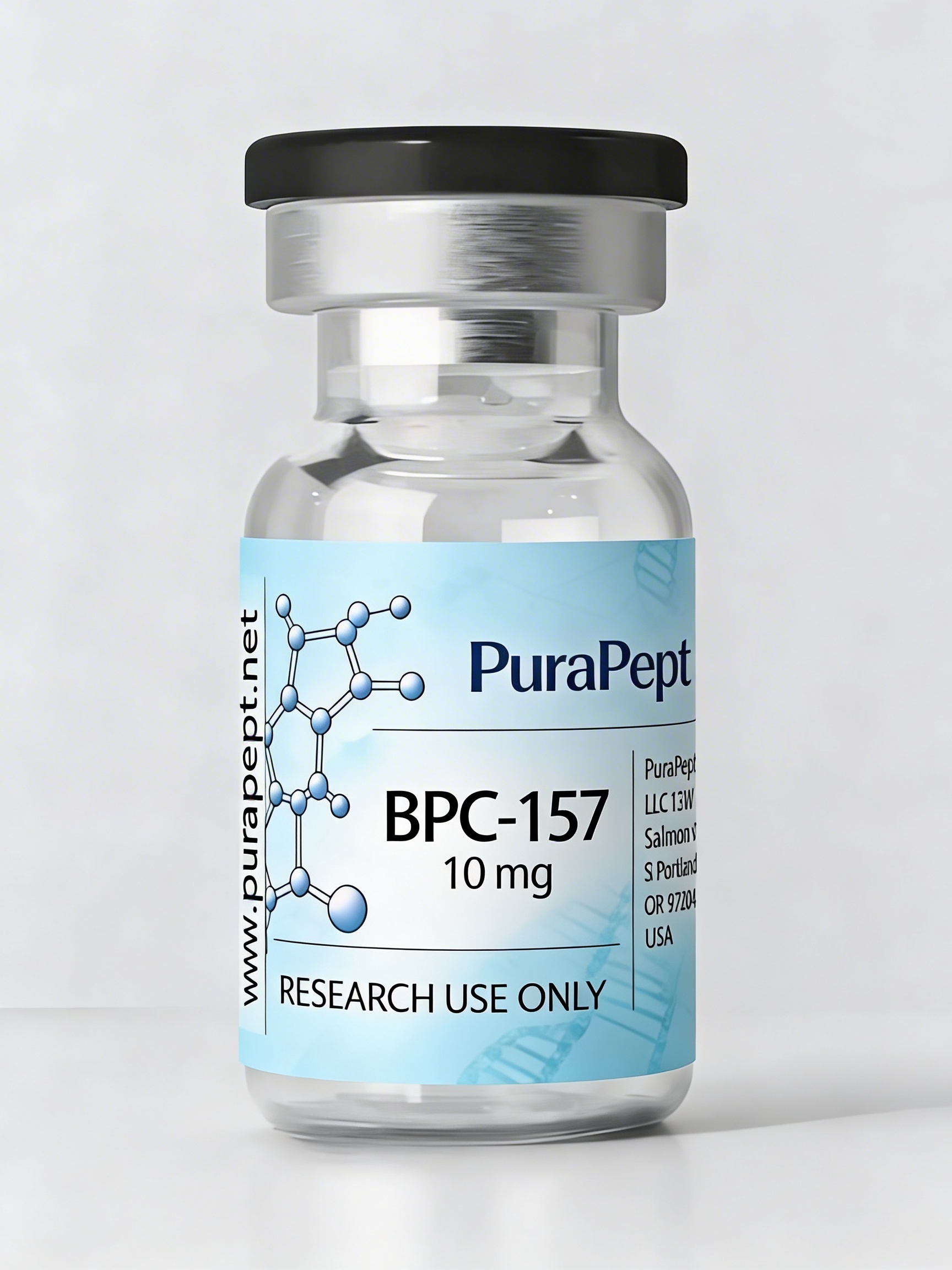 BPC-157 10 mg
Nobody in the peptide trade will ask this question the way a customer asks it. A researcher does: the vial arrives, it has been in a van and a depot and a hallway, and before the first experiment runs, the question is whether the material in the glass is still the material the paperwork described. This page answers it from the only place an honest answer lives — the published formulation literature — and separates clearly what our own operating facts are from what the papers report.
What we actually do, in our own words
Our FAQ on the store states it plainly, and nothing on this page changes it: “Does it need refrigeration in transit? No, and we do not ship cold.” and “Lyophilised peptide holds at room temperature in transit — typically 15–30 °C, out of direct light, never frozen. A parcel waiting in a hallway for a day is fine.”
The shipping page says the same thing from the other side: nothing travels refrigerated and nothing needs to, and once a vial is opened or reconstituted, follow what that vial’s page prints. There is no cold chain on our parcels and there is no cold-chain claim. Everything below is a statement about what the literature says about freeze-dried peptides, which is a different claim with a different author.
Why a freeze-dried solid is the right thing to send without refrigeration
The starting point is that a peptide in a liquid formulation is chemically fragile in a way the same peptide in a dry solid is not. Angkawinitwong and colleagues set out the general case in their review of solid-state protein formulations: when formulated as liquid dosage forms, therapeutic proteins and peptides often show instability during handling as a result of chemical degradation, and solid formulations are frequently required to maintain stability during storage, transport and upon administration. Freeze-drying is one of the three solidification techniques they discuss, alongside crystallisation and particle-forming technologies, and commercial freeze-dried products exist for several peptide and protein classes.
That is the whole argument for lyophilised presentation in a parcel: the degradation chemistry that needs a cold chain in solution is largely switched off in the solid state, so the material in transit is in the most chemically stable state the vial will ever be in. That is also the presentation our own FAQ describes, and the one the vial on this page arrives in: BPC-157 10 mg.
Temperature and humidity are not the same variable
The sharpest study on the page looked at a lyophilised peptide hormone formulation — human secretin — and stored samples at −20 °C, 4 °C, 25 °C, and 25 °C at 60 % relative humidity, then assayed them at time zero and at one, four and eight weeks by reverse-phase HPLC. What they found: by week eight the secretin concentration had fallen, reported as a 20 to 27 % decrease, and visual inspection and dynamic light scattering showed particulates, with particle size at 25 °C and 60 % RH going from roughly 390 nm at day zero to more than 2 µm as early as week one, and reconstitution time stretching from about 20 seconds at day zero to about 67 seconds at week eight. X-ray powder diffraction, thermal analysis and spectroscopy showed polymorphic transitions of mannitol and increasing crystallinity in the solid with time.
Read that carefully and it says something narrower and more useful than “peptides are fragile”. It says that a lyophilised peptide is a hygroscopic solid in a plastic or glass vial, and that humidity can act on it faster than heat does: the arm that behaved worst on that measure is 25 °C at 60 % RH, where particle size went past 2 µm as early as week one. It also says the label storage condition for that formulation was −20 °C, so every one of those warmer arms is an excursion away from a stated label — the study measures excursions, not room-temperature shelf life. For a vial that has spent a night in a hallway, the relevant literature is not “peptides must be cold”. It is “humidity and time are what you manage”.
Cold is not automatically safer
The teriparatide study by Merutka and colleagues is the paper that makes the point precisely, because it separates the solid from the liquid. Lyophilised formulations of PTH(1-34) containing glycine and trehalose in a lactate buffer were stable for months upon storage — the paper’s own words. After reconstitution, however, the physical stability varied considerably depending on peptide concentration and storage temperature, with precipitation seen within two to four weeks in some samples, while equivalent samples that had not been lyophilised showed no precipitation in the liquid state for as long as twelve weeks. The authors’ explanation is that PTH(1-34) appears to adopt a higher-order structure that the combined stresses of freezing and drying perturb, giving it a greater propensity to aggregate, a propensity accentuated at higher peptide concentration and higher temperature.
That is the reference for the word “never frozen” in our FAQ. Freezing and drying is a manufacturing step with a structural cost, not a free upgrade. And cold is not a preservative in the other direction either: in a ten-month longitudinal study of tryptic peptides stored frozen in acid, conditions common to proteomics sample preparation, degradation and loss still occurred and the conclusion drawn was that optimal storage of such peptides is at −80 °C and ideally in separate aliquots. A freezer does not stop peptide chemistry. It slows it.
Water is the variable nobody prints
The reason a freeze-dried vial is not inert is that it is not dry. Chen and Topp quantified peptide–matrix interactions in lyophilized solids using photolytic labeling: a model peptide derived from salmon calcitonin was labeled, formulated with excipients, lyophilized and probed. Peptide–excipient adducts were detected in the lyophilized solids with every excipient tested except NaCl, and — the result worth remembering — the fractional conversion to peptide–water adducts in the solid was poorly correlated with bulk moisture content, suggesting the local water content near the labeled residue differs from the measured bulk average.
That is a technical sentence with a plain reading: a moisture number printed on a certificate describes the average of the vial, not the water molecule sitting next to the residue that matters. Meyer and colleagues reached a compatible conclusion on a different molecule, showing that in a freeze-dried antibody the choice of bulking agent changed solid-state stability and that, where infrared spectroscopy could be applied, maintenance of secondary structure predicted storage stability better than the composition list did. The solid is a structure, not a powder, and which stabiliser went into it is part of the material.
After the vial is opened
Everything above concerns the sealed vial in transit, which is the part we control and the part our FAQ promises. It says nothing about the opened vial, and this page deliberately stops there: what happens after opening depends on the specific peptide, the specific excipients, and the specific liquid, and the honest source for that is whatever the supplier prints for that product. We do not publish general reconstitution or working-solution guidance, and a page that did would be advice rather than evidence. Follow the vial’s own page, and treat any number you find here as a statement about published work, not about your parcel.
What the data do not show
They do not show a shelf life for any vial we supply, an expiry, or a validated transit stability for any compound — no such figure is printed on the store, because none has been established for this material and inventing one is the one thing the product data rules forbid. They also do not transfer between molecules: the 20 to 27 % decrease at eight weeks is a fact about a particular secretin formulation with mannitol at particular humidity, not a general property of peptides and not a prediction about anything in your parcel. The storage literature describes how a freeze-dried solid behaves under defined conditions; it does not certify an unlabelled vial, and no page on this site will pretend otherwise.
Research use only. This page summarises published pharmaceutical-formulation literature for research reference. It is not medical advice, not storage advice for a specific product, and not a suggestion for human use. Nothing we supply is for human or veterinary use.
References.
- Srinivasan C, Siddiqui A, Korang-Yeboah M, Khan MA. Stability characterization and appearance of particulates in a lyophilized formulation of a model peptide hormone-human secretin. Int J Pharm 2015;481(1-2):104-113. PubMed record (PMID 25636302).
- Merutka G, Murphy BM, Payne RW, Wilson GA, Matsuura JE, Henry CS, et al. Stability of lyophilized teriparatide, PTH(1-34), after reconstitution. Eur J Pharm Biopharm 2016;99:84-93. PubMed record (PMID 26620825).
- Chen Y, Topp EM. Quantitative analysis of peptide-matrix interactions in lyophilized solids using photolytic labeling. Mol Pharm 2018;15(7):2797-2806. PubMed record (PMID 29792715).
- Meyer JD, Nayar R, Manning MC. Impact of bulking agents on the stability of a lyophilized monoclonal antibody. Eur J Pharm Sci 2009;38(1):29-38. PubMed record (PMID 19467324).
- Angkawinitwong U, Sharma G, Khaw PT, Brocchini S, Williams GR. Solid-state protein formulations. Ther Deliv 2015;6(1):59-82. PubMed record (PMID 25565441).
- Planyavsky M, Huber ML, Staller NA, Müller AC, Bennett KL. A longitudinal proteomic assessment of peptide degradation and loss under acidic storage conditions. Anal Biochem 2015;473:11-13. PubMed record (PMID 25479603).