Thymosin alpha-1 outside oncology: what the trials measured
A 2026 Cochrane review of 10 randomised hepatitis B trials, 1349 participants, graded every thymosin alpha-1 benefit as very low certainty.
4 October 2026 · 7 min read
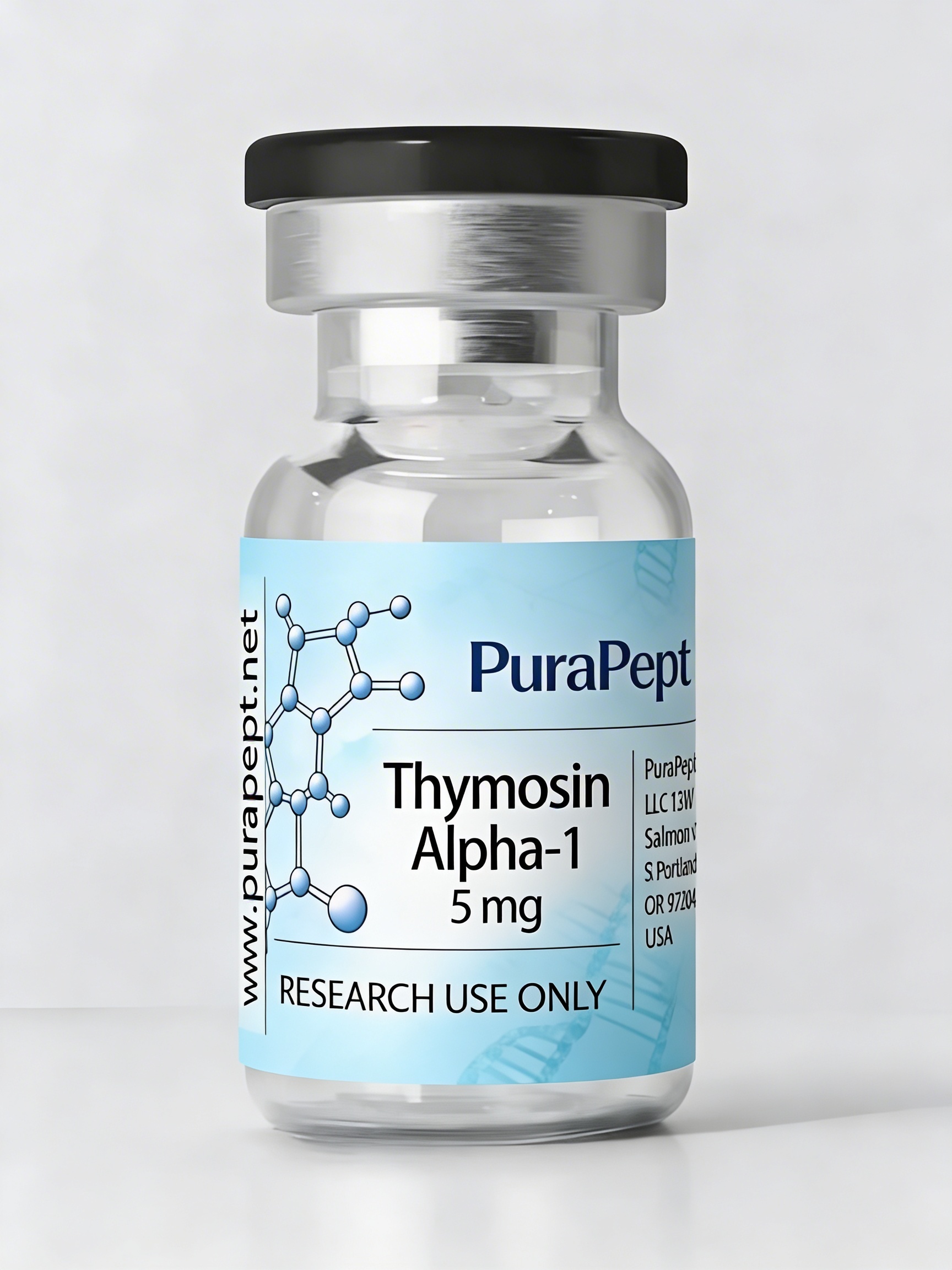 Thymosin Alpha-1 5 mg
Thymosin alpha-1 is one of those molecules that turns up constantly in forum threads and almost never in a properly graded evidence review. That imbalance ends now, because in 2026 the Cochrane Hepato-Biliary Group published a full synthesis of the randomised evidence for chronic hepatitis B. It is a certainty grade, and it is very low for everything that was supposed to work.
What Cochrane actually found, in its own numbers
Ten randomised trials, 1349 randomised participants, a range from 12 to 690 per trial, 1045 of them male. Conducted in Bangladesh, China, Italy, Korea, Singapore and Taiwan, published between 1991 and 2018, ages 17 to 75. Four trials were industry funded, five research grants, one said nothing.
The results, each with Cochrane’s certainty grade attached:
- All-cause mortality: risk ratio 0.53, 95% CI 0.29 to 0.96, from 3 studies and 907 participants. Very low certainty.
- HBV-related mortality: risk ratio 0.53, 0.29 to 0.96, 3 studies, 907 participants. Very low certainty.
- Serious adverse events: risk ratio 0.72, 0.53 to 0.99, 5 studies, 1056 participants. Low certainty.
- Non-serious adverse events: risk ratio 0.47, 0.27 to 0.83, 5 studies, 300 participants. Very low certainty.
- HBV-related morbidity: risk ratio 0.86, 0.54 to 1.40, 3 studies, 854 participants. Very low certainty.
- Histological improvement: risk ratio 0.51, 0.13 to 2.06, heterogeneity 74%, 2 studies, 702 participants. Very low certainty.
- Health-related quality of life: mean difference 0.70 on a 0 to 100 scale, confidence interval minus 2.55 to 3.95, one study, 161 participants. Very low certainty.
Read those honestly. Four of the seven do not cross the line of no effect, and Cochrane still graded three of those four very low certainty and one low, for stated reasons: risk-of-bias concerns, wide intervals, small participant numbers, and 74% heterogeneity. Three small trials can produce an interval clear of 1 and still carry very low certainty; that gap is the finding. The other three cross the null.
So: a molecule that may reduce mortality on the strength of three trials graded very low for certainty, and a molecule whose better-documented effect is fewer adverse events.
The 2008 meta-analysis that looked better, and why it does not rescue it
Eighteen years earlier, a meta-analysis compared thymosin alpha-1 directly against interferon alpha in four randomised trials with 199 chronic hepatitis B patients. The trials were small and inconsistent, the authors said so in their own abstract. At the end of six months of treatment, thymosin was behind: odds ratio 0.62 for virological response, 0.60 for biochemical, 0.54 for complete response. Six months after treatment ended, it was ahead: 3.71, 3.12 and 2.69, which the authors read as a benefit that accumulates rather than an immediate one.
Read next to the 2026 review, that is not a vindication. It is an older synthesis of a smaller evidence base reaching a more favourable conclusion that the newer review graded as very low certainty. When two syntheses of the same drug disagree, the one that graded its own uncertainty is the more useful document.
Hepatitis C, where the source itself is blunt
The 2001 pharmacology review is unusually honest, which is why it is worth reading still. Across 195 patients in four hepatitis B trials it tabulates the results: HBV DNA clearance at six months in 9 of 17 patients on thymosin alpha-1, against 10 of 16 on interferon alfa-2b and 4 of 15 historical controls. A randomised controlled trial found 40.6% and 25.6% at six and twelve months against 9.4% in untreated controls.
For hepatitis C it reports 162 patients across three trials, and in one of them the number of patients reaching normal ALT did not differ significantly between thymosin alpha-1 and placebo. The two combination trials are more flattering, at 71% against 35% and 37.1% against 16.2% against 2.7% for placebo. The closing line is the one to quote: its effects on morbidity and mortality remain to be seen. A later review of the same adjunctive role in hepatitis C, from 2010, is blunter still: clinical trials have failed to conclusively support the role in combination interferon-based therapies, so the promise remains but the proof will require large randomised trials in appropriate populations.
The vaccine study: a real trial with a real trade-off
There is one clean randomised trial outside liver disease, Haemodialysis patients received an adjuvanted pandemic H1N1v influenza vaccine alone, or the vaccine plus thymosin alpha-1 at one of two amounts. Immune response was measured by three assays on days 0, 21, 42, 84 and 168, with 94 patients in the intention-to-treat set, 82 per protocol and 99 in the safety set.
On day 21, both vaccine-plus-thymosin groups beat vaccine alone on haemagglutination-inhibition geometric mean titre and geometric mean ratio, and a large proportion of the intention-to-treat patients in both combination groups had seroconverted. 40% seroconversion, 70% seroprotected at 21 days and a 2.5-fold rise in adults, with 30%, 60% and 2-fold in the elderly. The paper prints the thresholds, which is unusual and useful. Those criteria were fully met in the two combination groups. No adverse event was attributed to the thymosin or to the vaccine.
Now the part that gets left out of summaries. On day 42, the decrease in titre was greater in the combination groups than in the vaccine-only group. The authors say further studies in larger haemodialysis populations are necessary. Read that as what it is: a pilot study in one population, with a trade-off in the curve and no clinical outcome measured.
Sepsis, and the COVID material
A 2018 review of thymosin alpha-1 in sepsis, drawing on English and Chinese databases, reports that single or combined treatment reduced sepsis mortality, improved monocyte HLA-DR expression and reduced secondary infections. Its authors then set two limits on their own review: sepsis is a remarkably heterogeneous syndrome, so much so that it is impossible to generalize the clinical results to all septic patients; and the present studies cannot focus on the immunosuppressive individuals, who the authors argue are the ones most likely to reveal the effect.
The pandemic-era material needs the same care. A 2023 immunology study found that activation markers including CD40, CD80 and TIM-3 were upregulated in the presence of thymosin alpha-1, especially in plasmacytoid dendritic cells, and that co-cultures of T cells with those treated dendritic cells produced decreased cytokine production in response to SARS-CoV-2 peptides. That is cell culture, and a 2020 review of the wider literature likewise calls for further investigation rather than conclusions (World J Virol, PMID 33362999).
Where this sits on the shelf
We carry thymosin alpha-1, alongside thymulin as the other thymic-derived peptide here. For a different approved molecule with one narrow, well-studied indication, tesamorelin in HIV lipodystrophy is the closest thing on this desk.
What the data do not show
No study here shows thymosin alpha-1 improving a hard clinical outcome to any standard a reviewer would accept. Cochrane grades mortality, morbidity, histology and quality of life as very low certainty, and the single outcome graded low is serious adverse events, which is a harm rather than a benefit. Four of the seven intervals clear the line of no effect; all four rest on very low or low certainty and, for the mortality outcomes, on three studies.
The vaccine data are antibody titres in haemodialysis patients on a pandemic adjuvanted vaccine. That does not transfer to any other population, and titres are not infection, hospitalisation or survival. The sepsis literature draws substantially on Chinese databases, and the review summarising it states that its own results cannot be generalised. The COVID material is cell culture. None of these trials enrolled a healthy volunteer, so nothing here describes what this molecule does in a well person.
A molecule with a decade of randomised trials behind it and a best evidence grade of very low needs more trials. Its case is not closed.
What we supply
The thymosin alpha-1 preparation above, as supplied by the manufacturer, tracked, from inside the EU. Batch documentation for every product that carries any is explained in the COA guide linked from the product page.
Research use only. This page summarises published trials and evidence syntheses for research reference. It is not medical advice, not a protocol, and not a suggestion for human use. Nothing we supply is for human or veterinary use.
References.
- Naing K, Ni Z, Aung S, et al. Thymosin-θ1 for people with chronic hepatitis B. Cochrane Database Syst Rev 2026;9(9) (PMID 42713852).
- Carraro M, Naso F, Montomoli E, et al. Thymosin-alpha 1 (Zadaxin) enhances the immunogenicity of an adjuvated pandemic H1N1v influenza vaccine (Focetria) in hemodialyzed patients: a pilot study. Vaccine 2012;30(6) (PMID 22178096).
- Yang X, Zhao J, Zhong Y, et al. Comparison of the efficacy of thymosin alpha-1 and interferon alpha in the treatment of chronic hepatitis B: a meta-analysis. Antiviral Res 2008;77(2) (PMID 18078676).
- Ancell KB, Phipps SM, Young JB. Thymosin alpha-1. Am J Health Syst Pharm 2001;58(10):886-890 (PMID 11381492).
- Sherman M. Thymosin alpha 1 for treatment of hepatitis C virus: promise and proof. Ann N Y Acad Sci 2010;1194 (PMID 20536461).
- Pei F, Guan X, Wu J, et al. Thymosin alpha 1 treatment for patients with sepsis. Expert Opin Biol Ther 2018;18(sup1) (PMID 30063866).
- Dominari S, Hathaway Iii G, Pandav K, et al. Thymosin alpha 1: A comprehensive review of the literature. World J Virol 2020;9(5) (PMID 33362999).
- The use of alpha 1 thymosin as an immunomodulator of the response against SARS-Cov2. Immun Ageing 2023;20 (PMID 37408063). In vitro cell-culture study.