Thymulin: a mechanism literature and almost no clinical trial
Thymulin has been isolated, sequenced and characterised for over fifty years, and the 2010 reviews that describe its anti-inflammatory activity conclude in the same breath that it is a candidate for future clinical trials. The 2026 immunology paper identifying it as an age-associated regulator is done in mice, parabiosis and bone-marrow chimeras. This page counts the human record.
19 October 2026 · 3 min read
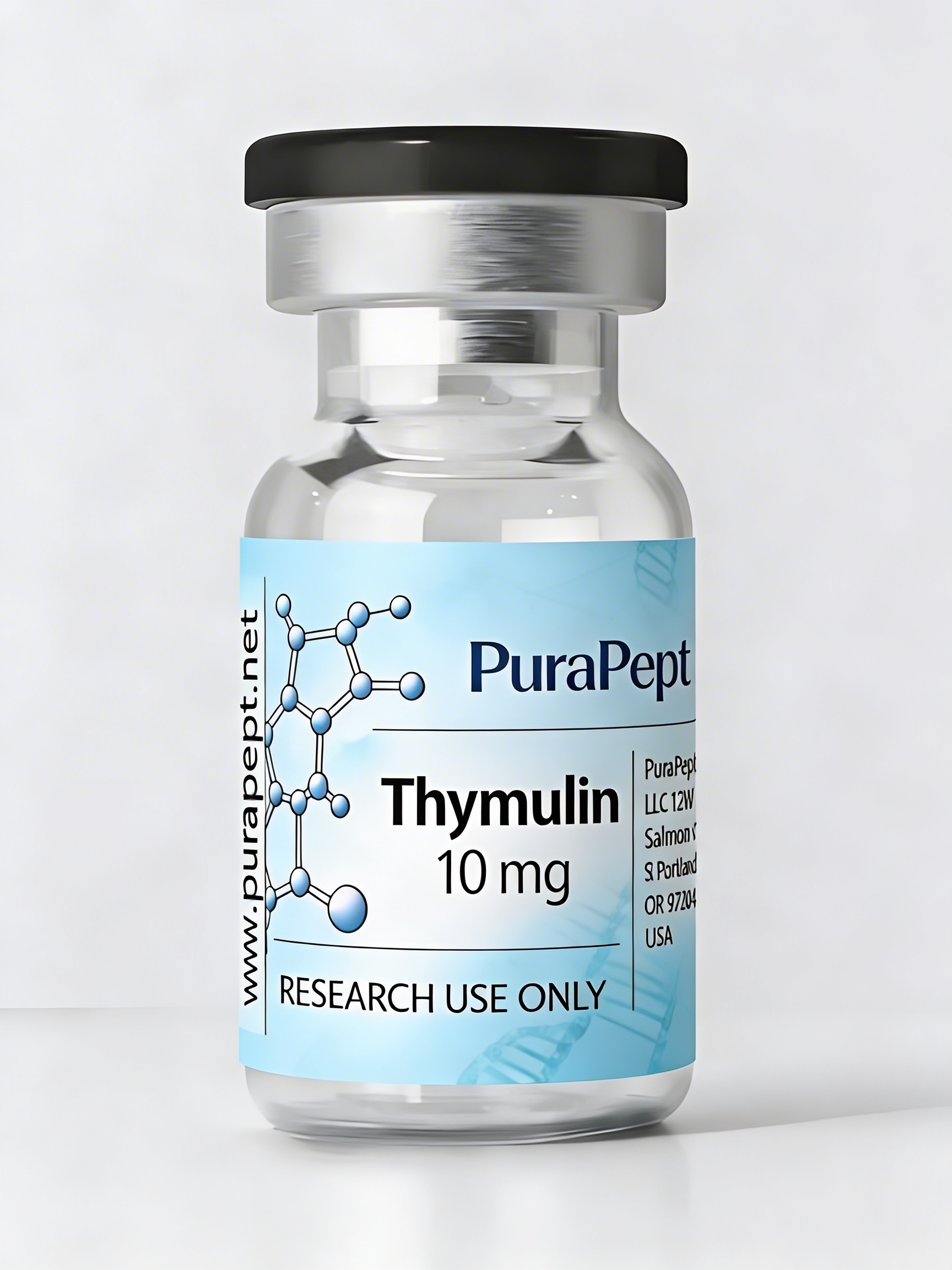 Thymulin 10 mg
Thymulin is a peptide produced in the thymus, identified more than forty years ago as a thymic hormone involved in immunomodulation. That is a real and long history. It is also not the same thing as a clinical trial record, and this page is mostly about the distance between the two.
The mechanism literature is substantial
Start with the 2026 Nature Communications paper, which is the most substantial recent work. It identifies an increased frequency of pro-inflammatory myeloid cells in aged mice and humans, characterised by elevated IL-1α, IL-1β, IL-6 and TNF-α, and shows that those cells are enriched in the breast tumour microenvironment. Using heterochronic parabiosis and bone marrow chimeras, the authors attribute the suppression of that inflammatory activation to non-bone-marrow-derived circulating factors present in young hosts. Integrative analyses then identify thymulin — described as a thymus-derived peptide that declines with age — as a mediator that suppresses pro-inflammatory cytokine production by inhibiting NF-κB signalling. The paper further reports that thymulin enhances anti-tumour T-cell immunity, improves tumour control and survival, and sensitises tumours to anti-PD-L1 therapy, in an age-dependent manner.
Read the methods with care: parabiosis, bone-marrow chimeras and the aging experiments are mouse and cellular work. Human material appears in the abstract only as cells characterised for cytokine production.
The 2010 reviews, and the sentence in them
Two Expert Opinion on Therapeutic Targets reviews from 2010 are the standard summaries, and they are unusually useful because of how they end.
The lung diseases review states that thymulin has consistent beneficial effects in experimental models of lung disease, inhibits pro-inflammatory cytokines broadly, suppresses p38 — a MAPK family member implicated in glucocorticoid resistance — and inhibits NF-κB activation. On toxicity it says the peptide has no toxicity even at high doses and, when expressed by adenoviral vectors, reduces the immune response against viral proteins. Then the take-home message: the breadth of effects across animal models makes thymulin a good candidate for future clinical trials.
The broader review covers thymulin, thymosin-alpha and thymopoietin as prospective anti-inflammatory agents, and proposes that their regulation of inflammatory processes could be therapeutically useful, mediated through effects on peripheral immune cell activity and bidirectional coupling with the hypothalamic-pituitary-adrenal axis.
Both reviews are mechanism and animal work, and both say the human trials are the thing still missing. That is the field stating its own gap in its own words.
What human work exists at all
The historical picture is thinner than the mechanistic literature. A 1992 review notes that diminished thymulin levels had been observed in immunodeficiency and autoimmune disease by semiquantitative bioassay, and that radioimmunoassay data confirmed those observations and suggested a role in the interaction between the immune system and the neuro-endocrine system. Thirty-odd years later, that framing — thymulin as a biomarker observed in disease — has not been replaced by a clinical trial record on this page.
The analgesic literature is worth a separate note, because it inverts expectations. The 2006 review reports that low, nanogram-scale local or systemic injections produced hyperalgesia with increased pro-inflammatory mediators, apparently acting directly on afferent nerve terminals through prostaglandin-E2-dependent mechanisms. Higher systemic amounts of thymulin, or of an analogue peptide deprived of that hyperalgesic effect, reduced inflammatory pain and the cytokine upregulation induced by endotoxin, and intracerebroventricular pretreatment reduced endotoxin-induced hyperalgesia in a dose-dependent manner. So in that body of work, the low end and the high end of the same peptide produce opposite effects.
A separate review of thymulin-related peptide in neuropathic pain covers the same mechanism-versus-clinical distance, reviewing how targeting inflammatory mediators may function in neuropathic pain.
What the data do not show
They do not show a randomised human efficacy trial for thymulin in any indication. Every clinical statement on this page is a statement about a biomarker, a review, or an animal model.
They do not show that thymulin is immunomodulatory in people in the therapeutic sense. The cytokine effects described here are in cells, mice and experimental disease models.
They do not show a monotone dose-response in humans. The one body of work that mapped the curve found hyperalgesia at low amounts and anti-inflammatory effects at higher systemic amounts.
They do not show a tolerability profile in a human sample large enough to describe one.
Where this sits on the shelf
The compound as supplied by the manufacturer: Thymulin 10 mg
What we supply
The thymulin preparation above, as supplied by the manufacturer, tracked, from inside the EU.
Research use only. This page summarises published studies for research reference. It is not medical advice, not a protocol, and not a suggestion for human use. Nothing we supply is for human or veterinary use.
References.
- Kanemaru H, et al. Thymulin restrains age-associated myeloid inflammation and enhances cancer immunotherapy. Nat Commun 2026;17(1).
- Santos M, et al. Immunomodulatory role of thymulin in lung diseases. Expert Opin Ther Targets 2010;14(2):131-141.
- Lunin SM, et al. Thymus hormones as prospective anti-inflammatory agents. Expert Opin Ther Targets 2010;14(8):775-786.
- Safieh-Garabedian B, et al. Thymulin and its role in immunomodulation. J Autoimmun 1992;5(5):547-555.
- Dardenne M, et al. Role of thymulin or its analogue as a new analgesic molecule. Ann N Y Acad Sci 2006;1088:153-163.
- Safieh-Garabedian B, Nomikos M, Saadé N, et al. Targeting inflammatory components in neuropathic pain: The analgesic effect of thymulin related peptide. Neurosci Lett 2019;702:61-65.