CJC-1295 with DAC: the half-life is the whole story
The acylated CJC-1295 is GHRH(1-29) with a maleimido group at the C-terminus that covalently binds albumin, and that conjugation is the entire pharmacological difference from the non-acylated form. The 2006 ascending-dose trials in healthy adults report an estimated half-life of 5.8-8.1 days, GH up 2-10-fold for 6 days or more and IGF-I up 1.5-3-fold for 9-11 days. There is a dedicated younglab page on the non-acylated form; this one is the other molecule.
27 October 2026 · 3 min read
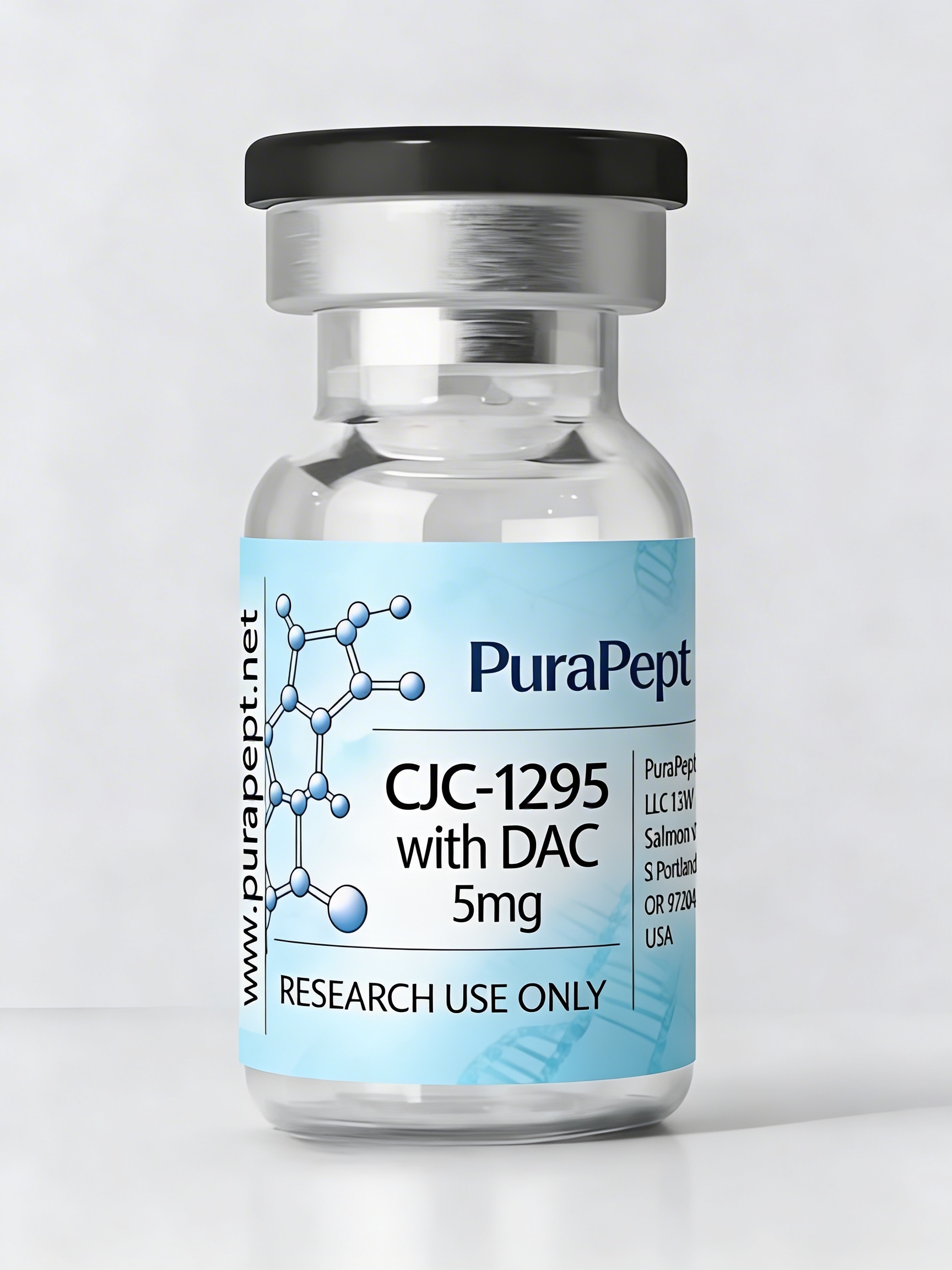
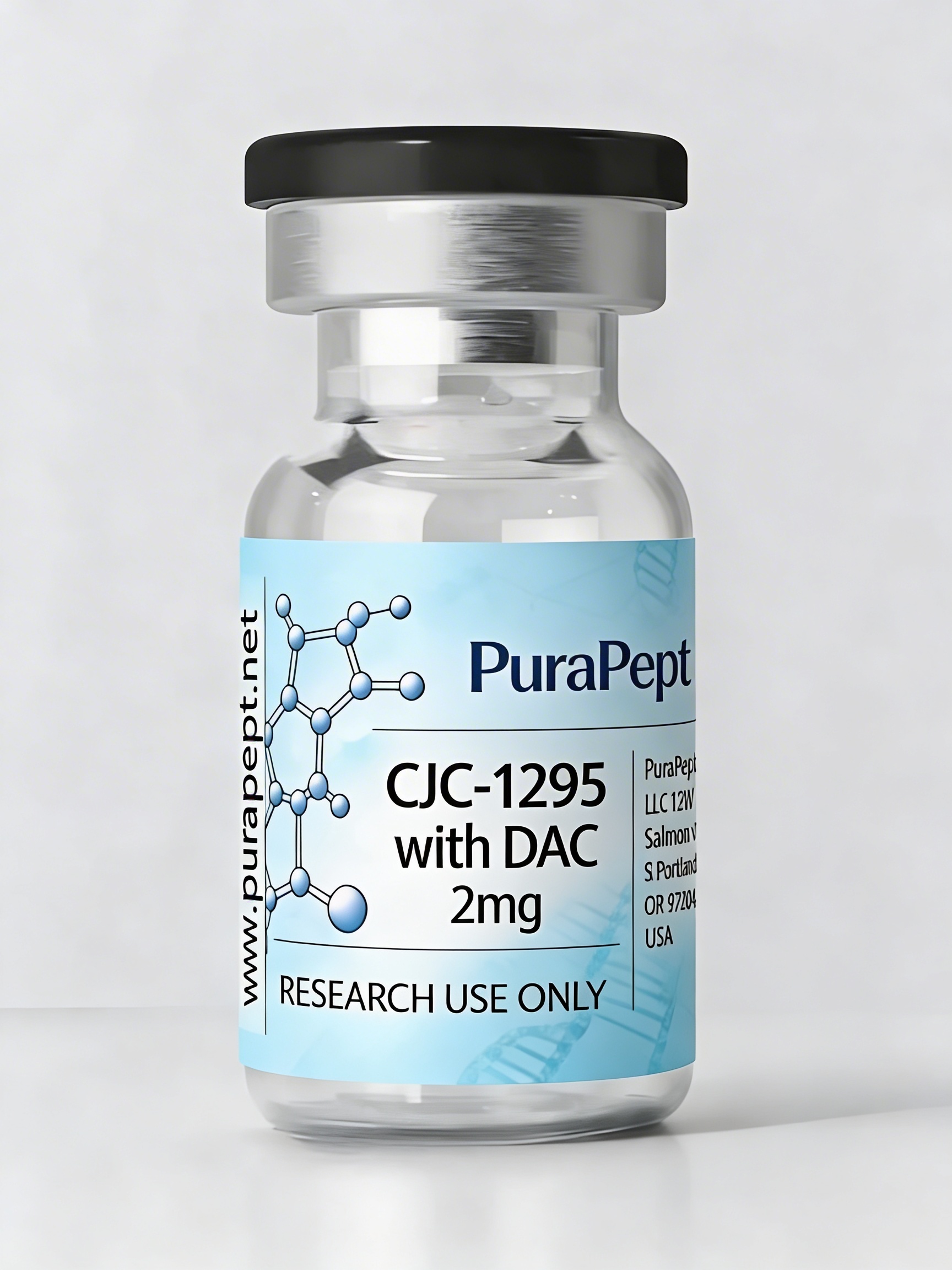 CJC-1295 with DAC 2 mg
This site has a separate page on CJC-1295 without DAC. This one is the other molecule, and the difference between them is not a small one — it is a covalent bond.
What the DAC actually is
A 2019 Drug Testing and Analysis paper states the chemistry directly: CJC-1295 is a peptide-based drug that stimulates growth hormone production from the pituitary, and it incorporates a functional maleimido group at the C-terminus that allows it to covalently bind plasma proteins such as serum albumin. These CJC-1295-protein conjugates have a much greater half-life than the unconjugated peptide, and are capable of stimulating GH production for more than six days in humans after a single administration.
That single sentence is the whole pharmacological difference. The non-acylated form relies on renal clearance and the GHRH receptor; the acylated form is carried around bound to albumin. Anyone reading a “CJC-1295” study has to know which one it is.
The two ascending-dose trials, in healthy adults
The 2006 Journal of Clinical Endocrinology and Metabolism paper is the human pharmacology study for the acylated form. The design was two randomized, placebo-controlled, double-blind, ascending dose trials with durations of 28 and 49 days, at two investigational sites, in healthy subjects aged 21 to 61. CJC-1295 or placebo was administered subcutaneously as one of four ascending single doses in the first study, and in two or three weekly or biweekly doses in the second.
The pharmacokinetic and pharmacodynamic results, as printed:
- After a single injection, dose-dependent increases in mean plasma GH concentrations by 2- to 10-fold for 6 d or more
- Increases in mean plasma IGF-I concentrations by 1.5- to 3-fold for 9-11 d
- Estimated half-life of CJC-1295 was 5.8-8.1 d
- After multiple doses, mean IGF-I levels remained above baseline for up to 28 d
- No serious adverse reactions were reported
- Well tolerated, particularly at doses of 30 or 60 microg/kg, with evidence of a cumulative effect after multiple doses
The main outcome measures were peak concentrations and area under the curve of GH and IGF-I. Everything printed is a concentration: no body composition, no bone, no strength, no cardiovascular endpoint, and no duration beyond 49 days.
The analytical consequence of the conjugation
The same 2019 paper carries a detail that matters for anyone handling this compound. Conjugated CJC-1295 is difficult to detect in blood by mass spectrometry due to its low abundance, high molecular weight, and conjugation to a range of different protein substrates. The paper describes a screening procedure using an immuno-PCR assay in equine plasma, and then confirms CJC-1295 by LC-MS/MS after immuno-affinity capture and tryptic digestion, identifying it down to 180 pg/mL in 1 mL of equine plasma.
The species matters for the headline number — that is equine plasma — but the chemistry is the point. If the peptide is covalently attached to a range of host proteins, “the peptide” in a sample is not one molecular species, and a screen that looks for free peptide is looking for the minority fraction.
What the data do not show
They do not show a body composition, muscle, bone or strength outcome. Both trials measure GH and IGF-I concentrations, and that is all.
They do not show an endpoint beyond 49 days of treatment, or any follow-up after discontinuation.
They do not show a dose-response above 60 microg/kg. The 2006 paper names 30 and 60 microg/kg as the doses at which the compound was well tolerated; nothing above that is printed here.
They do not show a clean blood assay by mass spectrometry. The 2019 paper states conjugated CJC-1295 is difficult to detect that way, and the 180 pg/mL limit of detection is an equine plasma figure reached after immuno-affinity capture and tryptic digestion.
They do not transfer to the non-acylated form. The half-life printed here belongs to the acylated molecule, and the page on the non-acylated form is the one to read for that.
One catalogue note, stated as a limit rather than as guidance: the presentations on this site are the 2 mg and 5 mg acylated vials, and the compound also appears on this shelf combined with ipamorelin. No abstract cited here tests that combination, and the 2006 paper did not include it.
Where this sits on the shelf
The compounds as supplied by the manufacturer: the 2 mg acylated presentation · the 5 mg acylated presentation
What we supply
The acylated CJC-1295 preparations above, as supplied by the manufacturer, tracked, from inside the EU.
Research use only. This page summarises published studies for research reference. It is not medical advice, not a protocol, and not a suggestion for human use. Nothing we supply is for human or veterinary use.
References.
- Teichman SL, Neale A, Lawrence B, Gagnon C, Castaigne JP, Frohman LA. Prolonged stimulation of growth hormone (GH) and insulin-like growth factor I secretion by CJC-1295, a long-acting analog of GH-releasing hormone, in healthy adults. J Clin Endocrinol Metab 2006 Mar;91(3):799-805.
- Timms M, Ganio K, Steel R. A method for confirming CJC-1295 abuse in equine plasma samples by LC-MS/MS. Drug Test Anal 2019 Aug;11(8):1248-1257.